Tang and Luo on the Figurative Painting’s Potential
Painting as Hybrid Modality Disrupting Traditional Thought
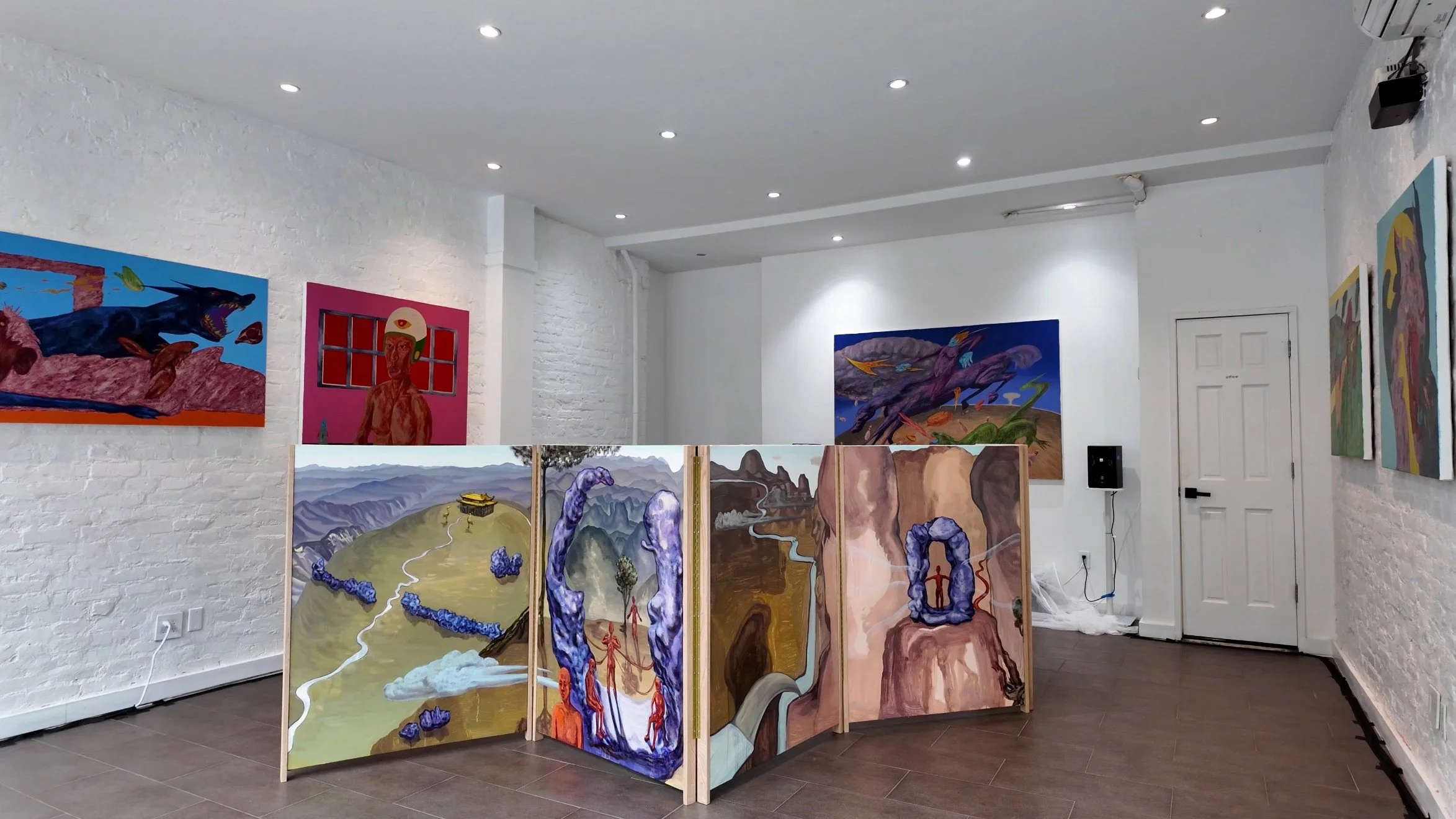
Yiming Tang and Xinzi Luo’s duo exhibition at Nguyen Wahed, titled “CORPUS” and curated by Eliza Xinping Tan, showcases two bodies of work that differ stylistically yet relate to one another as visual devices exploring the human psychological theater. One such theater might be the realm of animal symbols with differing personalities and strengths. Another might relate to the human relationship and social norms involving gender, which is contained within bathroom signs, with the red and triangular shape reserved for females and blue and rectilinear male shape reserved for males. The psychological theater, which declares the lion as brave and strong, and the rabbit as soft and beautiful, could be understood as a system of signs and symbols that can be used to construct visual metaphors and iconic images.
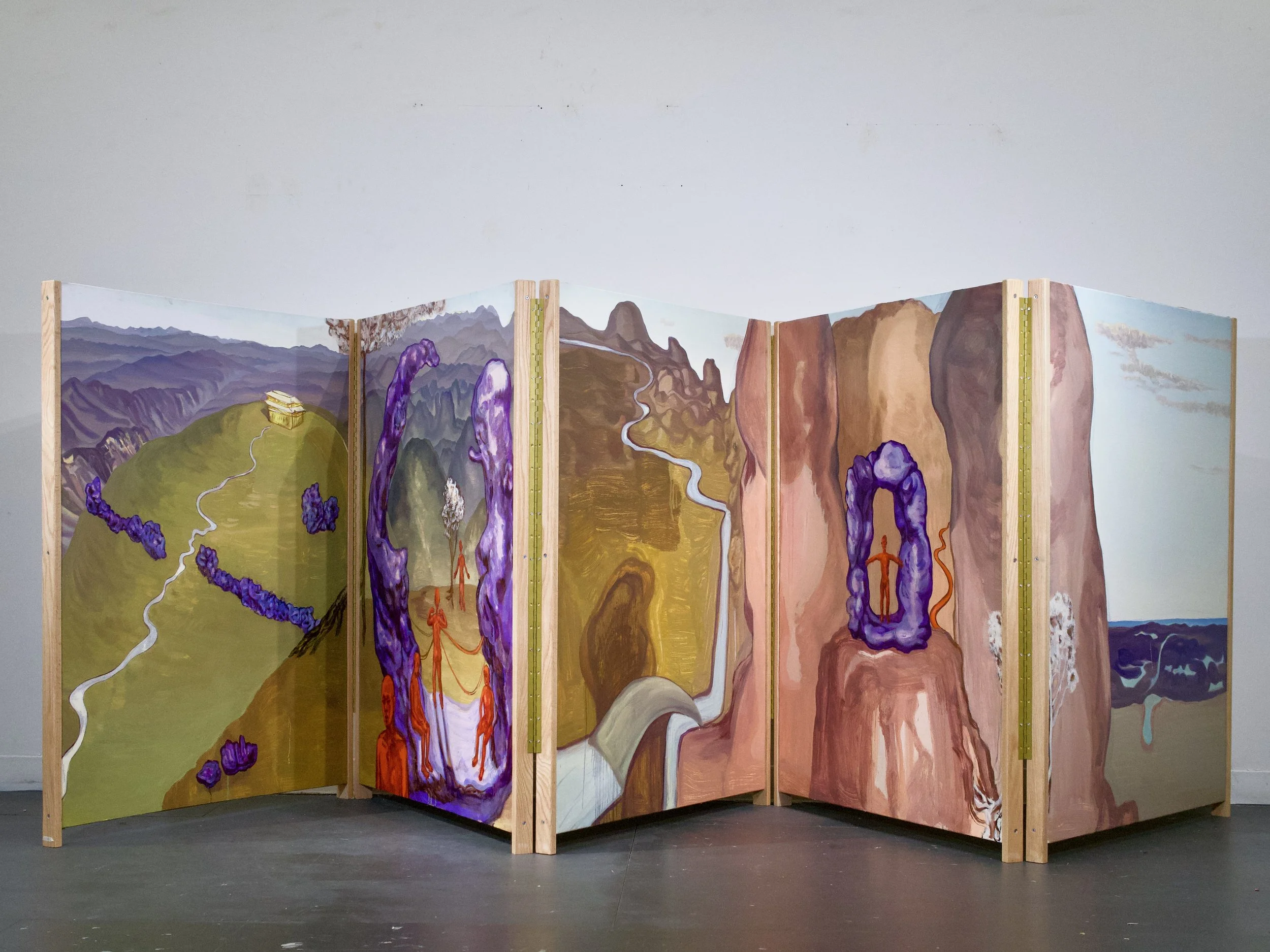
Xinzi Luo, A Walk Through Wudang, 2026, Oil paint on canvas, Chinese ink on silk, Wood, Wax, Piano hinge, 180 x 50 x 20 inches
Luo paints in a hybrid manner in which the classical, the contemporary, and the eastern and western converge to describe a dream-like or metaphorical context or a hidden meaning that must be unraveled through observation and reflection. Tang’s imagery is much more direct and energetic, carrying a cartoon-like kinetic quality that also involves hidden meanings through the unexpected juxtaposition of elements and characters.
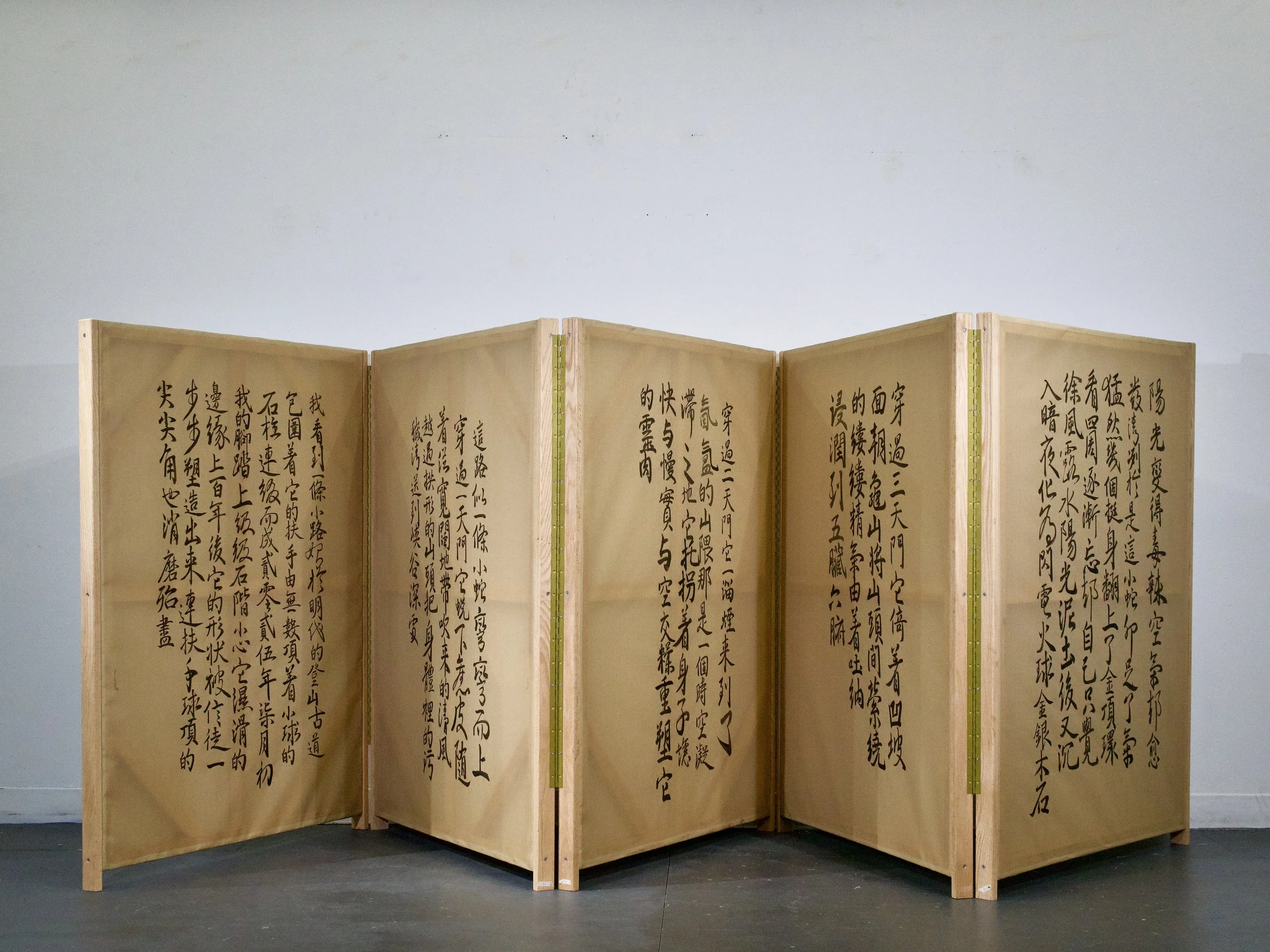
Rear view of A Walk Through Wudang (2026)
Luo’s defining work is “A Walk Through Wudang” (2026), which depicts a long winded trail within the depth of the Wudang Mountains in the Hubei Province of China. A kind of escapism and the need to define the personal identity with a national narrative serve as the underlying architecture behind this painting. A miniature, symbolic rendering of a Chinese-style palace occupies a tiny patch of the landscape and disarms the viewer from the grand, imperial ambitions of the Chinese mainland. This may be just as the Japanese invented the kawaii culture in the 1980s and the 90s in response to the ultranationalistic and hypermilitaristic image of Japan from World War II and prior. The pictorial logic of Luo’s painting automatically colors the mysterious rock formations in purple, which carries two opposing qualities, of the fleeting and impermanent ethereality and neverchanging and eternal essence. And clay-like figures and object renderings narrate the psychological disturbances and hidden desires as reaction formations to the limitations of everyday life. On the other side of the painting, which folds and unfolds in a zigzag, Luo’s poetry is vastly arranged, combining western painting with eastern calligraphy. If there is forgiveness and the ability to erase and layer over with oil painting, there is no room for mistake or blunder with Chinese calligraphy. The characters sit on top of transparent waxed silk revealing the cross braces of the canvas stretcher bars, and the work declares a composite style of contemporary Chinese art that has absorbed the western modalities and frameworks and must return to its national roots.
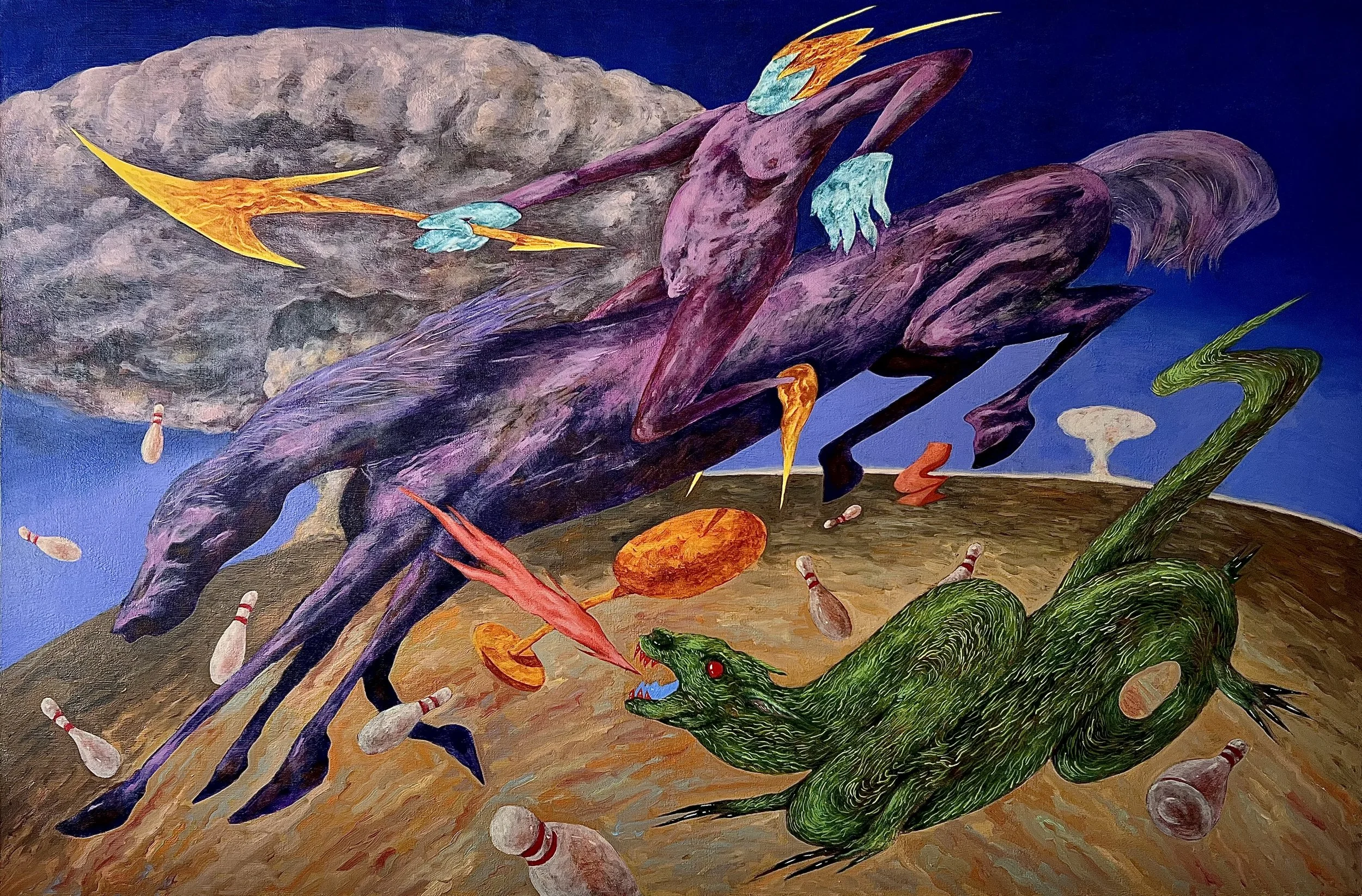
Yiming Tang, Slow Days Fast Mind, 2025. Oil on canvas, 48 x 72 inches
Yiming Tang’s “Slow Days Fast Mind” (2025) is an oil painting with a highly complex and volatile composition depicting a war between two spacefaring sides, who jump between planets and cause immense destruction in the form of mushroom clouds. On the purple side is a Zeus-like figure wielding a flame-like thunder bolt and ice-cold face and hands that react to compensate for the fiery heat. He is riding a horse-like dog and is being attacked by a green dog or squirrel-like serpent with furry skin. Bowling sticks scatter away as if they were hit by a bowling ball, suggesting the energy and the focus of the moment in which the kinetic attacks manifest. Tang’s painting may be based on a hybrid aesthetic of social realism and cartoon-inspired magical realism. The artist rejects realism in general due to its inability to imagine new possibilities and combinations that would resist closed hierarchies and systems of totalitarianism. The idea that individuals (or creatures) carry so much power as to unleash nuclear explosions that destroy planets is both unrealistic and realistic, perhaps reflecting the super powers that the leaders of certain countries have through nuclear football.
Through examining Luo and Tang’s representative works, we find that hybridity offers new paths forward toward challenging outdated paradigms and modalities of thought. Luo combines eastern and western art in the pursuit of national painting from the perspective of an immigrant artist. Tang combines elements and personalities that we traditionally identify and differentiate as separate species or categories.
Solving the psychological theater ultimately involves understanding the flip or inversion that occurs through the complex conditions of the psychological space in which the symbolisms arise. In short, the lion is in fact the rabbit, and the rabbit is the lion, but the lion has been oppressing the rabbit throughout the ages using the propaganda of masculine strength that is contained within the imagery of the lion, in opposition to feminine fragility that is assumed to be inherent in the rabbit. When people fixate on certain images or ways of working or being that are seen to be consistent throughout and without contradictions, then we risk the danger of accepting things as they are, without the ability to question. It is only when we identify the internal contradictions and the hybridity of human psychology and human-made systems can we acknowledge that power relations are reversible, and disrupt the traditional hierarchies and dichotomies.