A Sparrow’s Little Collection
Review of Kexin TANG: Mnemosyne’s Cabinet at BONIAN SPACE
In Kexin TANG’s paintings, objects rarely appear alone. Old belongings, implements, images, and bodily traces are gathered into boxes, compartments, and cases, arranged in proximity while retaining a measured distance from one another. As these containers recur throughout her debut solo exhibition, Mnemosyne’s Cabinet, at BONIAN SPACE, the paintings begin to assume the logic of an ordered repository. The canvases resemble drawers drawn out from the wall, laying before the viewer fragments gathered from disparate moments and sources. What emerges is less a continuous narrative than a constellation of partial experiences, preserved and deliberately arranged. The title Mnemosyne’s Cabinet consequently acquires a more literal spatial resonance. Mnemosyne, the Greek goddess of memory, invokes remembering and recall. At the same time, the cabinet gives this immaterial psychic faculty an architecture in which experience may be enclosed, stored, and reopened. In Tang’s work, the abstraction of the past appears to acquire the material logic of an everyday possession: something that can be gathered, kept, and retrieved.
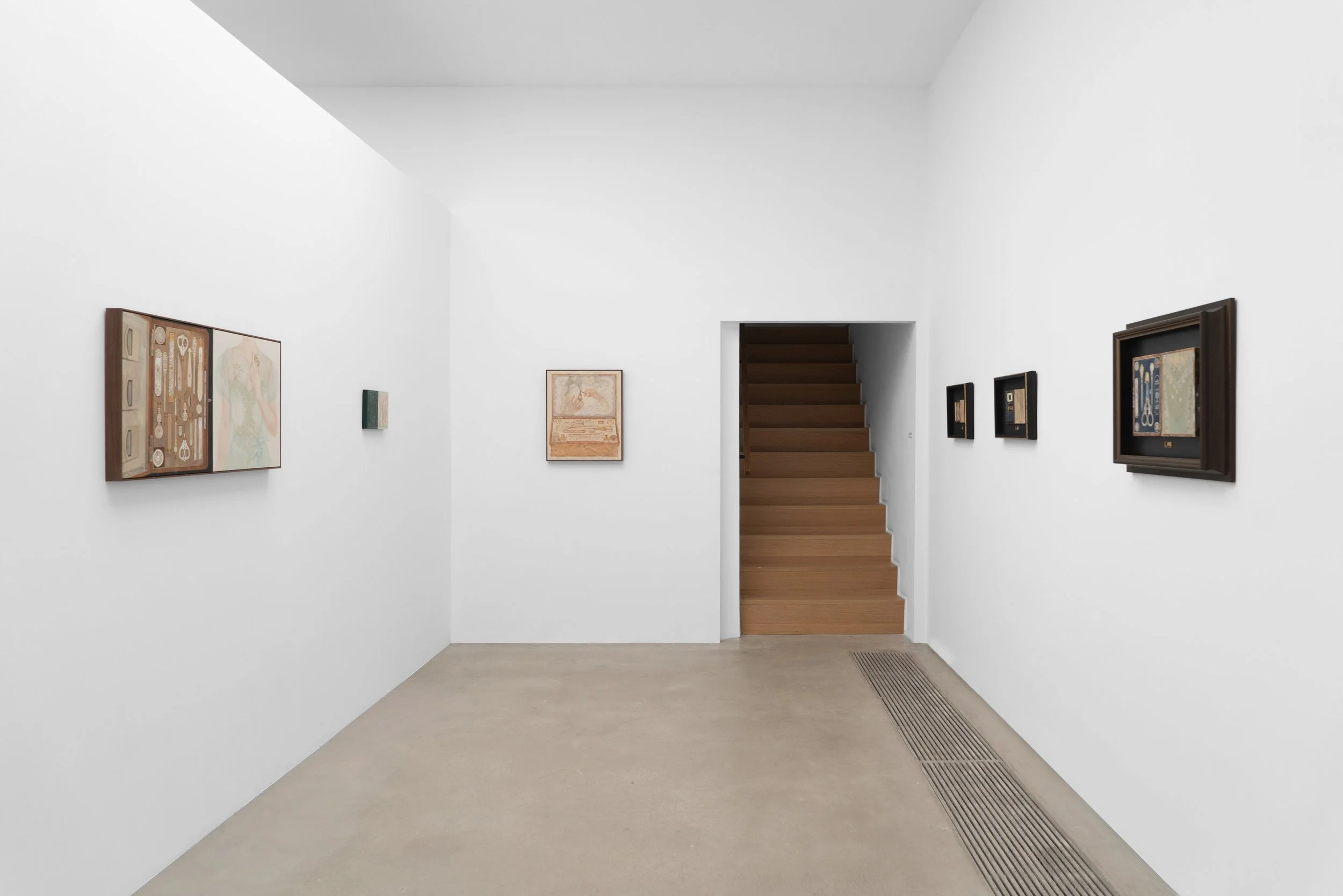
Installation view of TANG Kexin: Mnemosyne’s Cabinet. Courtesy of the artist and BONIAN SPACE.
Within this logic of arrangement, collecting emerges as a central mode through which Tang apprehends and reorganizes the visible world. She has described her practice as shaped by a collector’s gaze, drawn as readily to objects encountered in everyday life as to images culled from museums, historical archives, and digital circulation. Many of these subjects remain materially beyond her possession; through selection, sustained looking, pictorial translation, and re-inscription, however, she absorbs them into an order of her own making. Once removed from their original contexts of use and historical circumstance, objects acquire new significance through the relations, classifications, and proximities established around them. Painting therefore becomes more than a means of recording what appears worth preserving. The act of making itself assumes the logic of collection. Keys, sofas, insects, and other fragments drawn from disparate sources are granted another form of possession through representation. As these heterogeneous elements are reduced in scale, juxtaposed, and placed in boxes and compartments, a world once dispersed and resistant to grasp is reorganized into a miniature order.
TANG Kexin, Still Time (2026). Acrylic on wood panel, mineral pigments on silk, vintage box, brass, and solid wood frame, 20 × 40 cm (framed: 28 × 48 cm). Courtesy of the artist and BONIAN SPACE.
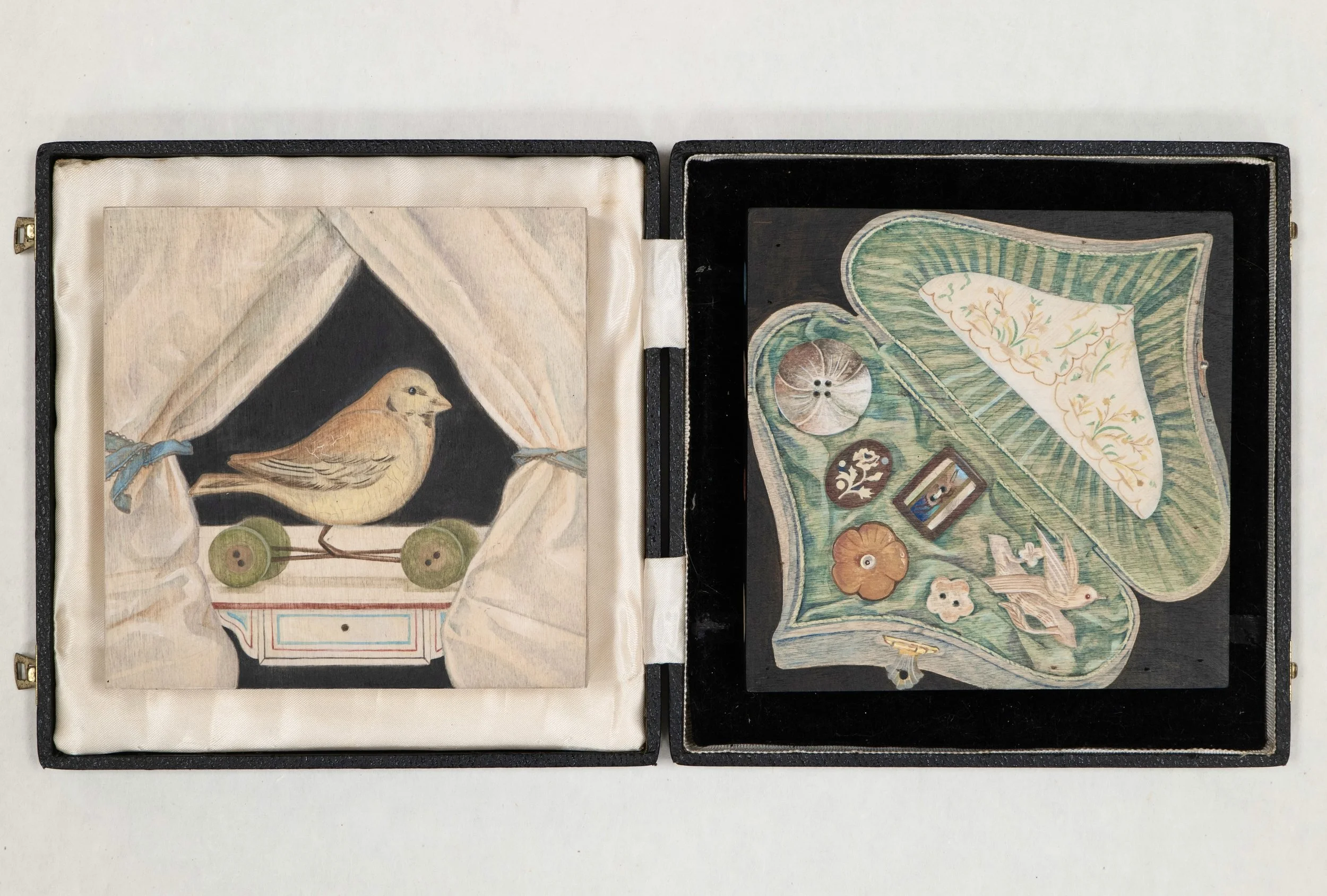
If collecting reconfigures the ownership of objects and their relations to one another, the container reconfigures the conditions under which they are seen. In The Poetics of Space, Gaston Bachelard considers drawers, chests, and wardrobes as structures intimately bound to psychic interiority: through concealment and opening, they establish a threshold between the visible world and an interior withheld from view. Suspended Everyday Life (2026) unfolds across two corresponding scenes. On the left, a neatly drawn curtain frames what appears to be a windowsill in the early morning. A lifelike sparrow rests before it, perched on a small support raised by four buttons. On the right, an open, finely crafted jewelry case dating from the 1940s holds an assortment of buttons in varying shapes and colors. The recurrence of the button creates a discreet correspondence between the two halves of the composition, and the objects inside the case begin to resemble the sparrow’s own private collection. The windowsill, toy bird, and buttons are consequently drawn into an enclosed and self-sufficient world. The Unoccurred Moment (2026) extends this spatial interiority into time. Inside an antique case, a miniature ensemble appears poised to begin: the violinist has taken position, the percussionist turns through a score, and the scene seems suspended at the threshold of performance. The box holds not only what has already passed, but also a future poised to unfold. In Tang’s work, Bachelard’s interiority takes on the force of a viewing structure: the container temporarily withdraws experience from the external world, then discloses, upon opening, the compressed and suspended temporality held within.
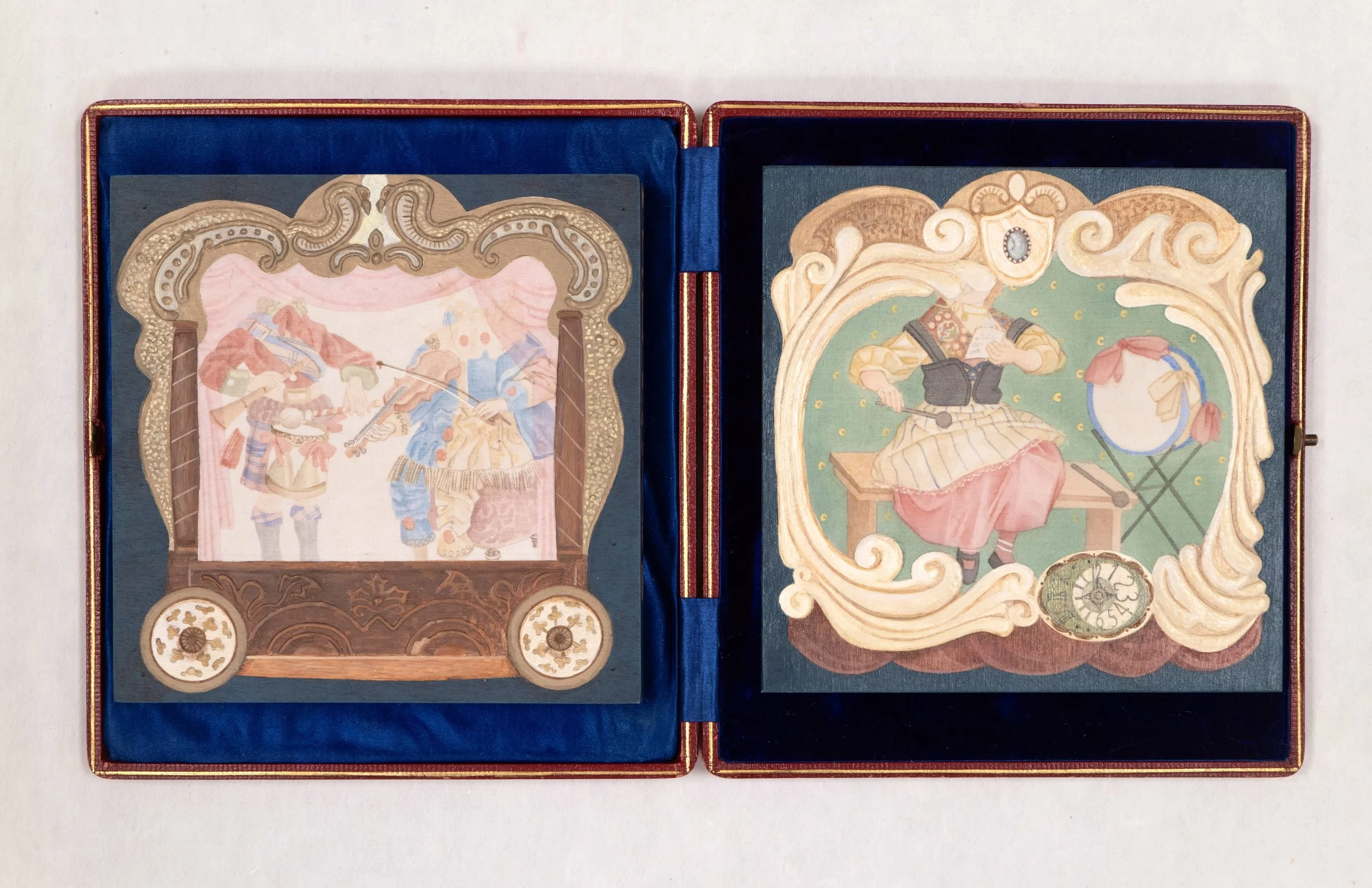
TANG Kexin, The Moment That Never Was (2026). Acrylic on wood panel, mineral pigments on silk, shell white, vintage box, brass, and solid wood frame, 20 × 36 cm (framed: 28 × 48 cm). Courtesy of the artist and BONIAN SPACE.
The interiors established by these containers acquire a more explicit relation to boundary and environment in Caged Cricket (2026) and Caged Sparrow (2025). The left side of Caged Cricket is comparatively diffuse: pale grasses and layered textures fold into one another as tiny insects emerge intermittently from the vegetation. On the right, a clearly articulated cricket box divides different insects into separate compartments. The same forms of life assume radically different conditions according to their surroundings. In one, they remain partially submerged within an environment that appears to grow around them; in the other, they become legible as discrete specimens, classified, contained, and displayed. Caged Sparrow sharpens this spatial logic further. The cage on the left encloses no actual bird, but the Chinese character “雀,” meaning “sparrow”; on the right, the bird returns in the form of a more conventional painterly motif. Within the same composition, language and image offer two modes through which the sparrow can be rendered present, while the cage shifts the act of confinement from the living creature to its naming and designation. The distinction between interior and exterior therefore does more than establish intimacy. It alters the terms through which what is enclosed can be apprehended and assigned meaning.
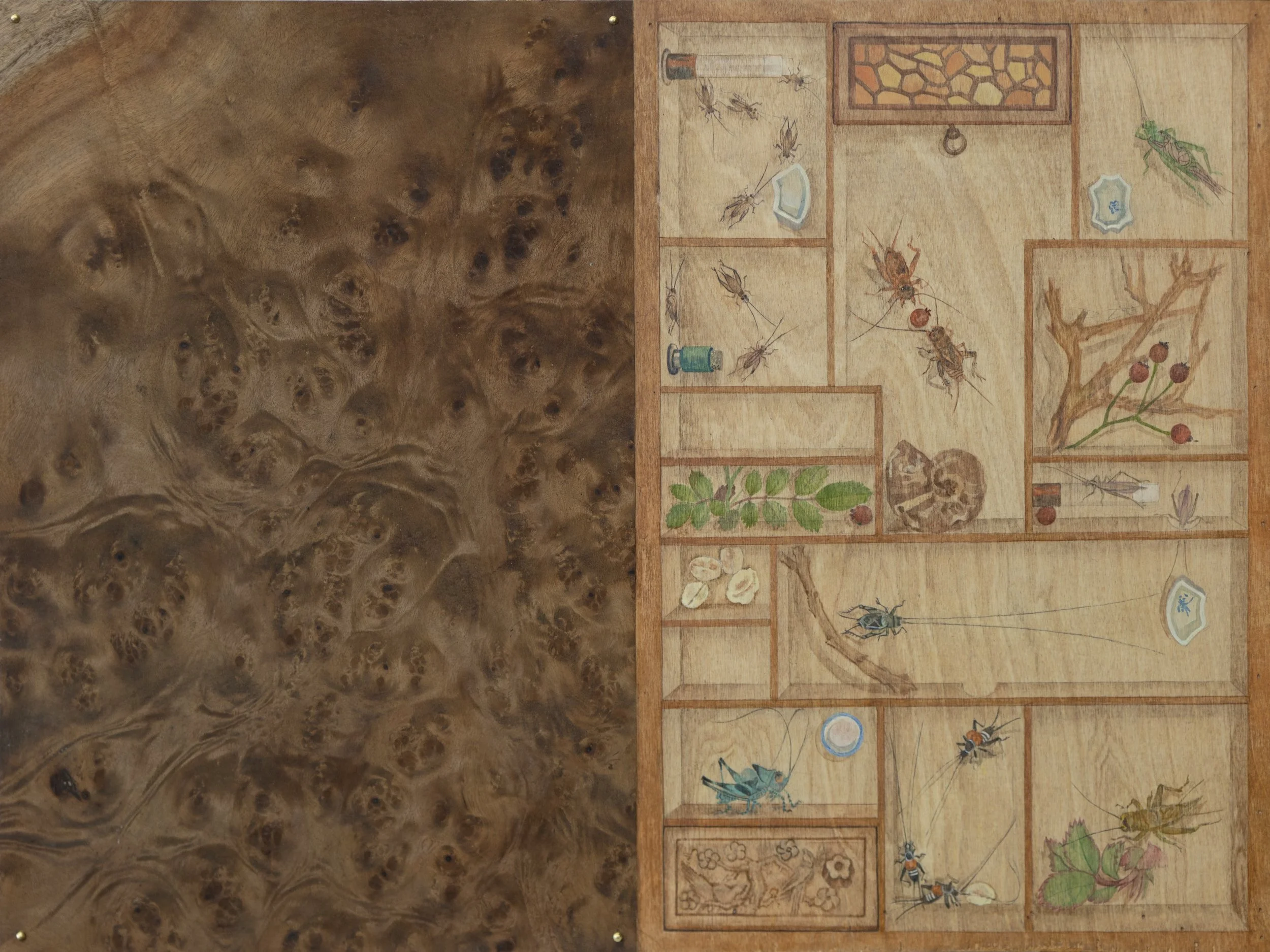
TANG Kexin, Caged Cricket (2026). Acrylic on wood panel, golden madrone bark veneer, brass, and solid wood frame, 30 × 40 cm (framed: 31.5 × 41.5 cm). Courtesy of the artist and BONIAN SPACE.
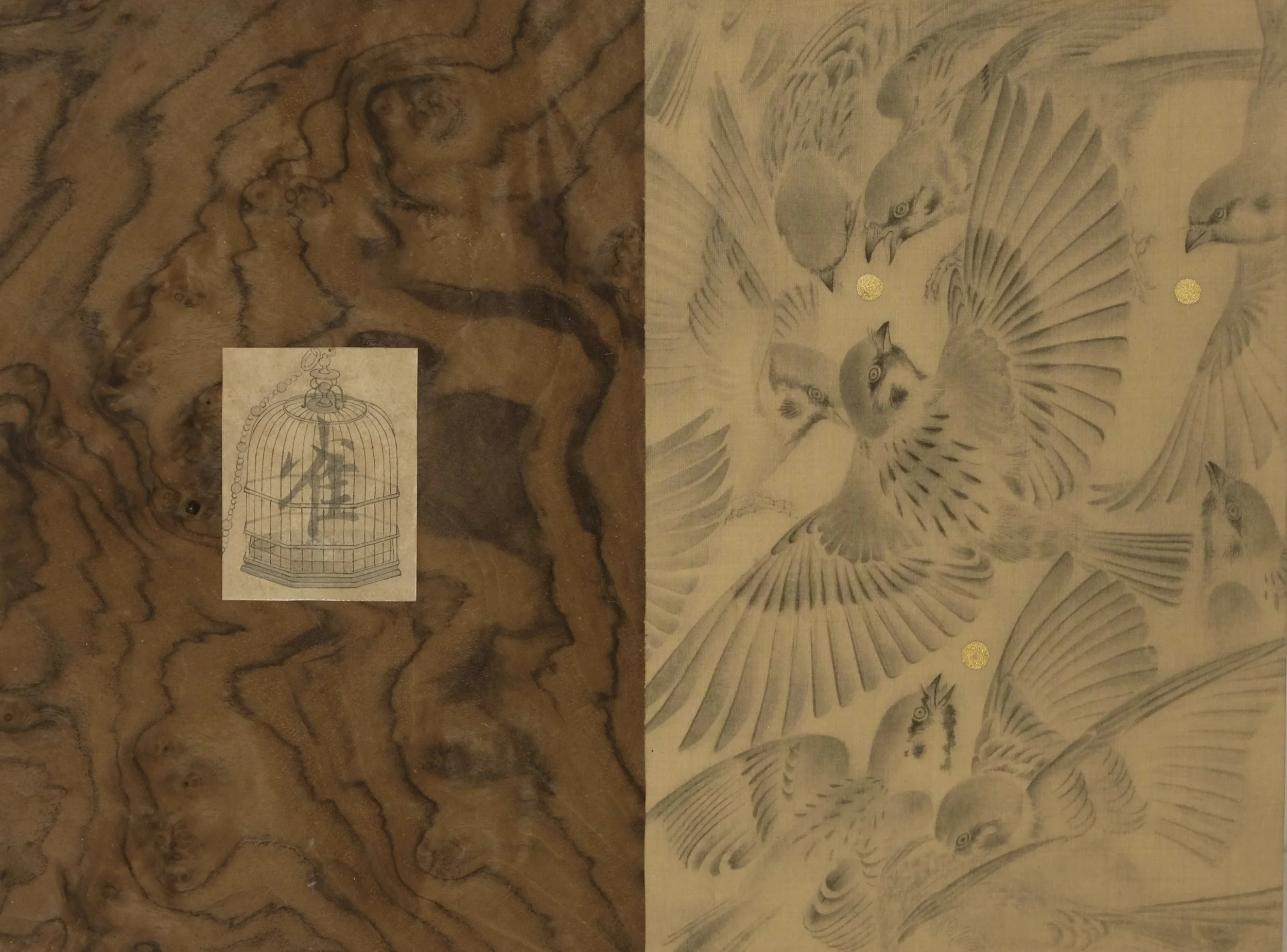
TANG Kexin, Caged Sparrow (2025). Mineral pigments on silk, black walnut bark veneer, and solid wood frame, 30 × 40 cm (framed: 31.5 × 41.5 cm). Courtesy of the artist and BONIAN SPACE.
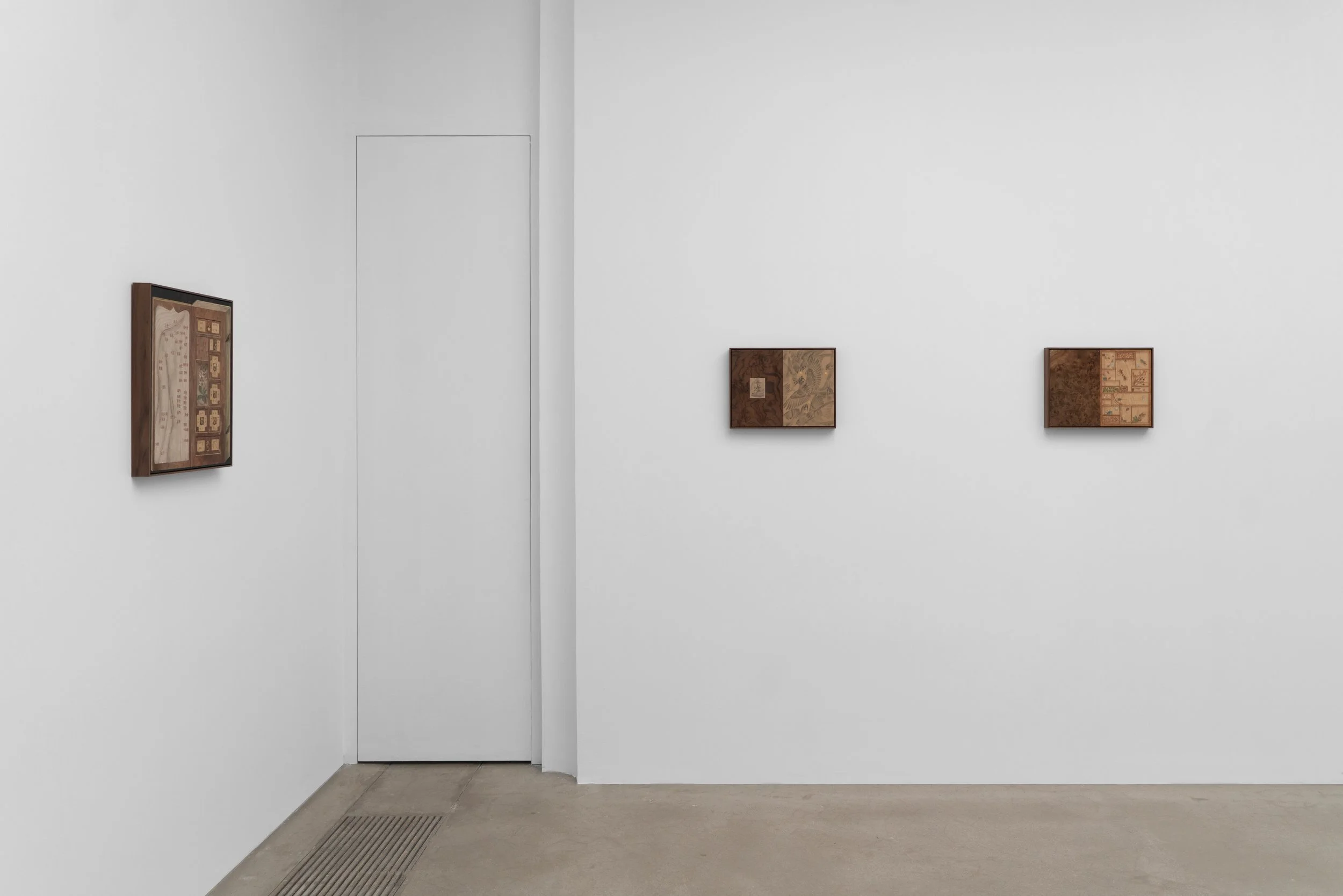
Installation view of TANG Kexin: Mnemosyne’s Cabinet. Courtesy of the artist and BONIAN SPACE.
Returning to the exhibition space, the boxes, compartments, and cage-like structures establish a succession of enclosed interiors that are, at the same time, made available to public view. The viewer remains outside these miniature domains, able to inspect what has been preserved, classified, and rearranged within them while retaining a degree of separation from their interiors. The gallery consequently functions as a larger container, enclosing these already privatized spaces once again. Objects enter boxes; boxes enter paintings; the paintings, in turn, enter Mnemosyne’s Cabinet. Across this sequence of nested interiors, memory passes from personal experience into a form that can be collectively observed, while privacy itself is transformed by the conditions of display. Tang’s “cabinet” thus remains suspended within an order of opening and enclosure.