Se Young Yim et al at Transmitter Gallery
Anthropomorphism of the Non-Human Others as a Mirror Mechanism of Empathy
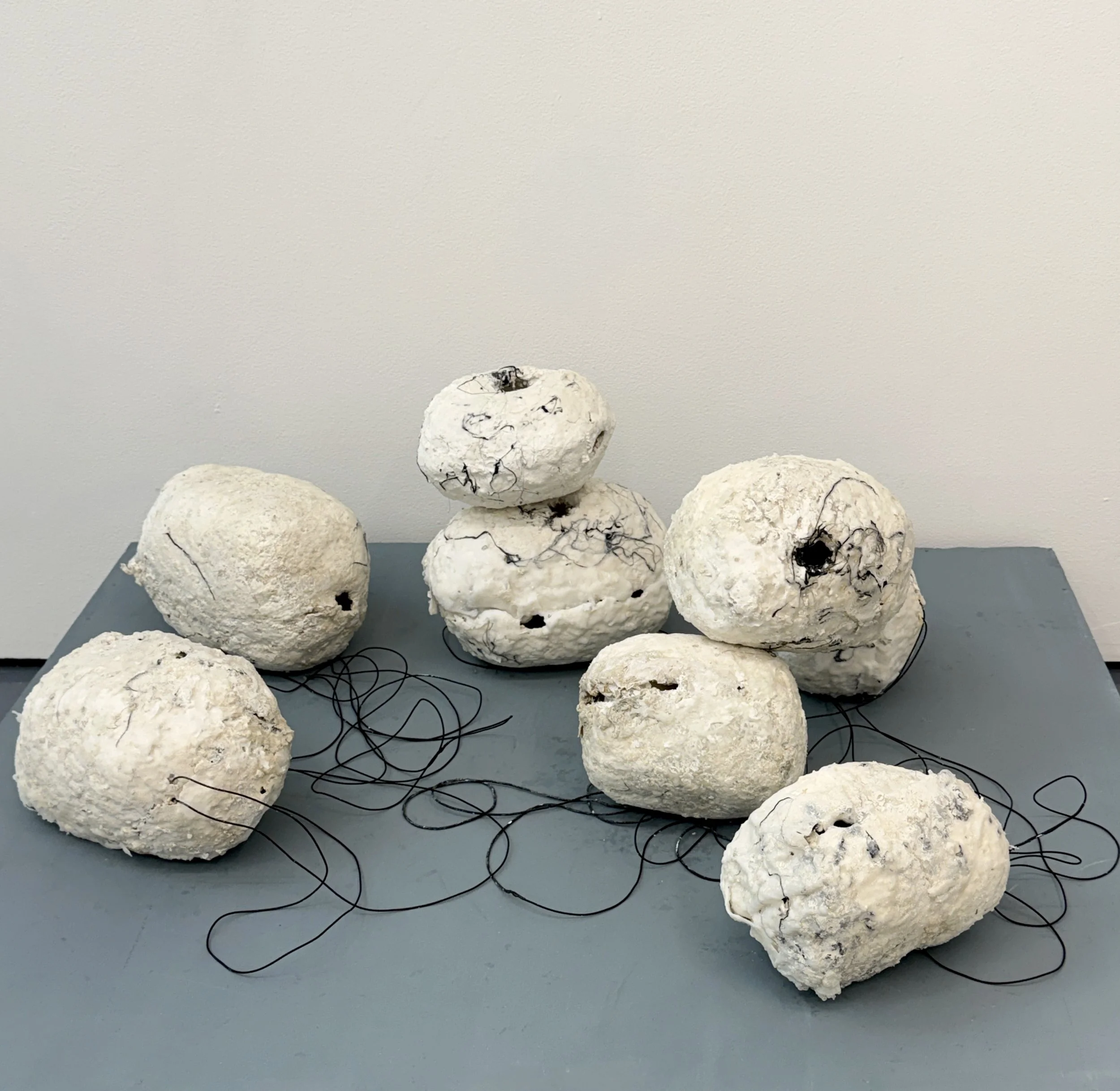
Se Young Yim, Pebble, 2026, Silicone, Plaster, Hanji (Korean traditional paper), motor, wires, acrylic paint, 37.5 x 31.5 x 6 inches
At Transmitter, a group exhibition of sculptural works and installations by Alison Kudlow, Susan Meyer, Hanna Washburn, and Se Young Yim, titled, “Do I know you from somewhere?”
The exhibition revolves around the concept of pareidolia, which is “the tendency to impose meaningful forms and patterns onto ambiguous or arbitrary objects and surfaces… to find meaning and presence where none was intended.”
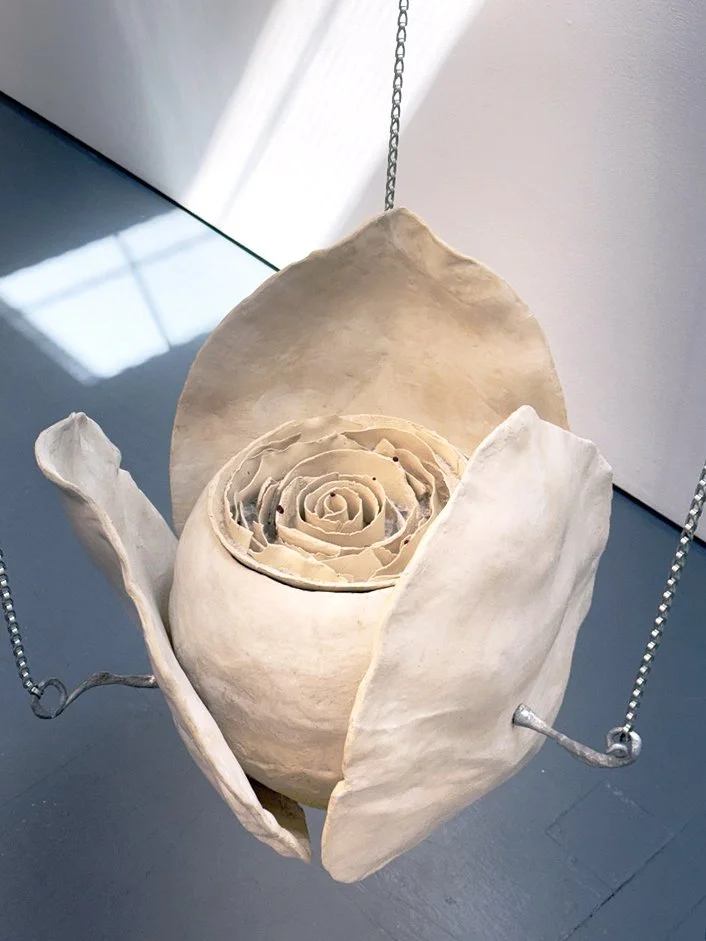
Alison Kudlow, Ēostee (Risen), 2026, Ceramic, glass, cast aluminum, chain, 28 x 28 x 28 inches, hung 1 foot from the floor
Alison Kudlow’s “Ēostee (Risen)” (2026) is a sculptural installation that beckons the floral motif and form to capture the essence of floral logic or language of form without illustrating a flower on a literal level. Stationed like a satellite or a spacecraft and hanging on three wire supports from the ceiling, the work signals the beginning of human perception that associates the outer shields and the inner spiral as petals. A discontinuity occurs between the path of the outer and larger “petals” and the inner spiral, wheel-like form, yet our human brain connects the two seamlessly under a unifying linguistic logic of the symbolism or the concept of the “flower.” The work refuses to be a flower, yet it cannot escape the curse or the label. In some ways, the sculpture captures the essence and the core definition of the flower by the nature of its disparate parts working together to reconstruct the idea of a flower more so than any individual flower would.
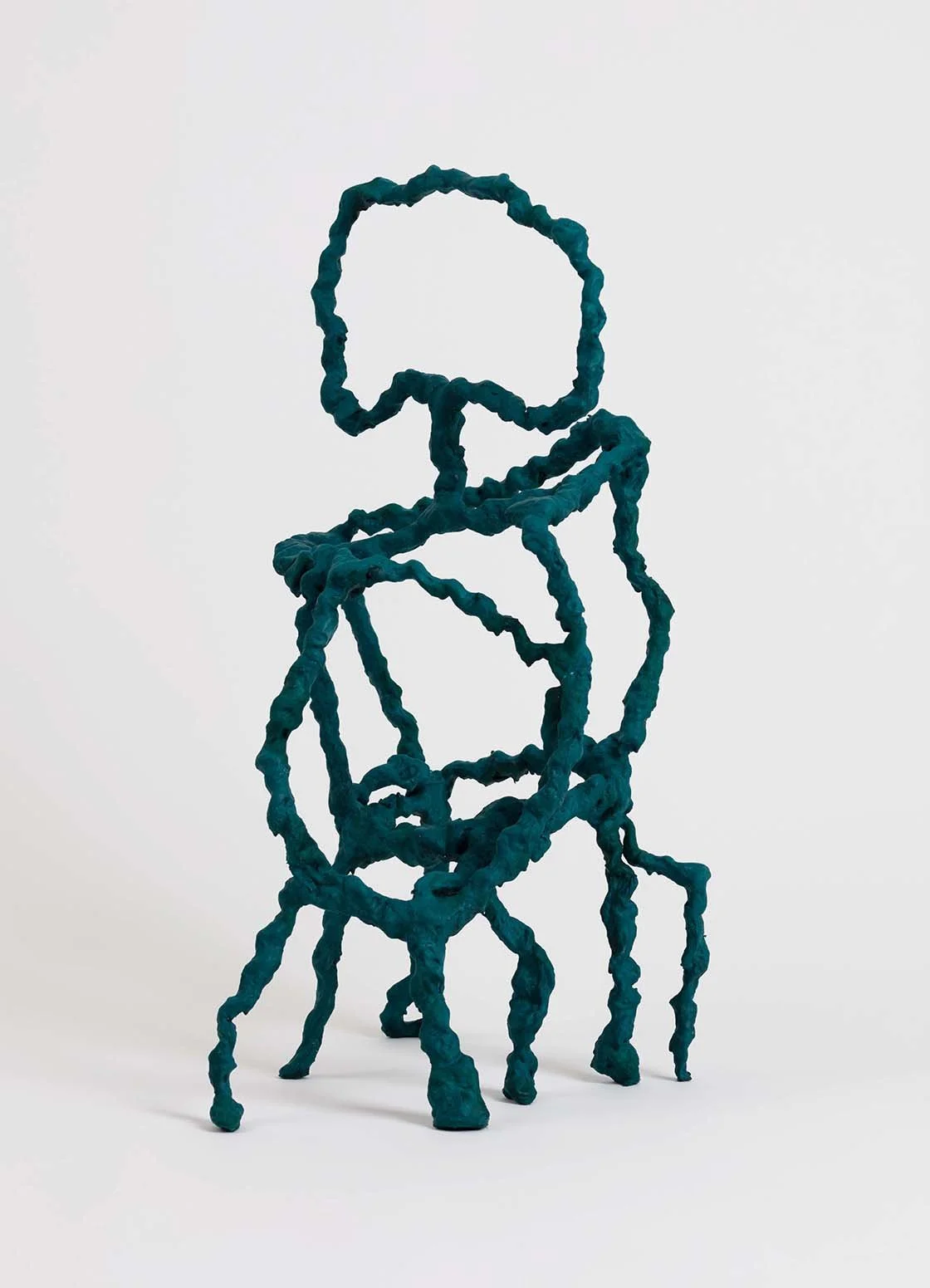
Susan Meyer, Lagoon, 2025, Wire, dye, Aqua Resin, 25 x 15 x 15 inches
Susan Meyer’s “Lagoon” (2025) is a wire sculpture that is half crab, half flower vase, and half extraterrestrial. It is half silhouette of a body and half a symbolic outline connoting abstract associations. The sculpture appears to crawl sideways with its multiple appendages and simultaneously facing the viewer frontally. Its rhythmic bits or bumps suggest a pixel-like dimension or reality within which the being or the artwork is situated. The deep and dark turquoise points toward an alert form of vegetal life with magical powers. It is neither gullible nor manipulable like the greens abundant with the idealistic yellows. This creature or vegetal form is computational in nature and has the power to respond variably to the inputs from the surrounding, like a computer code or program. The work serves as a mirror mechanism, in which we observers identify a being with a head, torso, and legs. Our anthropomorphic tendency involves seeking a likeness to ourselves on a symbolic and biological level because we desire a partner who can share our emotions, thoughts, and feelings. We do not want to be alone in the universe.
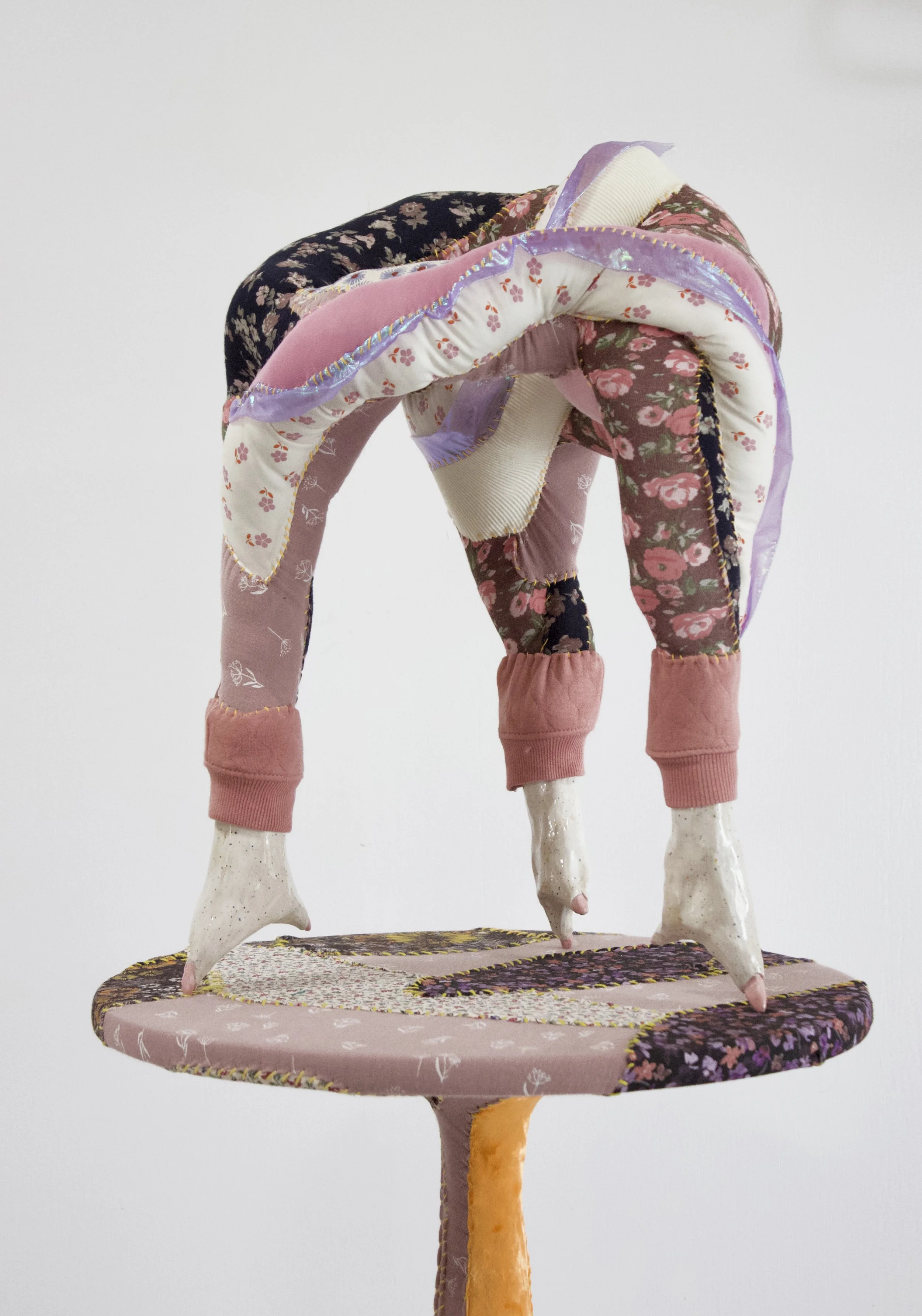
Hanna Washburn, Pitter-Patter, 2026, Recycled textiles, thread, batting, ceramic, wooden table, found metal armature, Pedestal + sculpture: 42 x 18 x 18 inches
Hanna Washburn’s “Pitter-Patter” (2026) is a plush sculpture made of fabrics, textiles, and found objects, which suggests the feminine posture of a deer’s thighs or the legs of a chair of regal design. The delicate nature of the sculpture is complemented by its welcoming and disarming softness. However, the overall sculpture suggests a creature of eclectic hybridity and engineered syntheticism of bodily parts and absorbed identities. The work may reflect on the mimetic nature of the human psyche, which borrows traits and personalities from external sources.
Se Young Yim’s “Pebble” (2026) is a complex work involving technology and machinery to generate meanings and metaphors about the possibility of life on the level of both conception and motherhood, and the anthropomorphic habit of recognizing life force within things.
When Yim was young, her brother accidentally mistook an egg in the grass as a baseball and cracked it, exposing the smell and the yolk from within. This encounter with the egg as a symbol and a biological entity carrying the promise of life shaped the artist’s early psychology and experiences.
The artist’s work has evolved from previous investigation of pebbles and rocks as carriers of the timelessness, solidness, and inertness, in relation to the questions of ontology. It has evolved to involve a weird territory in which the biological or biomechanical, the natural and the non-life converge to the singular image of a rock that moves like a pulsating dinosaur egg from within. It has changed to concern with the artist’s own love and fear of motherhood, which is a real possibility for Yim at this stage in her life.
The symbol of the egg points to and combines different characteristics, such as the shell which could be described as inert and solid like rocks. Yet the shell is thin and vulnerable to cracking when exposed to pressure or impact, and this makes the egg a precious object that must be protected. We also consume eggs for food, so there are many different qualities that are embedded in the sign.
The internal machinery is not the art or the metaphor itself; rather, the internal machinery facilitates subtle movement which gives birth to the moment of observation for the viewer to recognize a sign of life of vital force within the rock and egg-like forms. The egg, prior to hatching, is not quite alive but is somewhere in between the living and the unborn states.
While the loud sounds of the gears moving about in repetitive motion could detract from this epiphanic encounter and metaphor, we must remind ourselves that the sculptural installation is not meant to be an illustration of a situation or an idea. Rather, we must filter out the mechanical sounds and be attentive to the moment of realization recognizing or locking onto the biomechanical signature or the sign of a life force within.
We can all relate to the idea of pareidolia in the context of anthropomorphism because we have those moments and encounters from childhood. When we look at a camp fire, it moves and dances in energetic swirls that hints at its inner vital signature, just like us and perhaps communicating to us.
It is the cold, calculative filter of science that stops us from connecting to this interconnected view of the cosmos and existence. But the exhibition is an important reminder that we manifest humanity most succinctly and strongly when we listen to our heart and the hidden voices that we first encountered from childhood. If we are unable to respect non-human beings and entities, we are unable to treat other humans with the dignity that we all deserve by the same dismissive logic. Pareidolia is not simply the mere instance of pattern recognition. It is a human character or trait that has involved a paradigm shift, evolving from the need to observe the world in the wild through lens of fear (when we were hunters and foragers) to truly appreciating the cosmos and all its creations… to see ourselves in the non-human others and the possibility of a future in each and every life and non-life forms. It is a form of communication and empathy that makes us truly human.