Preserving Bitterness
On Shengjie Jiang’s solo exhibition The Cabinet of Hers
Before every move when I was a child, I would spend a long time lingering in my room. What felt hardest to leave behind was never the furniture itself, but the smallest things: scratches left on the corner of a desk, the smell inside a cabinet, the position a cup had settled into after sitting in the same place for years, the color curtains took on after long exposure to sunlight. Only when leaving did I realize that one’s memory of “home” is not preserved through space itself, but through these nearly unnoticeable objects.
Yet these things can never truly be carried away. Time distorts them. Colors fade, smells disappear, textures are forgotten. Even when trying to remember them again, it becomes difficult to tell whether those details ever truly existed in the first place.
Shengjie Jiang’s solo exhibition The Cabinet of Hers at Cub_ism_ Artspace, exists precisely within this condition between preservation and disappearance.
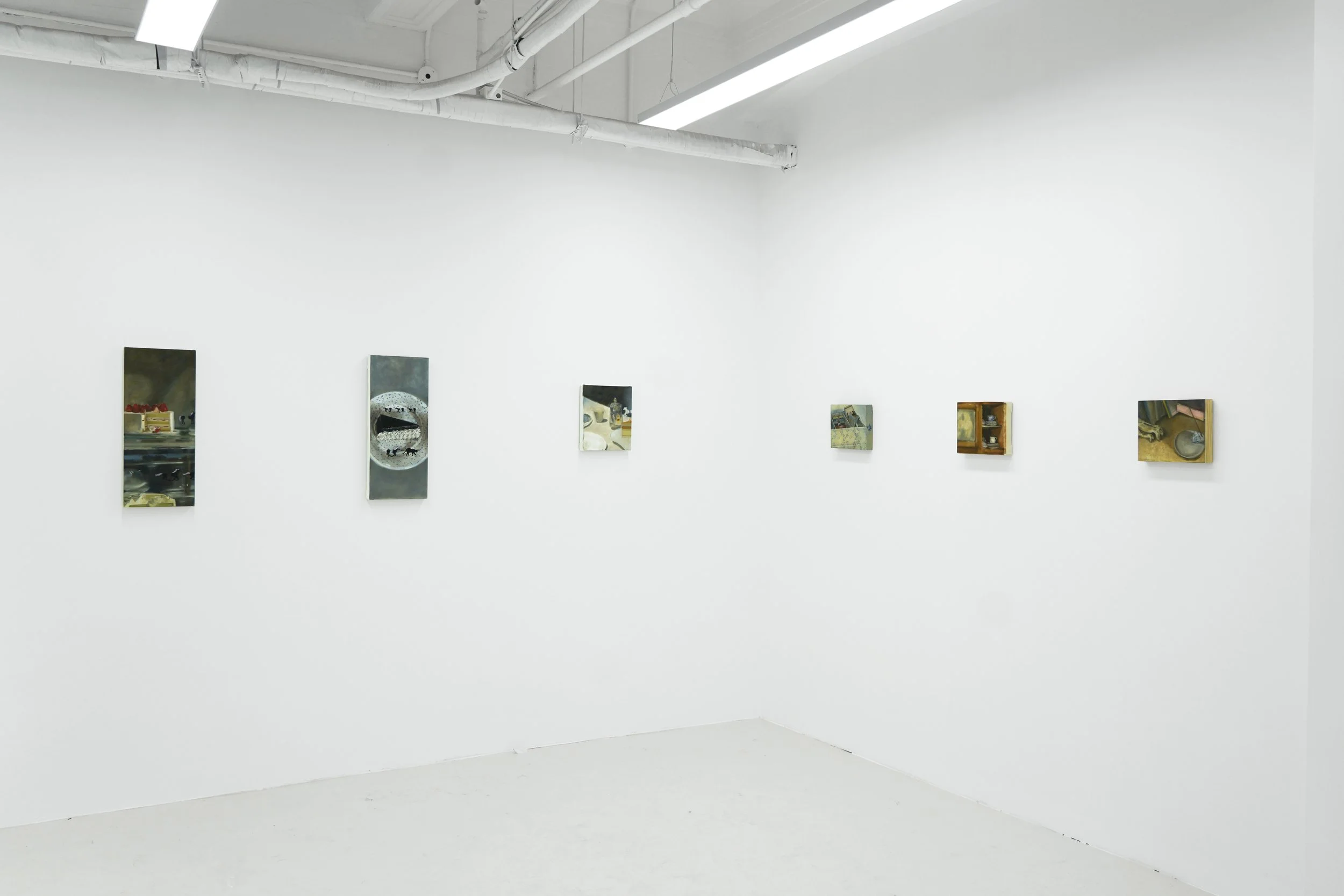
Installation view of The Cabinet of Hers. Courtesy of the artist and Cub_ism_ Artspace.
In this exhibition, looking feels less like entering a complete narrative and more like approaching an emotion that has been quietly sealed away. Cakes, porcelain cups, cabinets, metal trays, spoons, and faintly appearing animals emerge like fragments slowly surfacing from memory itself. They carry a blurred quality, as though soaked by time, resting quietly within the paintings. For Jiang, the “cabinet” does not simply refer to a storage space. It becomes closer to an emotional container, an internal structure for holding experiences of departure, anxieties of growing up, and forms of longing that have never been fully processed. Having moved constantly between Anhui, Pennsylvania, New York, and Chicago, Jiang no longer understands “home” as a fixed place, but as a temporary assemblage formed through objects, smells, textures, and fragments of memory.
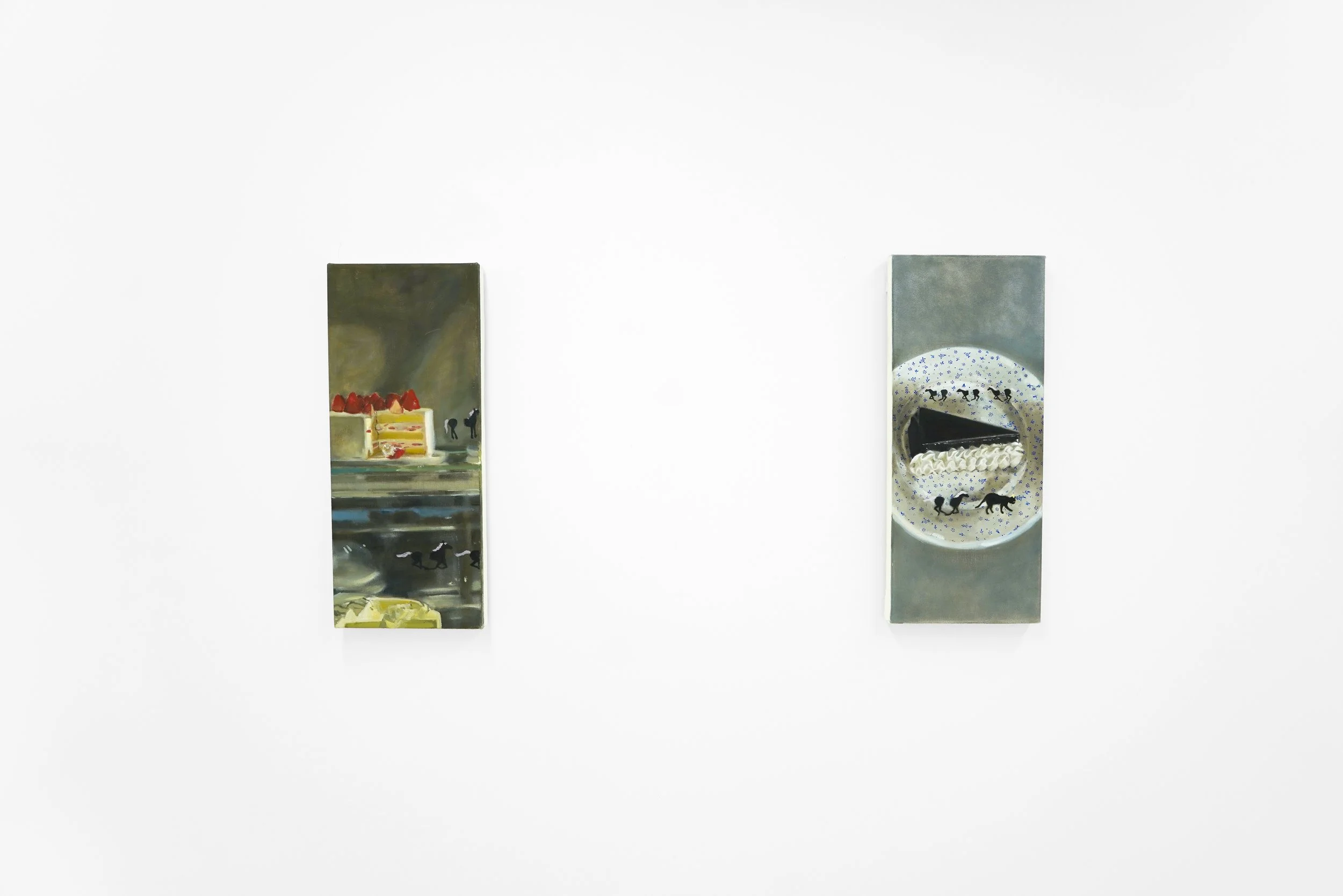
Installation view of The Cabinet of Hers. Courtesy of the artist and Cub_ism_ Artspace.
To some extent, Jiang’s cabinets recall Gaston Bachelard’s discussions in The Poetics of Space on drawers, wardrobes, and chests: enclosed spaces are never merely functional sites of storage, but structures that contain memory and emotion. In Cabinet of Delphinium Days, half-open cabinet doors and tilted boxes resemble both physical storage spaces and psychological compartments. Blue decorative patterns, blurred photographs, and small ornaments are layered into spatial arrangements that never fully stabilize. Looking at these paintings produces a peculiar uncertainty: they feel intensely private, yet impossible to fully access. Memory is never completely revealed, always retaining a partially closed state. This inability to fully enter the image becomes one of the exhibition’s most compelling qualities. The viewer senses the presence of emotion, while remaining unable to entirely reach the moment from which that emotion emerged.
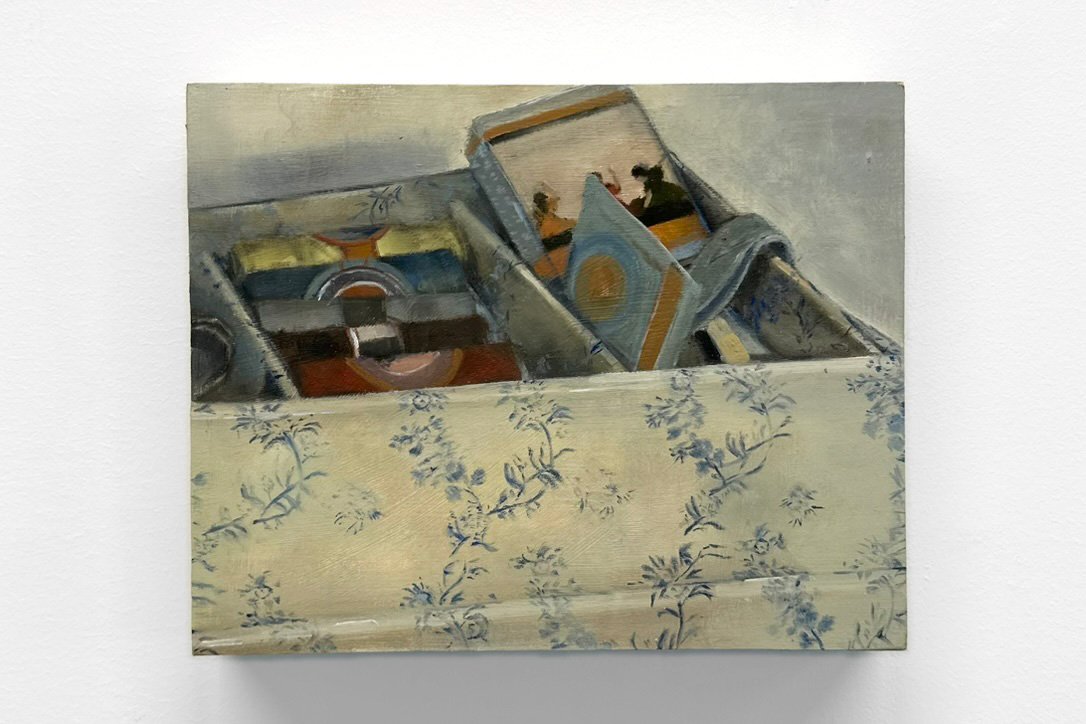
Shengjie Jiang, Cabinet of Delphinium Days, 2024. Courtesy of the artist.
"I strive to make the world's bitterest ice cream. Even if it is the most bitter scoop, even if its hue is darker than that of a black cat, even if its first touch upon the tongue is as sour as a cream of tears—still, as it slowly dissolves in the mouth, it remains nothing more than a scoop of ice cream, far less bitter than sorrow. When I consume that scoop, as it melts into a part of my heart, I shall become, in my own eyes, the strongest and most composed person of all."
——Shengjie Jiang
Rather than directly depicting pain, Jiang seems more interested in how emotion lingers within objects. Half-eaten cakes, melting cream, emptied plates, and tilted spoons do not feel like the aftermath of emotional eruption, but more like traces left behind after something has quietly remained for too long. In Sourness, a small piece of cake rests on a plate while a fork leans slightly to one side. Almost nothing happens within the image, yet looking becomes unexpectedly slow. The gray tones of the cream, the cold whiteness of the plate, and the shadows gradually sinking into the background together create a nearly suspended sense of time. The painting is not truly about dessert; rather, it feels closer to the emptiness left after sweetness has already ended. Something important seems to have already happened, yet it remains absent from the image itself, leaving behind only a residue on the table.
A similar feeling appears in Pot, where only a spoon and a nearly vanished fragment of food remain. The composition is restrained to the point of scarcity, yet it is precisely this minimal residue that gives the work its emotional intensity. Jiang does not rely on elaborate compositions. Instead, she preserves moments that feel on the verge of disappearing.
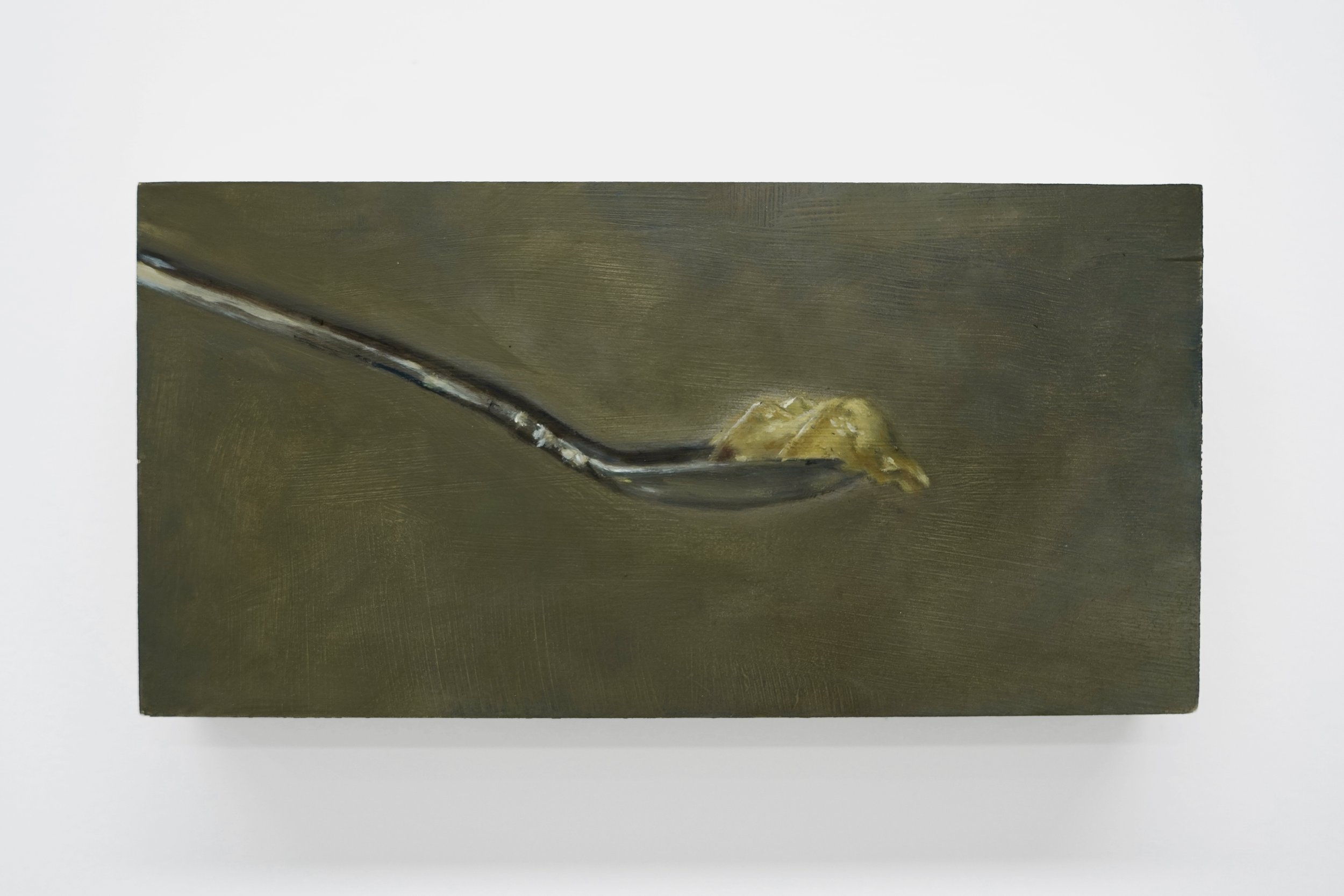
Shengjie Jiang, Pot, 2025. Courtesy of the artist.
Her treatment of animal imagery is equally striking. Black cats, horses, and small running creatures appearing along the edges of the paintings do not behave like stable entities within physical space. They resemble slideshow fragments, animated afterimages, or fleeting flashes passing through consciousness. Their presence introduces a subtle but continuous movement into otherwise quiet still-life paintings. As a result, the works never remain entirely still. Memory continues to move, and emotion moves with it. The animals feel less like symbolic figures than sensations that repeatedly surface in the mind while resisting fixation.
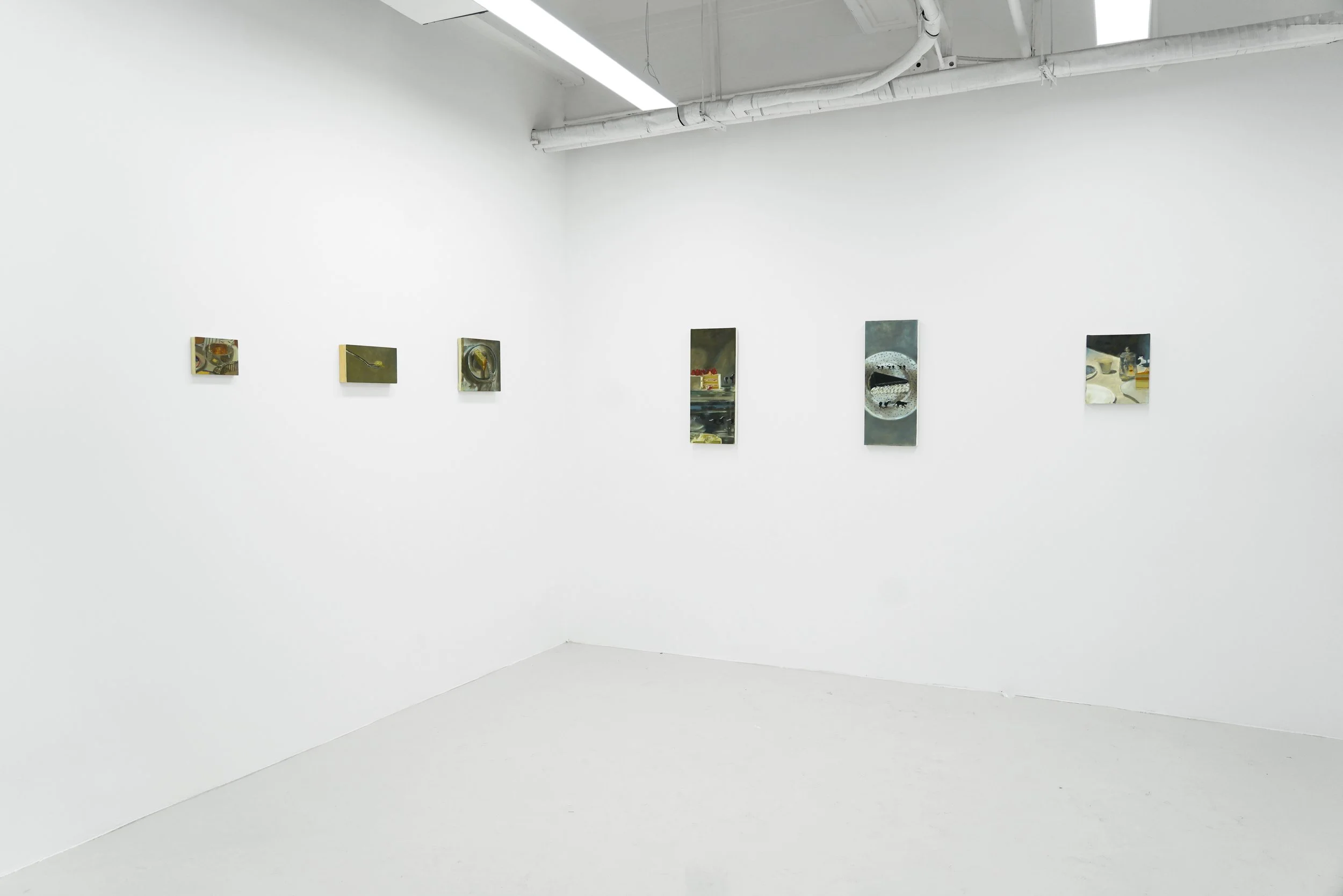
Installation view of The Cabinet of Hers. Courtesy of the artist and Cub_ism_ Artspace.
Jiang’s paintings are ultimately concerned with the parts of experience that cannot be fully preserved: distorted textures, blurred furniture edges, half-eaten cakes, forgotten corners of cabinets, and the departures one is forced to accept while growing up. She once referenced a line from Haruki Murakami’s Kafka on the Shore: “What I seek is the strength to accept external forces.” That endurance runs throughout the exhibition. The objects she paints cannot restore time, nor repair loss, but they allow certain fading sensations to remain present just a little longer.