
“I, too, have betrayed painting."
Interview with Lucia Shuyu Li
Lucia Shuyu Li’s work weaves a recursive fiction between unconventional deconstructions of picture frames and the act of viewing paintings and her private, subconscious dreams. She describes herself as a free child who, having failed to gain sufficient recognition in traditional painting to satisfy herself, has adopted a defiant attitude. Tearing and cutting paintings, she assembles them into a long strip that fills the space, carving out a hole in the canvas to hold a performance within her chest—thus completing her continuous traversal, meandering between multiple selves and the ever-expanding manipulation of media. She is also an active performance artist, glaring at her own multiple shadows, hunched over, or darting into installation works to grapple with them.
This interview took place a year after she graduated from MICA Mount Royal. Her studio was set up in an empty room in her home, filled with the lingering scent of oil paint that, because the floor was covered in carpet, refused to dissipate. Lucia’s relationship with oil painting cannot be summed up in a few words, but it is worth noting that she has never received formal training in the medium. In her various works, the color blocks, dreamscapes, and mechanical wanderings are strangely smooth and velvety, yet these bold color blocks are all the result of her “self-taught” approach to mixing colors. She applies paint directly to the canvas and then mixes the colors as she goes.
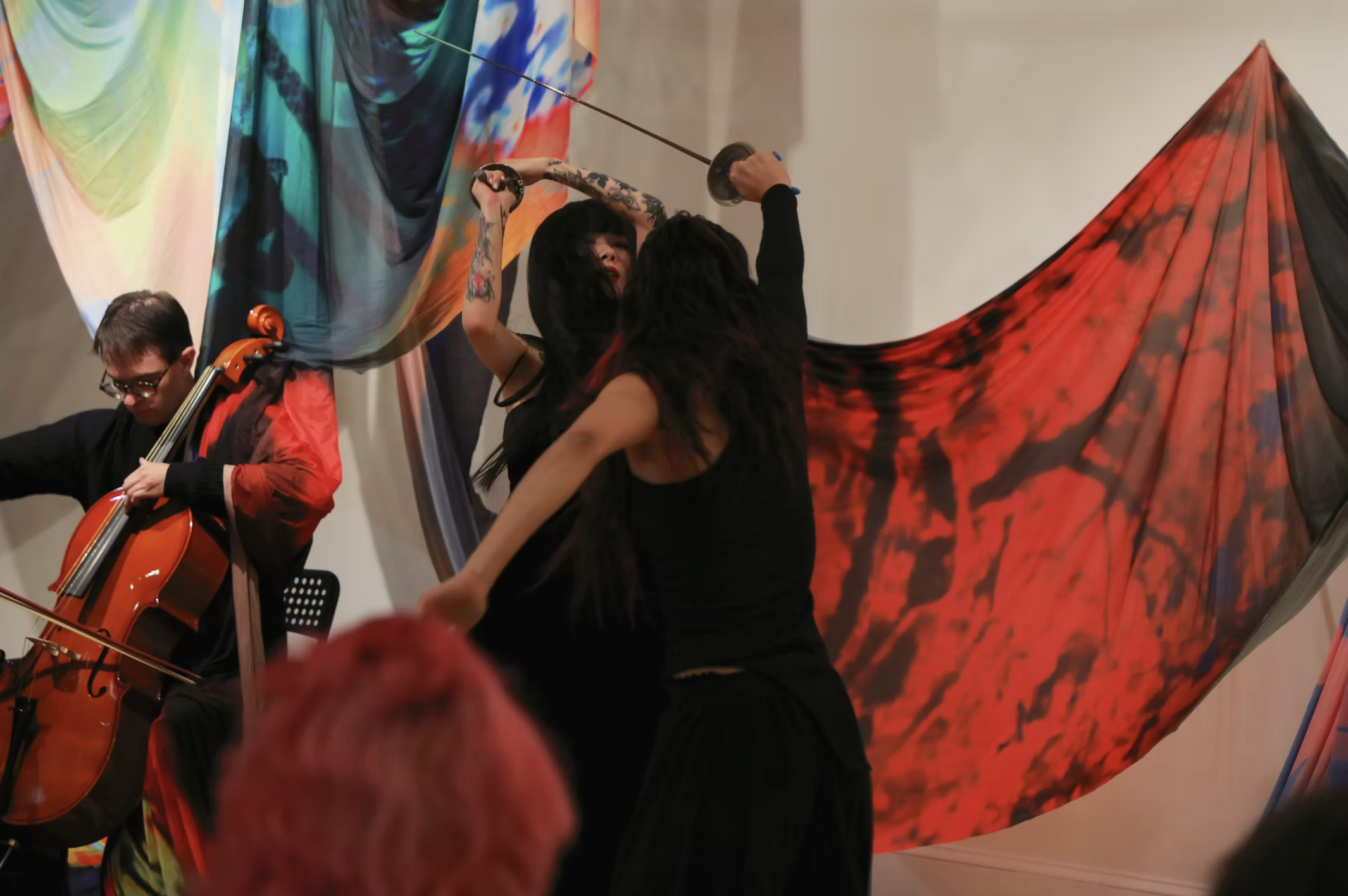
Résistance in Fluxing Nature #4, 2025, Lucia Shuyu Li performing in front of her painting installation with dancer Ceci Sun and cellist Robert Karpay, Making Space, Baltimore. Image courtesy of AX Qin.
Rui Jiang (RJ): So you still have the urge to paint.
Lucia Shuyu Li (Li): Yes.
RJ: From my observations over the past few years, your paintings often depict subconsciousness and dreams in an immediate way. How do you title your works? (a cliché but sincere question)
Li: If it’s based on dreams, then it’s usually a rough summary of the dream’s content and situation, or the critical angle I had at the time, or simply a kind of matching process where things find each other.
RJ: Speaking of things finding each other, there are many multiple selves generated and represented in your work. You are both the creator and the object being created. What is your relationship with them? A mother–offspring relationship? I know many are not, many seem more like dramatized scenes of self-struggle.
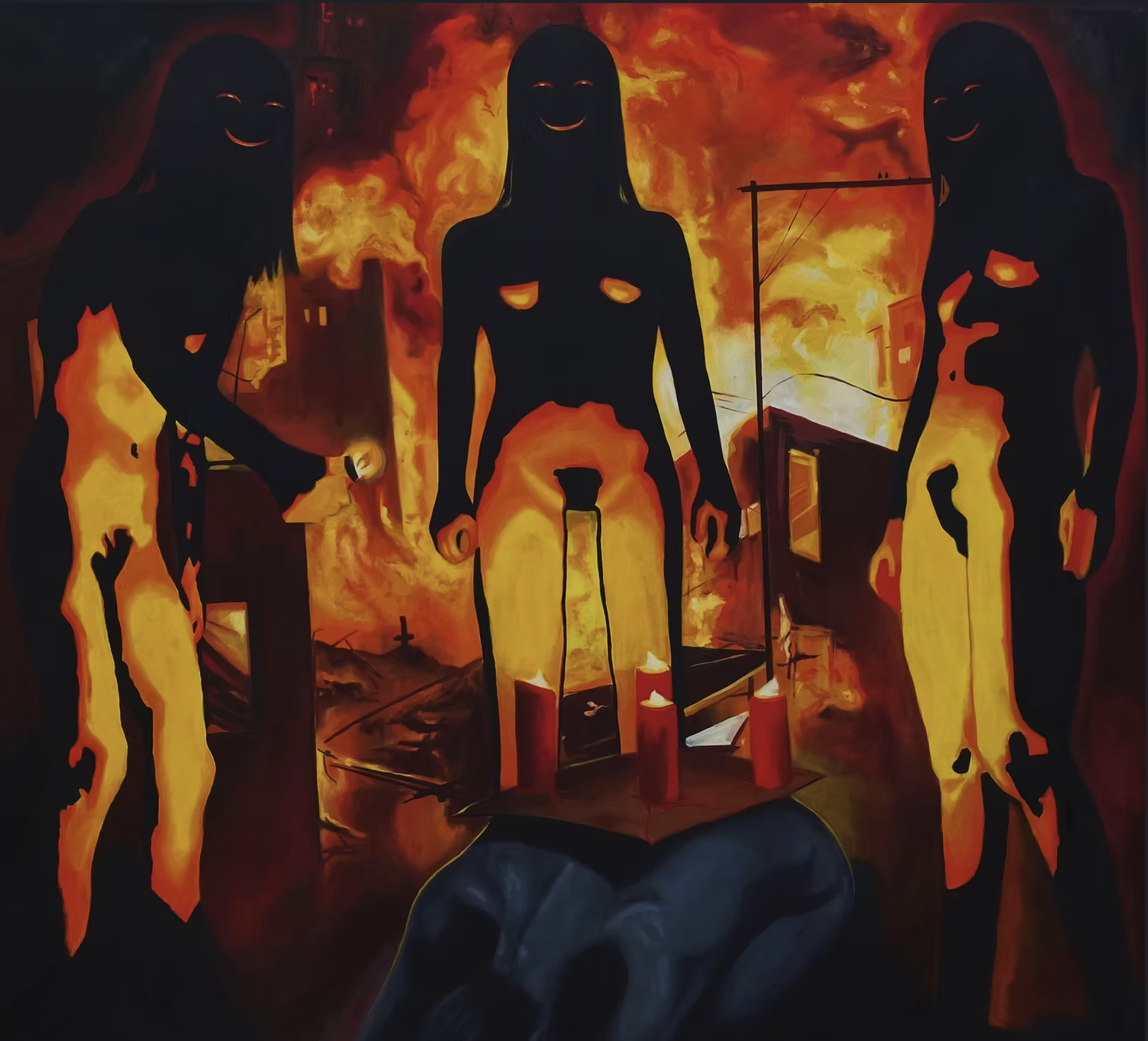
Tumor in Confusion, 2022, oil on canvas, 7.4 x 8 feet. Image courtesy of the artist.
Li: Being labeled as a “portrait painter” is actually both a concern and a driving force stemming from a toxic relationship with the industry. But the main reason is that there are simply too many things I find difficult, impossible, or lack the authority to convey through someone else’s voice. There has always been a sense of frustration at being unable to express myself fully. Portraits that tell a story through my own image, on the one hand, skirt the line of narrative authenticity, while on the other, my own narration serves as the inspiration for my work. Thus, in many of my paintings and performance pieces, I am both the subject and the object. Thinking from another’s perspective—putting myself in someone else’s shoes—is, for me, a grand lie, because we inevitably project our own thoughts onto others. Thus, this multi-layered dialogue of self-portraits serves as both a surrender to this paradox and an existential critique of psychology.
Consequently, I tend to present the gaps in this process of self-overlapping speculation. On a more practical level, there is also a consideration of the continuity of the work’s identity. When my paintings, installations, and performances are all entangled (haha) with my own figure as their starting point, these obsessions and my own inclinations become easier to understand and connect.
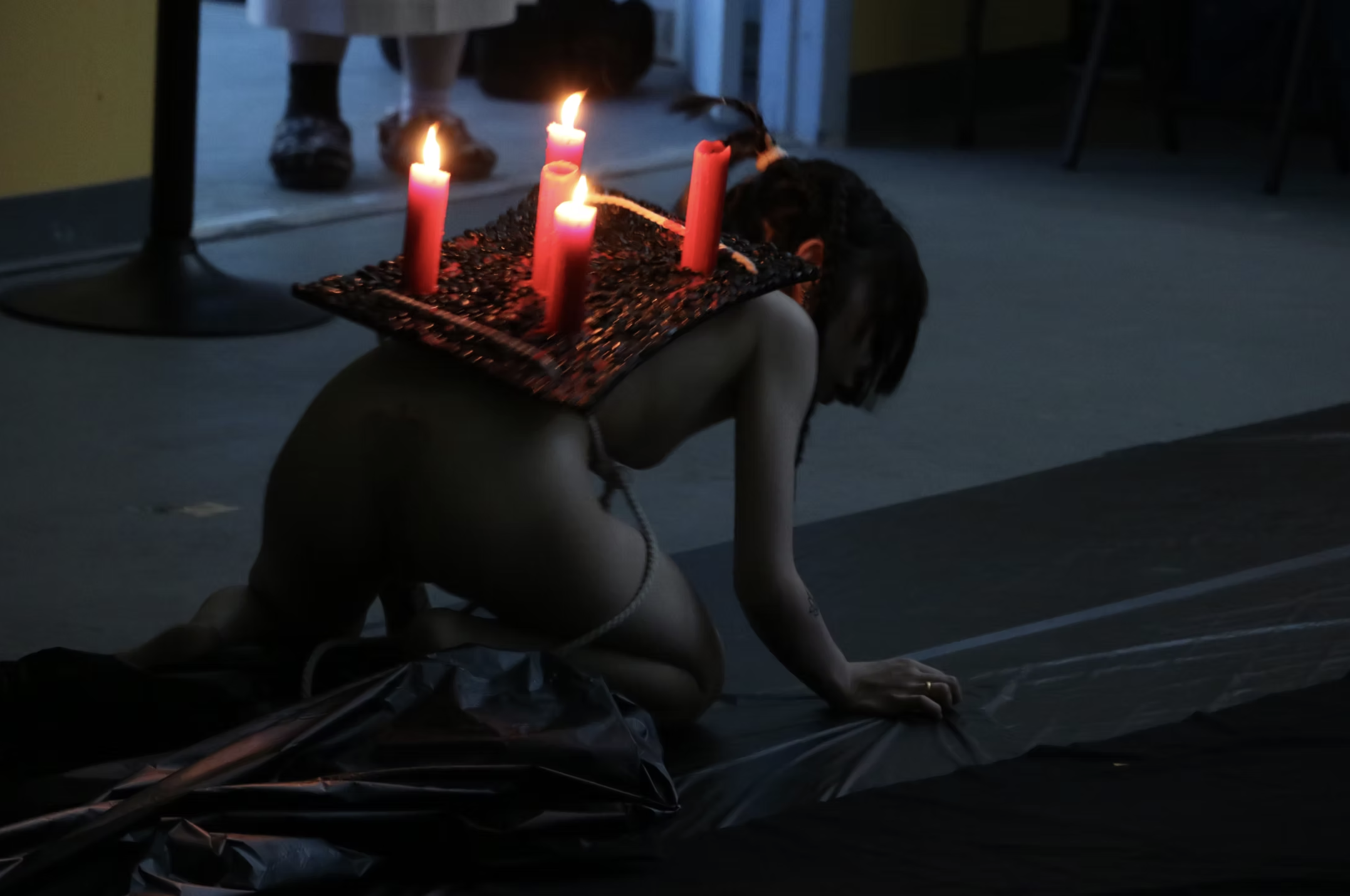
Light Me Up 1, performance, Merci, Baltimore, 2022. Image courtesy of the artist.
RJ: From my perspective, these multiple identities in your work generate dialogues and conflicts, like a labyrinthine vortex of the self. The body becomes a constant reactor.
Li: Yes, these too stem from the constant sense of loss of identity I have experienced—not geographically, but in the broader sense of being rootless and adrift. Ultimately, it is from these heterotopic, liminal states of being that I always return to my inner conflicts to find the most precise and comfortable means of expression, arriving at a narrative of loss that does not leave me feeling lost.
Li’s use of the self as the primary generator of imagery, precisely because of this suspended in-betweenness, produces an inward drive and a desire for precision.
RJ: When you paint, do you know what you’re going to paint before you start?
Li: I determine the final image before I begin.
RJ: Does the image ever betray you? Like suddenly revealing another face?
Li: I don’t think the work betrays me; rather, I betray the work. Most of the time, the result is almost exactly what I want. But this betrayal is temporal—when I revisit it later, unavoidable self-criticism makes me want to change its form or suppress that past phase through another form.
When Judy Pfaff visited my studio, we talked about the trajectory from painting to multi-media practice. We found we were very similar. I spoke about my pain in painting, and he asked, “Then why do you keep painting? Stop painting.” At that time I felt frustrated—why would you say that too? My obsession with gaining traditional painting recognition was triggered again. But after that, I became much freer.
RJ: It makes me sentimental. From your reflections on painting and identity loss, and then looking at your works that challenge the frame, they feel like birds growing wings. You seem loyal to painting, but choose to play physically within the canvas and frame to continue exploring your relationship with it. Anybody says your Painting Sickness series feels ghostly? They are hollow in the air. From what we discussed, your loss in painting, your “screw it” attitude, your freedom across media, it all connects. This freedom along with your desire for traditional recognition, hangs metaphorically like a ghost around these canvases, and you choose to present this dilemma faithfully through the canvas.
Li: Yes, especially the emphasis on misalignment of form. Ghosts, the ghosts of dead oil paintings, haha. Not many people describe it that way, though. Perhaps because when exhibited, there are often more visually intense or interactive works alongside, so this one appears more subdued, floating there. I like this balance of movement and stillness, the shifting weight of viewing.

Painting Sickness, 2023, oil on canvas, stretched canvas, epoxy, wire, 60 x 40 x 40 inches. Image courtesy of the artist.

Puzzles of, 2023, oil on canvas, size variable. Image courtesy of the artist.
In the Painting Sickness series, the frame, which is normally used for enclosure and separation, functions here as a dynamic vacuum. It is both a rigid boundary and constantly transforming, reconstructing bodily posture. Every brushstroke and layer is not only a trace but also a cut into space, a rupture between surface and structure, a corridor that bends, blocks, and loops back onto itself. Her paintings cling to the viewer’s body, demanding passage through them. They exist as architectures of transit, built from accumulated gestures that insist on their bodily presence.
Later, in Zip.file, Li cuts a 10-foot painting into a 60 x 0.15 ft strip. The densest color blocks gaze intensely at the viewer. A feast, a feast of color blocks. Techniques, lines, light distribution, color, texture, emotion, all are neatly compressed into a “barrier” that occupies space. Perhaps even an overreaching line.
Is painting itself audacious?
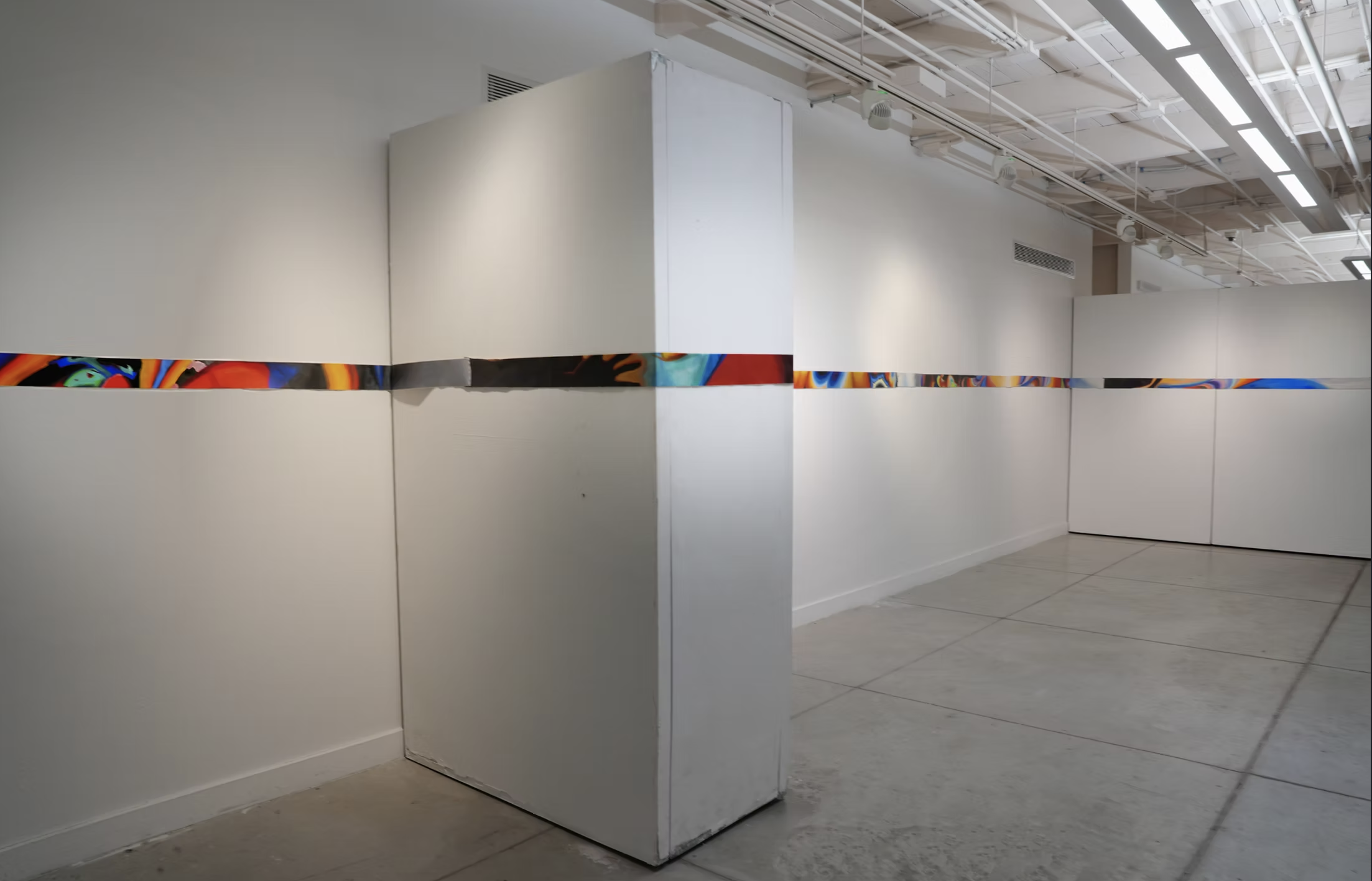
ZIP. file, 2025, oil painting, sewing threads, 60 x 0.15 ft. Image courtesy of the artist.
RJ: After cutting the painting into a long strip, do you want to tell people what the original image was?
Li: I didn’t think about destroying it when I made it. After some time, honestly, I just didn’t like it anymore. Conceptually, it’s hard to escape the provocative glance of added gestures. Sometimes people are curious, but with Zip.file, not many are. The form already imposes a new discipline of viewing and even a kind of viewing incapacity. My paintings have a lot of color; laid flat, they can feel dull. But forcing viewers to scan from one end to the other distributes the colors more evenly and adds some enjoyment. As a concept-driven multidisciplinary artist with a PAINTING background, what do I mean by cutting a painting? Haha.
RJ: The frame.
Li: Right, it challenges the conventional frame format, and adds a spatial dimension to that challenge. This piece stands quite on its own, and I’m not inclined to exhibit it alongside my other oil paintings or the series that challenges the frame. Compared to the visual impact of those works and their massive, “tricky” challenges to the viewer’s perspective, I actually hope ZIP.File serves as a buffer. The others are quite intense, so sometimes I want to take a gentler approach and play with the audience in a new way.
RJ: So you feel that some of your previous exhibitions presented too much content due to constraints of the situation and the space?
Li: Yeah, it was like a show-off of my diverse practices. … But speaking of space, there’s always a paradox between creation and space. My work has always sought to challenge the conventional structure of space,
but once it’s completed, as you know, the work is inevitably constrained by the space.
RJ: In your work, the construction of this space and the creation of a physical, traversing experience for the viewer—or, when you look at these canvases, you might feel as though they, too, are undergoing a process of traversal, including your performance art, which involves a self-navigation between different subjects. This labyrinth, built by you, is then shaped together with the audience to create a more expansive narrative, particularly in terms of the psychological level of this collusion between consciousnesses. I remember you mentioned to me a long time ago that when generating ideas for your creations and installations, luring the audience was a key objective.
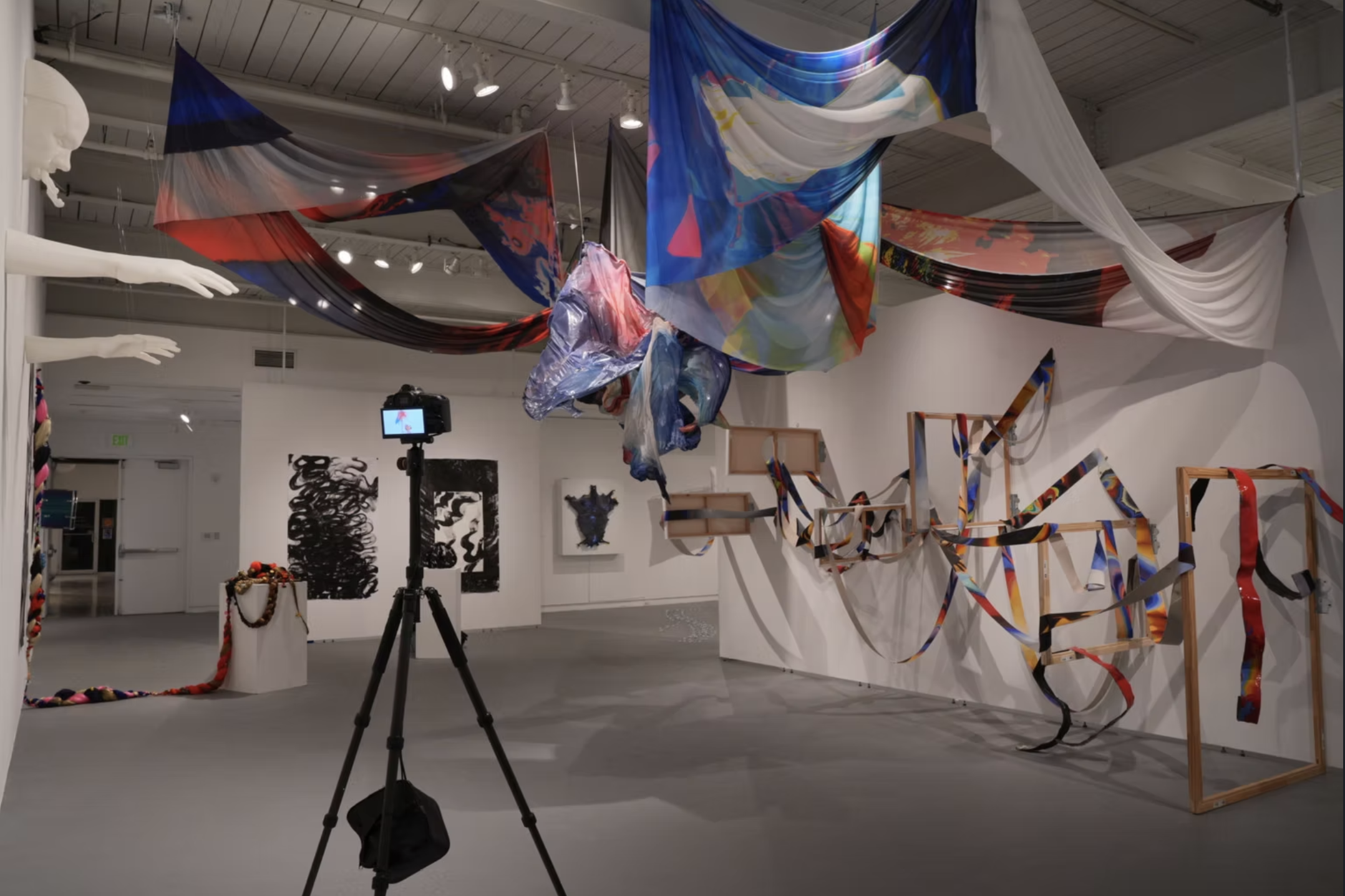
Painting Sickness & Far Gone, 2025, Installation view at Decker Gallery, Baltimore. Image courtesy of the artist.
Li: Practices outside of performance art certainly have valid, effective purposes: first, to catch the eye; then to capture the viewer’s time, prompting them to speculate and interpret. My works are relatively large in scale, so they inevitably must adapt to the specific conditions of each space; moreover, I expand them to a size that makes immediate sense to the viewers. These are dynamic experiments in installation too, movement, rhythm, hospitality toward the viewer.
Performance is different: the audience is already there, fully prepared. You don’t need tricks, in a way, they’re already on stage. Like you said, artists convey basic perceptions economically to convey the most fundamental human perceptions metaphorically. Yet, at the same time, the question of how much an artist must do to be appreciated—and the recursive pain of determining what constitutes an effective experience—is actually quite a conflicted irony. I even find myself doubting whether the work I create would even be categorized within the realm of performance art. But after performing, I always feel exhilarated. I try to explore the possibilities of different media within my performance practice, just as I do in my other work. That's why I've done some cross-media performance pieces, challenging the traditional, singular-present form of traditional performance art. My exploration of the act itself is similar to my exploration of painting, but this embodied, ephemeral form runs parallel to my painting practice—and yet it also feels like a form of compensation.
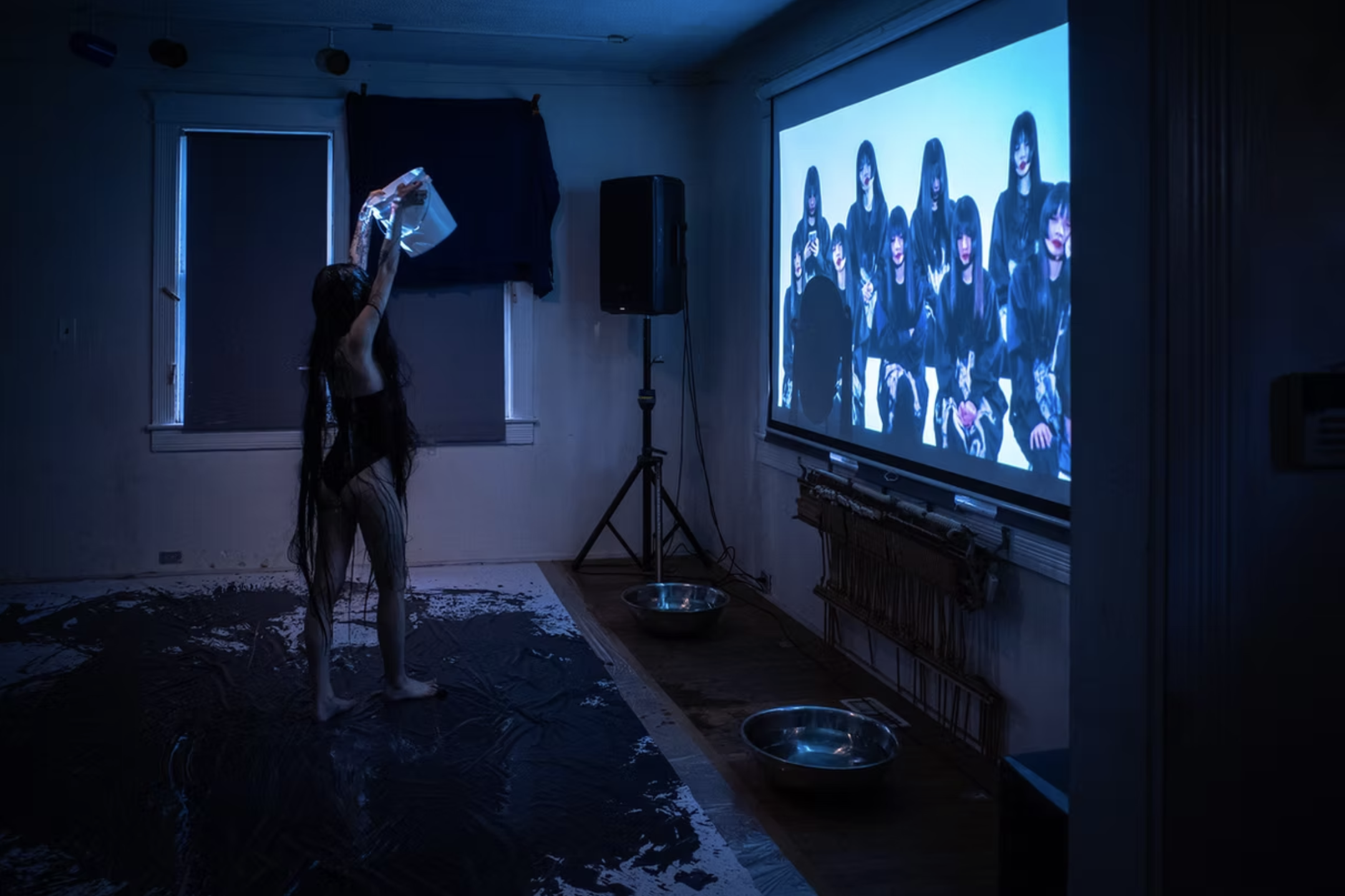
Scrutiny from Amniotic Fluid, 2023, performance, Rhizome, Washington, DC. Image courtesy of the artist.
RJ: I’m also curious about how you view the element of physicality in these painting installations. As you mentioned, they’re not only a hollow gesture, an invitation that speaks to both the nature of painting itself and your subconscious, but also a moving gesture. Take the work Far Gone but So Close, for example: you have several cameras arranged around a hollow frame, with your gauze painting, resin-coated and stiff, suspended in the center. Meanwhile, the cameras play back the physical entanglement between you and the gauze, captured when it was still soft, as you moved through the wind.
Li: In the piece exhibited at New Uncanny Gallery, the ideal scenario was for the projection to be cast directly onto the hollowed-out section in the center of the canvas, showing a performance video of me painting my own chest in front of a mirror. First of all, the human body is a simple element that can bring you back from the abstract to reality. And for me, dreams are also my reality. How could dreams not be reality? They originate from me, shape my thinking, intertwine with my entire lived reality, encompassing these elements and the fictional subconscious.
In all my explorations of the subconscious, the human subject remains central. I’m not particularly interested in constructing a completely abstract, fictional realm of the subconscious. Between painting and performance, I always use my own presence to construct a continuous sequence of scenes and pauses. Physicality essentially serves as an information-based anchor point for the audience, but it is anchored within a hollow, cut-out canvas suspended in mid-air.
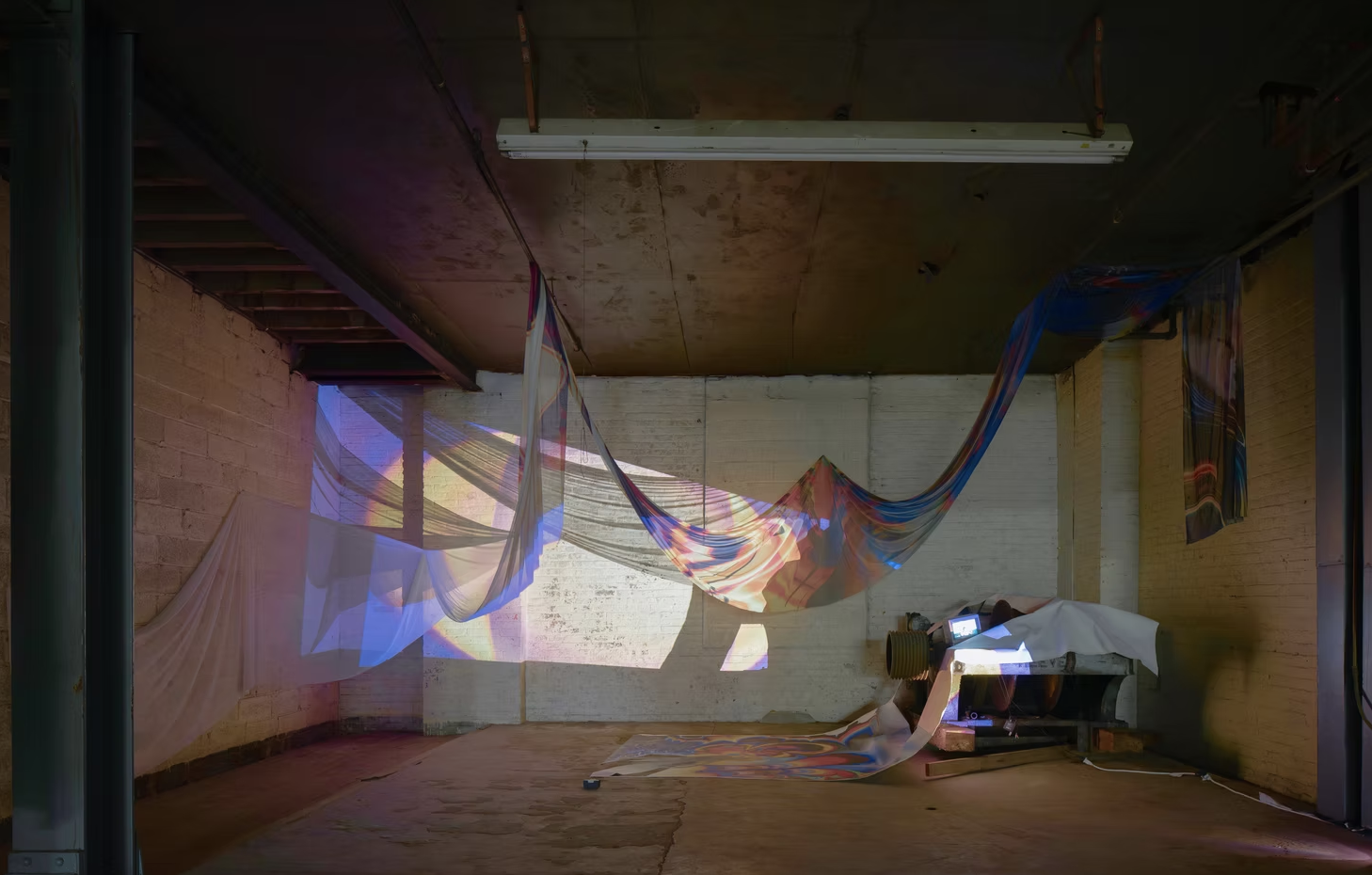
Fluxing Nature #2, 2024, installation view at New Uncanny Gallery, New York. Image courtesy of Yuhan Shen.
With Far Gone but So Close, after creating a large quantity of performance-based works, I returned to the medium from a theoretical perspective. On the one hand, as mentioned earlier, I explored the medium’s potential for performance art; on the other hand, this work transcends the physical constraints of time, place, and space inherent in the immediacy of performance art, effectively presenting the audience with a pantomime—a scene of nonexistent evidence where I am both present and yet long gone.
RJ: This work also prompts me to reflect on the violence inherent in the photographic lens; as the camera moves around the space, the screen displays what are, technically, afterimages of your performance. As the subject, your physical presence has already “escaped” or “vanished” by the time the audience watches, or rather, stares at the screen, yet the lens replays your actions over and over. This ghostly treatment of presence seems to extend your discourse and manifesto on media pluralism, while it actually evokes a chilling sense of alarm, especially when we consider contemporary self-surveillance.
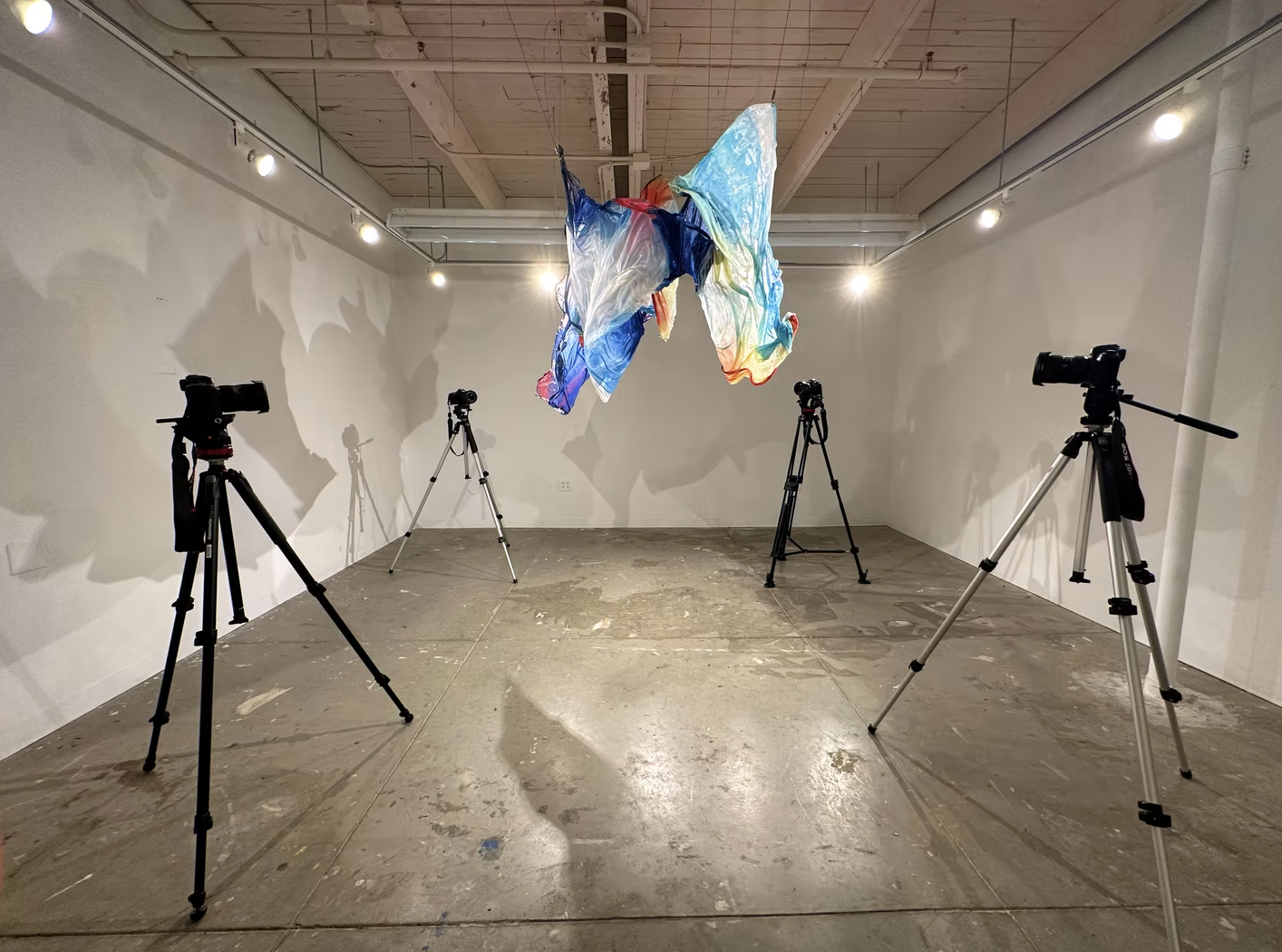
Far Gone but So Close, 2025, print on fabric, epoxy, 4 cameras, installation and performance. Image courtesy of the artist.
Li: Right, thoughts related to the violence of the lens are triggered by this presence that seems to have slipped away. But to be honest, especially since I recorded my own performance and edited it myself, and setting up these cameras myself, as a performance artist, I must, during the performance, cast aside my perception of natural everydayness and accept this inevitable sacrifice. The sacrifice inherent in performance is not the subjectivity I sacrifice to being gazed upon, but rather the inescapable necessity of first stripping myself down to the very essence of being human and existence itself.
RJ: When you're creating, do you feel like these tangible things are like debris falling off you?
Li: Yes, for a while, the paintings I created all featured elements of fire, stemming from a fear of fire that I couldn’t quite pinpoint. Later, I even bought a fire extinguisher. These absurd, sensational synchronicities somehow turned the creative process into a form of self-healing, a kind of exposure therapy.
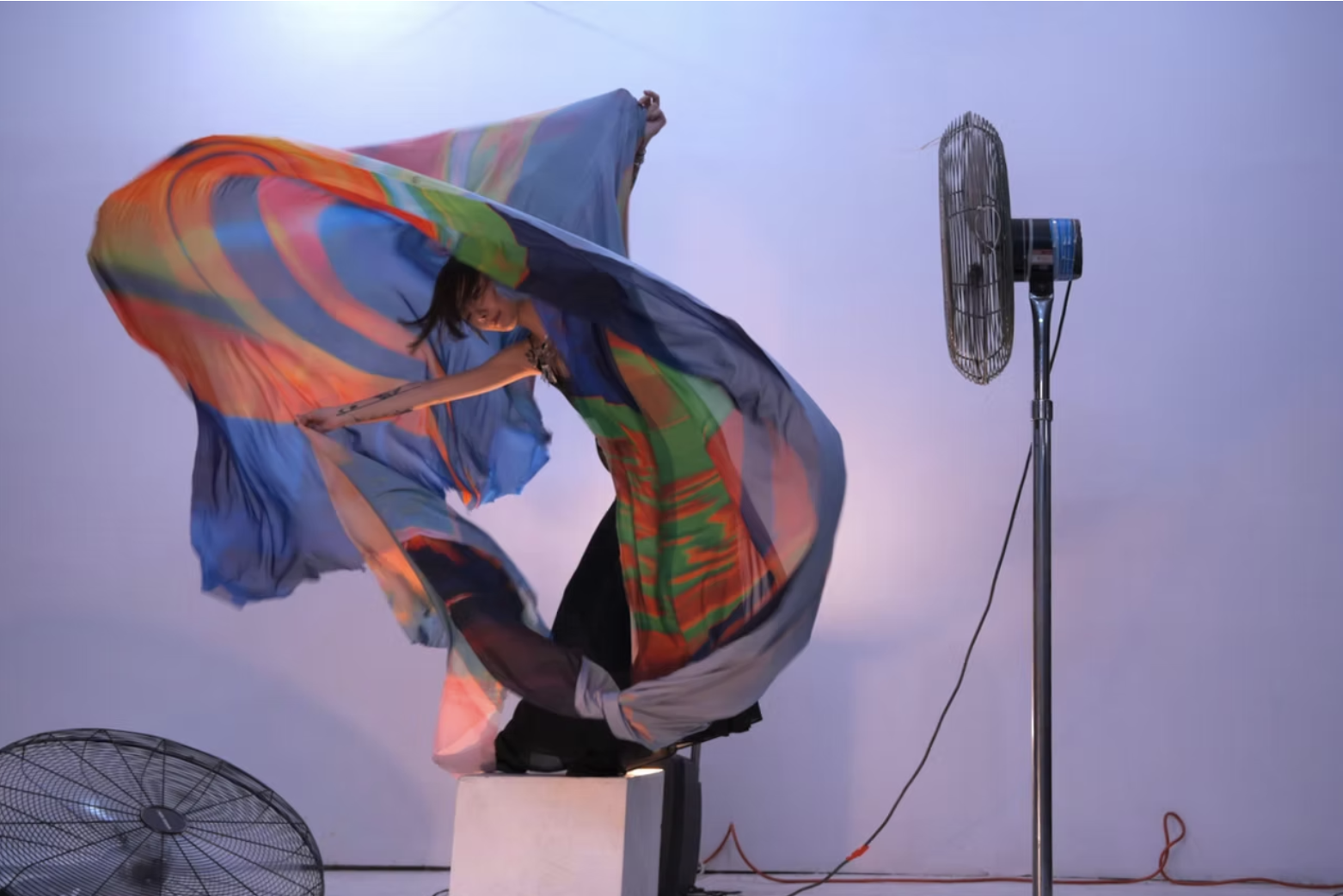
and I’m Here, 2025, performance, Bogus Gallery, Baltimore. Image courtesy of Dooree Kang
RJ: Indeed, whether the body serves as a vessel that constantly evaporates or overflows, it is born into the world and becomes these works of your creation. These are, on the one hand, temporary manifestations, and on the other, a monastic-like process of endless repetition within the body.
Li: Right, definitely some wear and tear; it consumes you. But at the same time, the sense of healing I’ve described stems from an unstoppable creative instinct—manifestation? Ultimately, it’s the ecstasy brought on by the logic of manifestation. I love this process, just like today, I honestly hadn't thought about how my relationship with painting has turned/revealed itself as “from love to hate” until our conversation, hahaha.
