If the Background Woke Up
The Unseen White Starts to Talk
When is the last time you truly seeing a switch, a handle or a hanger?
They recede into the architecture of habit: a light switch waiting beside the door, a hanger emptied at the end of the day, a hinge that disappears precisely because it works. Their presence is so constant that perception edits them out before consciousness can register them. White body hides themselves on the white walls, like snow rabbits disguise in the snow. Less visible the better. No memory nor to attention, but to the silent mechanics that allow everyday life to proceed uninterrupted. One day, Zhiyi Zhang woke them up.
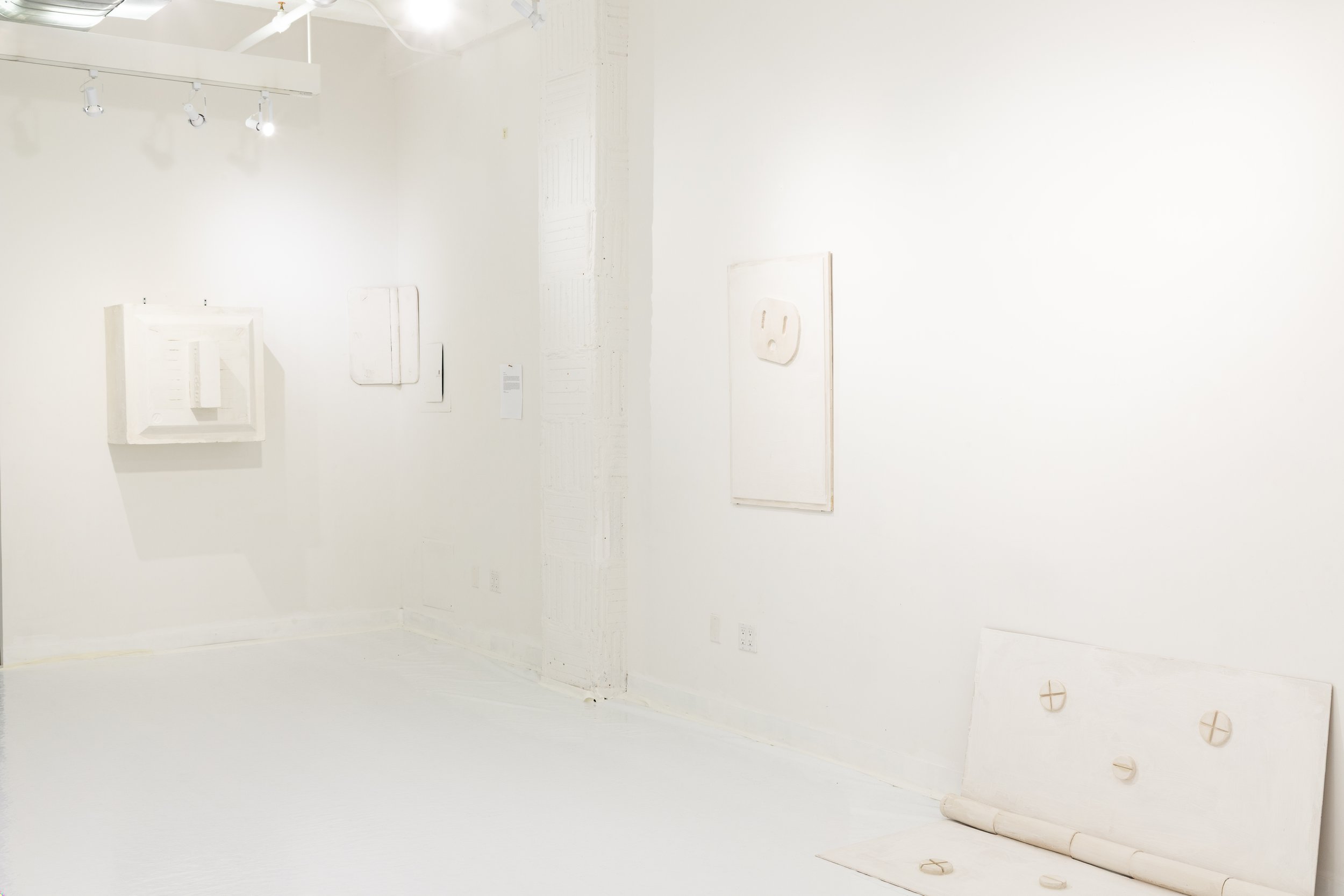
Installation view, credited by Haidong Yang, courtesy of FLOHAUS Gallery.
When the Background Takes Center Stage begins precisely where perception ends. Rather than treating domestic fixtures as ready-made objects, Zhiyi Zhang dismantles the hierarchy that has long separated foreground from background. Enlarged to an almost bodily scale, switches, handles, hooks, hinges are withdrawn from utility and reintroduced as sculptural protagonists. Detached from the walls they once served, these objects no longer facilitate movement; instead, they interrupt it. They are silently yelling for be seen, rather than be used.
Scale becomes the exhibition’s first act of estrangement. Standing before an oversized light switch, one experiences an uncanny collapse between recognition and unfamiliarity. The object remains immediately identifiable, yet its function has dissolved. What once belonged effortlessly to the choreography of everyday gestures now demands contemplation. Familiarity, displaced from use, becomes a form of distance.

Zhiyi Zhang. Hinge, 2026. Detail view, MDF wood and spackling wall paste. Dimensions variable. Credited by Haidong Yang, courtesy of FLOHAUS Gallery.
Nothing appears overtly dramatic. There is no narrative climax, no symbolic excess, no theatrical intervention. Instead, Zhang allows the overlooked infrastructure of domestic life to occupy the same contemplative space traditionally reserved for monumental sculpture. The French writer Georges Perec once urged us to question “that which happens every day and returns every day, the banal, the quotidian.” The ordinary, he argued, is not transparent but invisible precisely because it is incessantly repeated. Zhang’s sculptures seem to inhabit this proposition. They do not monumentalize the everyday but reveal how the everyday has always been structured by an economy of selective perception. The background is never merely what lies behind. It is what sustains the possibility of everything else while remaining systematically unnoticed.
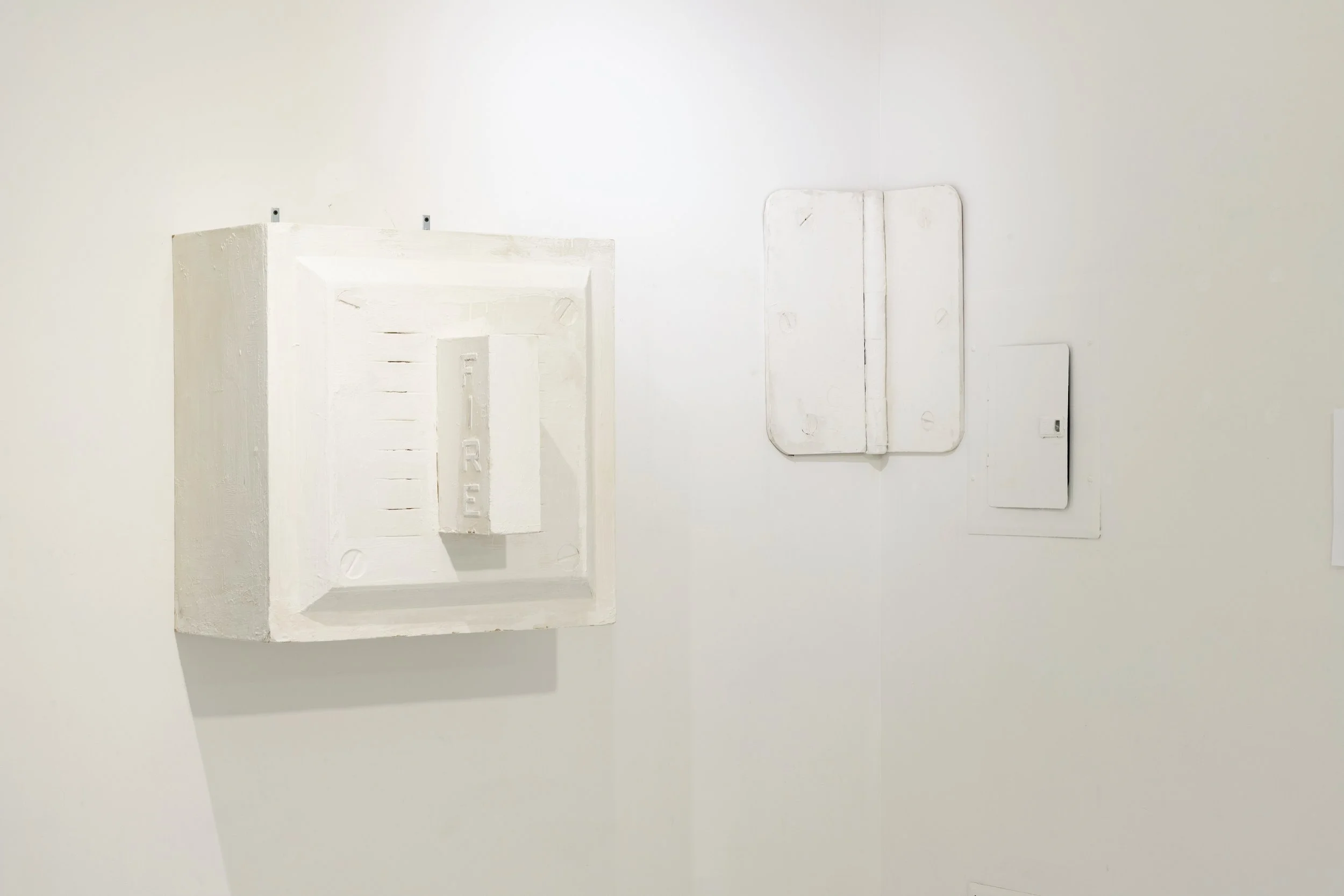
Zhiyi Zhang. Fire Alarm, 2026. MDF wood and spackling wall paste. Credited by Haidong Yang, courtesy of FLOHAUS Gallery.
Zhang’s sculptures suspend these automatisms. By rendering familiar objects unusable, she returns them to visibility. One suddenly recognizes how profoundly the body has depended upon these unnoticed companions. Their silence is no longer neutral. It becomes palpable.
The works also suggest a more elusive condition: the experience of learning a place through its smallest infrastructures. Every migration begins not with monuments but with thresholds - with unfamiliar door handles, differently positioned switches, electrical outlets that refuse familiar plugs. These modest encounters rarely enter the grand narratives of displacement, yet they quietly reshape the body’s relationship to its surroundings.
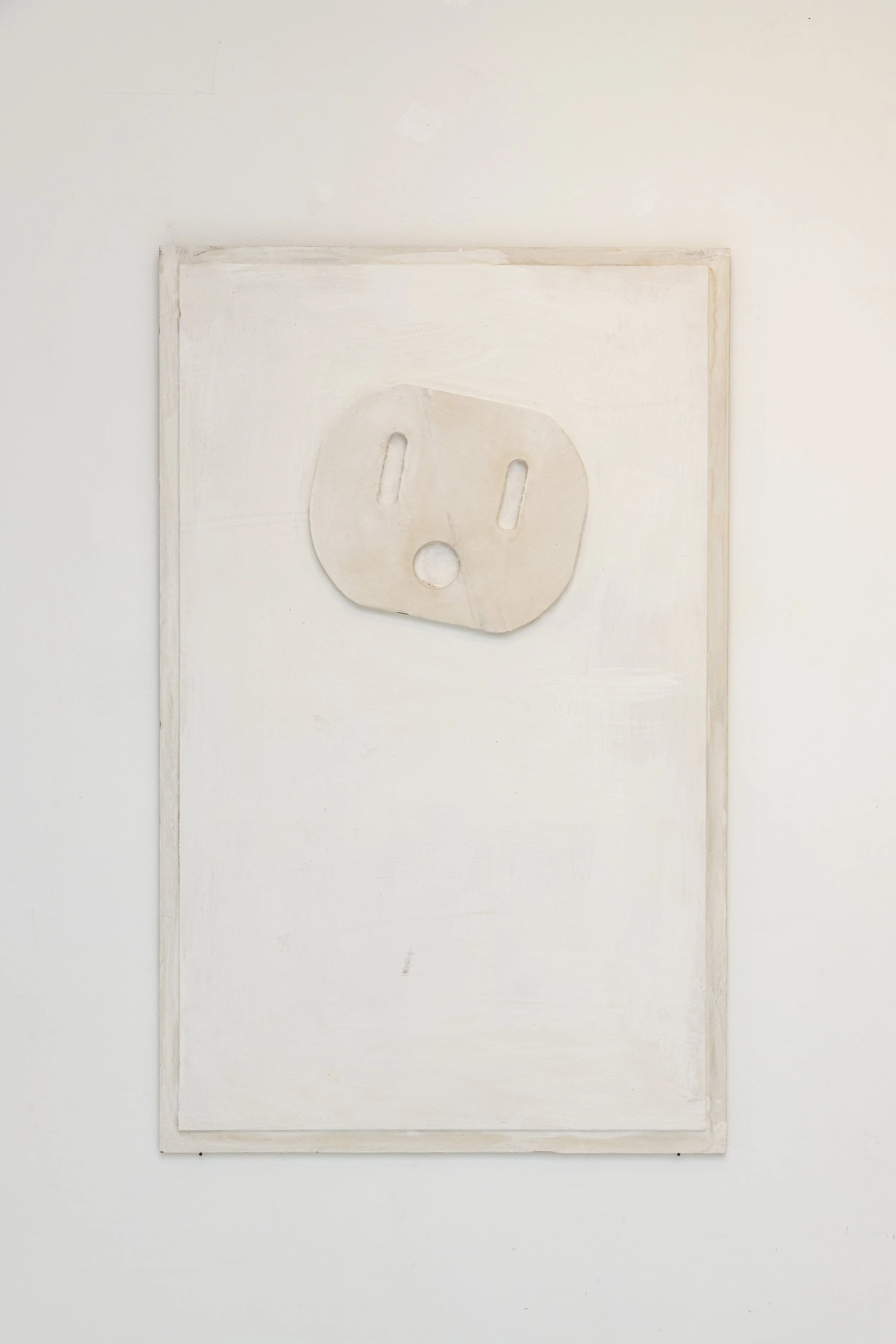
Zhiyi Zhang. Socket, 2026. MDF wood, spackling wall paste, and paint. Dimensions variable. Credited by Haidong Yang, courtesy of FLOHAUS Gallery.
Perhaps this is why the sculptures possess such an unexpected dignity. They do not imitate architecture; they expose its nervous system. They make visible the unnoticed labor performed by objects whose purpose has always been to disappear behind our attention.
By the time one leaves the gallery, nothing has materially changed. A light switch remains a light switch. A hinge continues its patient rotation. Yet something within perception has shifted almost imperceptibly. One begins to hesitate before touching what previously required no thought.
The background has not moved to the center because it demanded recognition. It has always been there, quietly sustaining the world. What changed was only the direction of our gaze.