“He Spoke to the Birds”
Presented by AAIE & FanFlus, Curated by Fanfan Yuxuan Fan
So from that day on he would earnestly exhort all wild animals, birds, reptiles and even insensate creatures to praise and love their Creator, because every day, after calling on the Saviour's name, he learned from personal experience that they would obey him.
——Thomas of Celano, First life of St. Francis of Assisi

Installation view of He Spoke To The Birds, Rome. Artist: Diego Azzola. Curated by Fanfan Yuxuan Fan. Courtesy of AAIE and FanFlus.
This passage from a biography of Saint Francis describes how, after preaching to the birds, he realized that communication was not limited to human beings, but could also extend to animals and even non-sentient creatures. They, too, were created by God and should therefore be treated equally. Drawing from this story, curator Fanfan Yuxuan Fan chose “He Spoke To The Birds” as the title of the exhibition, held at the AAIE Center for Contemporary Art (AAIE) in Rome. It reflects the attitude shared by three artists and curator Fan towards materials: materials are not simply tools to be controlled and used, but also something with which artists seek to enter into dialogue. Just as Saint Francis treated all of God’s creations equally, the artists also try to build an equal relationship with materials.
The three artists come from China, Italy, and Austria. Despite their different backgrounds and education, they are brought together by a shared passion for art and materials. This also reflects AAIE’s long-standing approach. As an experimental art space in central Rome, AAIE is committed to supporting emerging artists from around the world and encouraging exchange between different communities, cultures, and artistic experiences.
In the corridor leading to the main exhibition hall, visitors first encounter paintings by Huang Zhe. Curator Fan begins with his smaller paintings here, avoiding the overwhelming visual weight that large paintings might impose in the narrow corridor, while allowing viewers to take in details at close range. Further in, the paintings expand in scale to fill the main exhibition hall, arranged along the wall and extending towards the corner — a spatial turn that also marks a shift in the rhythm of viewing. Along the second wall, the paintings return to a smaller size. Huang Zhe enters into a dialogue with smoke as a “material”, not real smoke, but a visual symbol rooted in his memories of growing up in a Buddhist family. Against green-toned grounds, the smoke layered across appears as a thin veil between the present and the past, between the viewer and the artist’s memory. Through it, viewers glimpse blurred images of past experience (Play a Game, 2026). The small–large–small arrangement by curator Fan makes the paintings resemble a strip of film unfolding frame by frame, drawing viewers from fragmented images into a deeper space of memory. As the works quietly recede after the corner, their visual intensity softens, allowing attention to shift naturally towards Diego Azzola’s installation works.
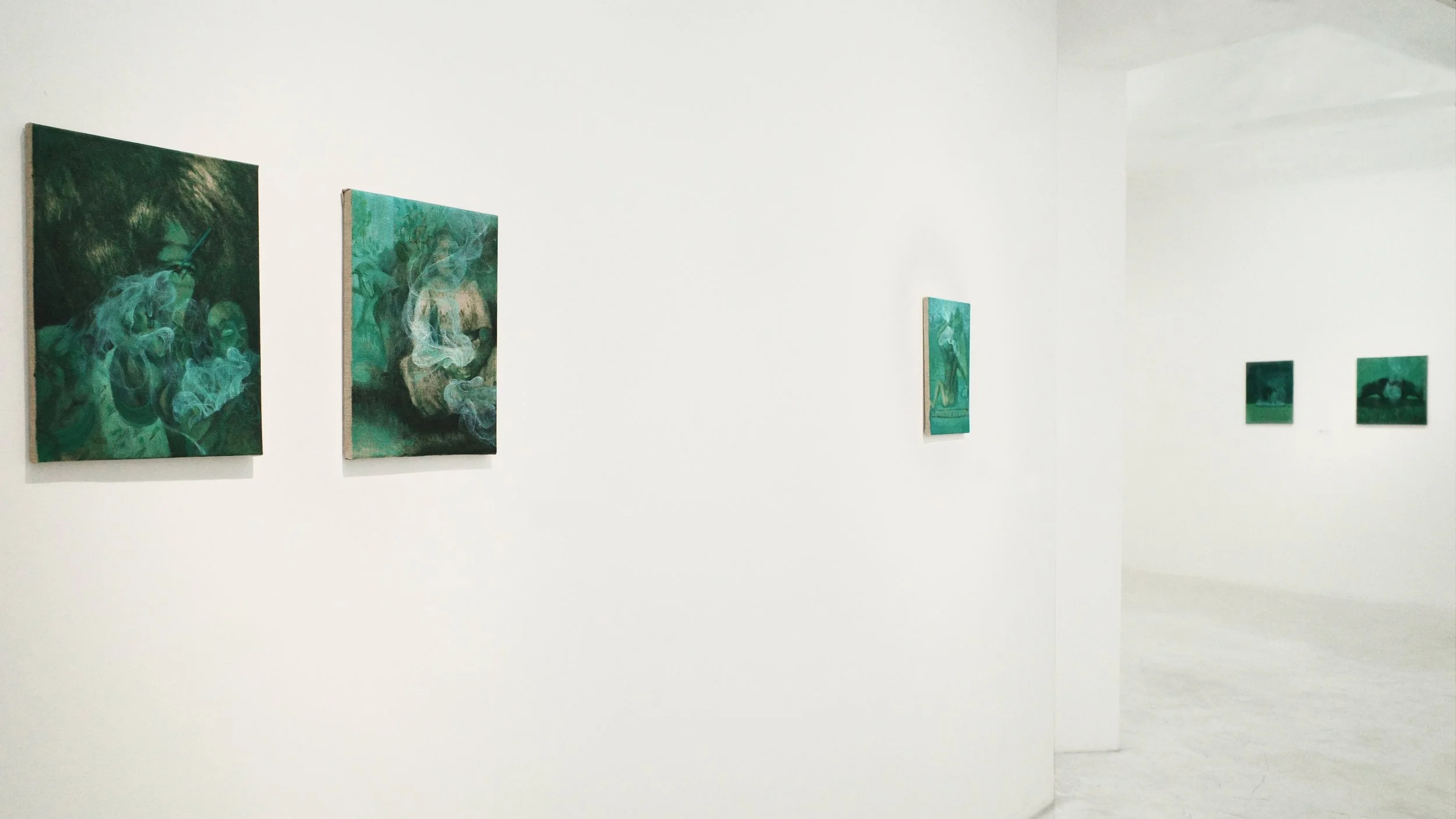
Installation view of He Spoke To The Birds, Rome. Artist: Huang Zhe. Curated by Fanfan Yuxuan Fan. Courtesy of AAIE and FanFlus.
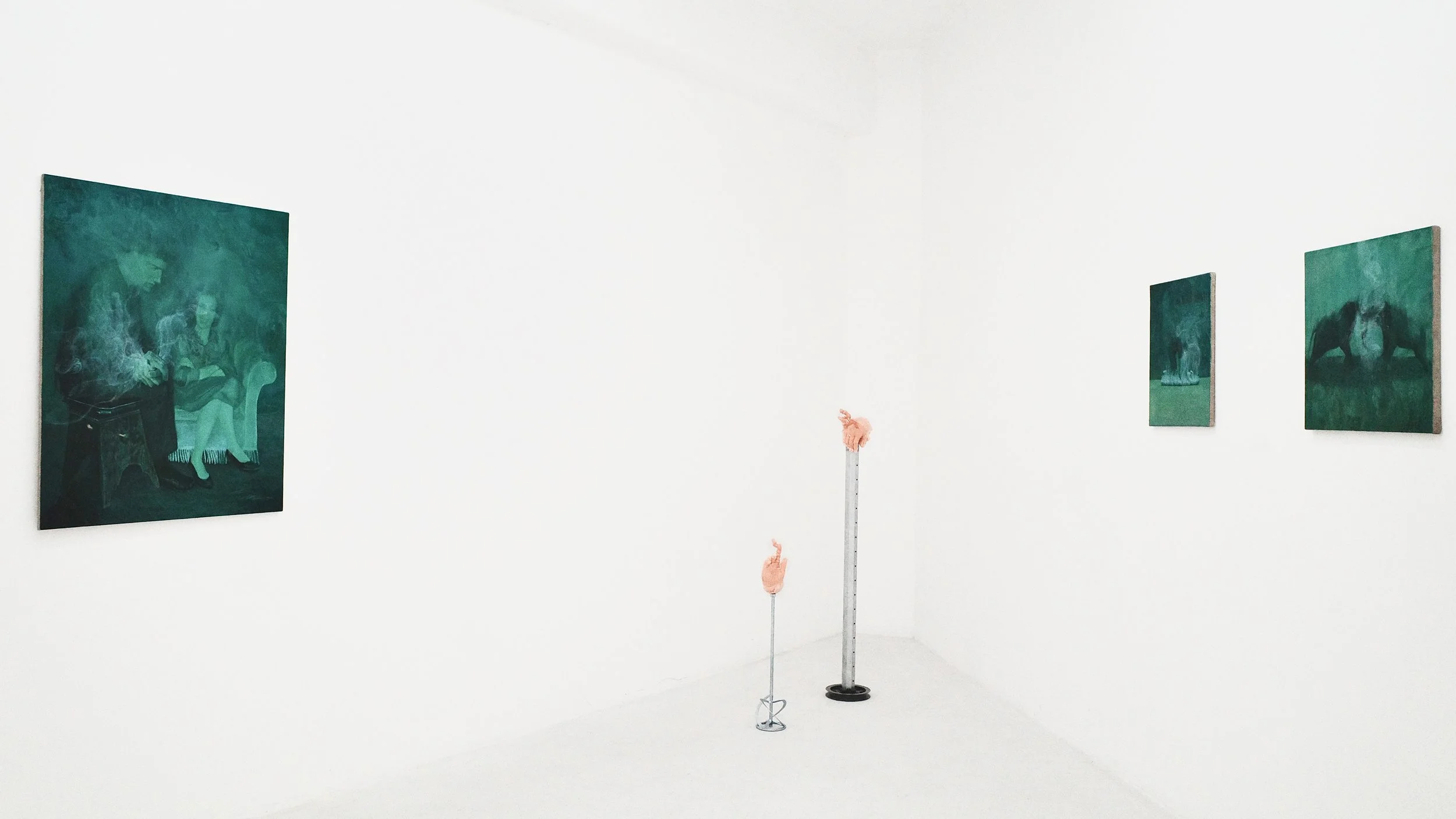
Installation view of He Spoke To The Birds, Rome. Artists: Diego Azzola, Huang Zhe. Curated by Fanfan Yuxuan Fan. Courtesy of AAIE and FanFlus.
The central section presents installation works by Bergamo-based artist Diego Azzola, who combines painting and galvanized pipes. The pairing of classical painted elements with industrial materials creates a sense of rupture between the historical and the contemporary (The Woman with the Sea Fair, 2026). By extending the works across both walls and floor, curator Fan releases them from the isolated and elevated logic of the White Cube, inviting viewers to approach, circulate around, and even move through them. The viewer’s participation becomes part of the work’s meaning. This arrangement reflects the artist’s concern with issues in the external world. The blue tones and marine elements in Azzola’s works (Experiment 4. Marine Woman, 2025) reflect his concern about ecological transformation, such as global warming, rising sea levels, and humanity's growing estrangement from nature.
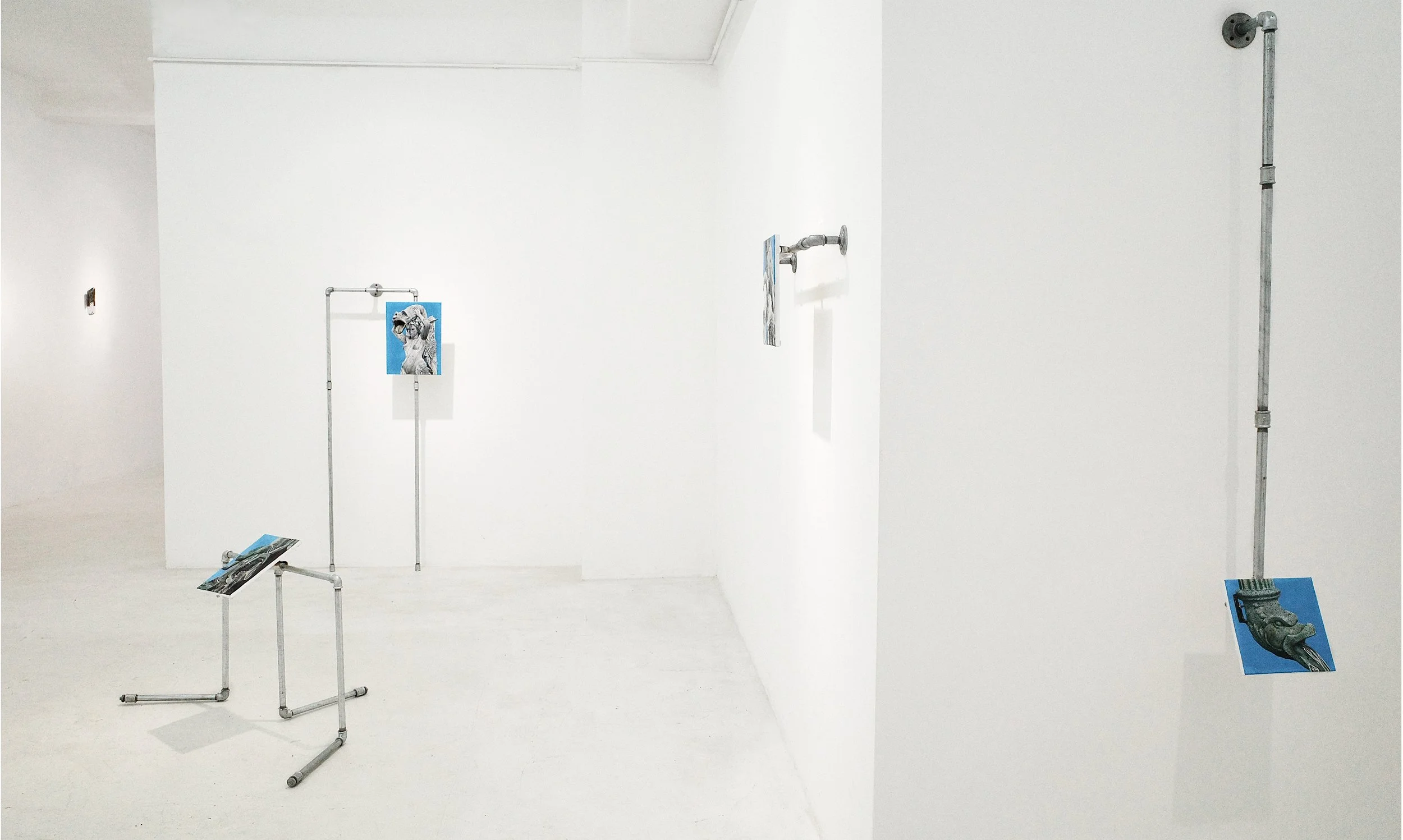
Installation view of He Spoke To The Birds, Rome. Artist: Diego Azzola. Curated by Fanfan Yuxuan Fan. Courtesy of AAIE and FanFlus.
On the other side of the exhibition hall, a projecting wall creates a natural turn and acts like a boundary, leading visitors into the more enclosed world of Jeremias Rumpl. This separation feels apt: Rumpl's method differs fundamentally from the previous two artists. Rather than fully controlling the final form of his materials, he cedes part of the creative process to the materials themselves and to time. Acid corrosion and natural weathering leave marks of varying depths on the zinc plates, suspending their surfaces between formation and decay. This process of decay and corrosion echoes Rumpl’s thoughts on war and ruins. The eroded, torn, and reshaped zinc surfaces evoke fragments left after war, damaged buildings, or material remnants that persist silently after violence. The repeated use of the word “House” in the titles of his works (House Armor, 2024) suggests a concern with collective historical trauma rather than personal memory alone.

Installation view of He Spoke To The Birds, Rome. Artist: Jeremias Rumpl. Curated by Fanfan Yuxuan Fan. Courtesy of AAIE and FanFlus.

Installation view of He Spoke To The Birds, Rome. Artist: Jeremias Rumpl. Curated by Fanfan Yuxuan Fan. Courtesy of AAIE and FanFlus.
In my view, curator Fanfan Yuxuan Fan brings these three practices together through a carefully sequenced viewing path: from painting, to the intersection of painting, installation, and industrial materials, and finally to the direct presentation of material transformation. The exhibition feels like an artistic experiment in materiality, with time running throughout: in the smoke of memory, in history and the imagined future, and in traces of corrosion and change. This open understanding of material also recalls Arte Povera’s emphasis on the mutability of matter and meaning: the work is no longer a closed object, but a field in which sensory experience, memory, and thought can continue to unfold. In this sense, “He Spoke To The Birds” is not only a poetic title but also a key to the exhibition: the artists do not simply use materials but listen to how materials carry time, generate images, and tell their own stories.

Installation view of He Spoke To The Birds, Rome. Artists: Diego Azzola. Curated by Fanfan Yuxuan Fan. Courtesy of AAIE and FanFlus.

Installation view of He Spoke To The Birds, Rome. Artists: Diego Azzola, Huang Zhe. Curated by Fanfan Yuxuan Fan. Courtesy of AAIE and FanFlus.

Installation view of He Spoke To The Birds, Rome. Artists: Diego Azzola. Curated by Fanfan Yuxuan Fan. Courtesy of AAIE and FanFlus.

Installation view of He Spoke To The Birds, Rome. Artists: Diego Azzola. Curated by Fanfan Yuxuan Fan. Courtesy of AAIE and FanFlus.
He Spoke To The Birds is currently on view through 28 July 2026 at the AAIE Center for Contemporary Art in Rome (Via Sermide, 7).