Echoes of the Himalayas
A Journey Through Art, Education, and Preservation
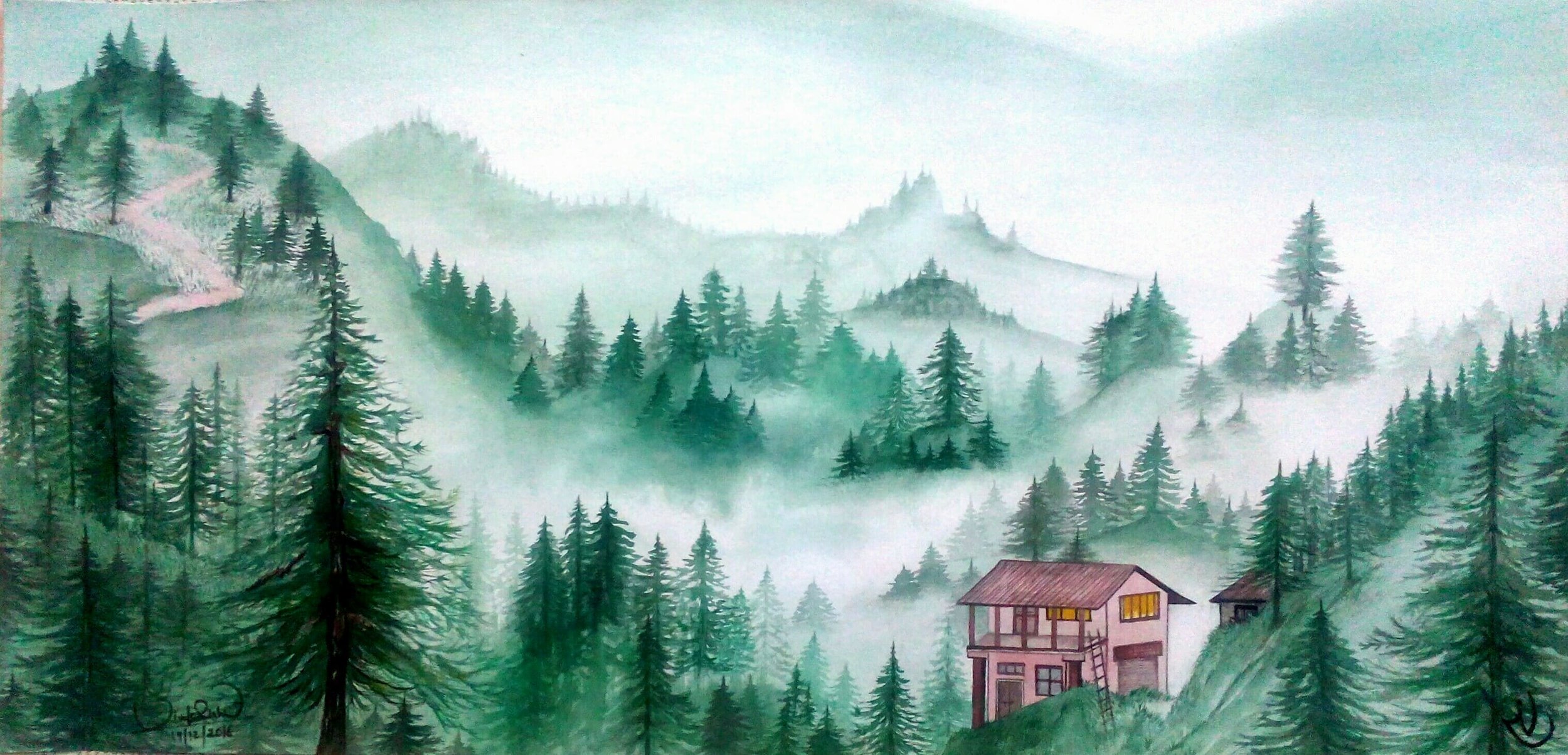
Vivek Chandra Bisht. Mist In The Valley, 2016. Watercolour on Paper. 11 × 22 in. Image Courtesy of the Artist.
How Art, Heritage, and Community Became One Creative Journey
"The mountains do not merely stand before us; they stand within us."
This belief has quietly guided my artistic journey for more than fifteen years. Long before I understood the language of galleries, exhibitions, or contemporary art, I was learning from a different teacher—the Himalayas.
I was born and raised in the Indian Himalayan state of Uttarakhand, where every landscape tells a story. The mountains are not simply geographical formations; they are living archives of culture, spirituality, craftsmanship, and resilience. Ancient temples emerge from forests, traditional stone houses blend into terraced fields, and centuries-old pathways continue to connect communities that have learned to live in harmony with nature. Growing up in this environment shaped not only how I saw the world, but also how I understood the purpose of art.
As a child, I was fascinated by the patterns surrounding me. The geometry of traditional wooden architecture, the rhythm of mountain villages, the changing colours of distant peaks, and the silence that settled over valleys at sunrise became my earliest visual education. What appeared ordinary to many gradually revealed itself as extraordinary. I began to realise that every carved doorway, every abandoned house, and every forgotten water source carried stories that deserved to be remembered.
Years later, these observations became the foundation of my artistic practice.
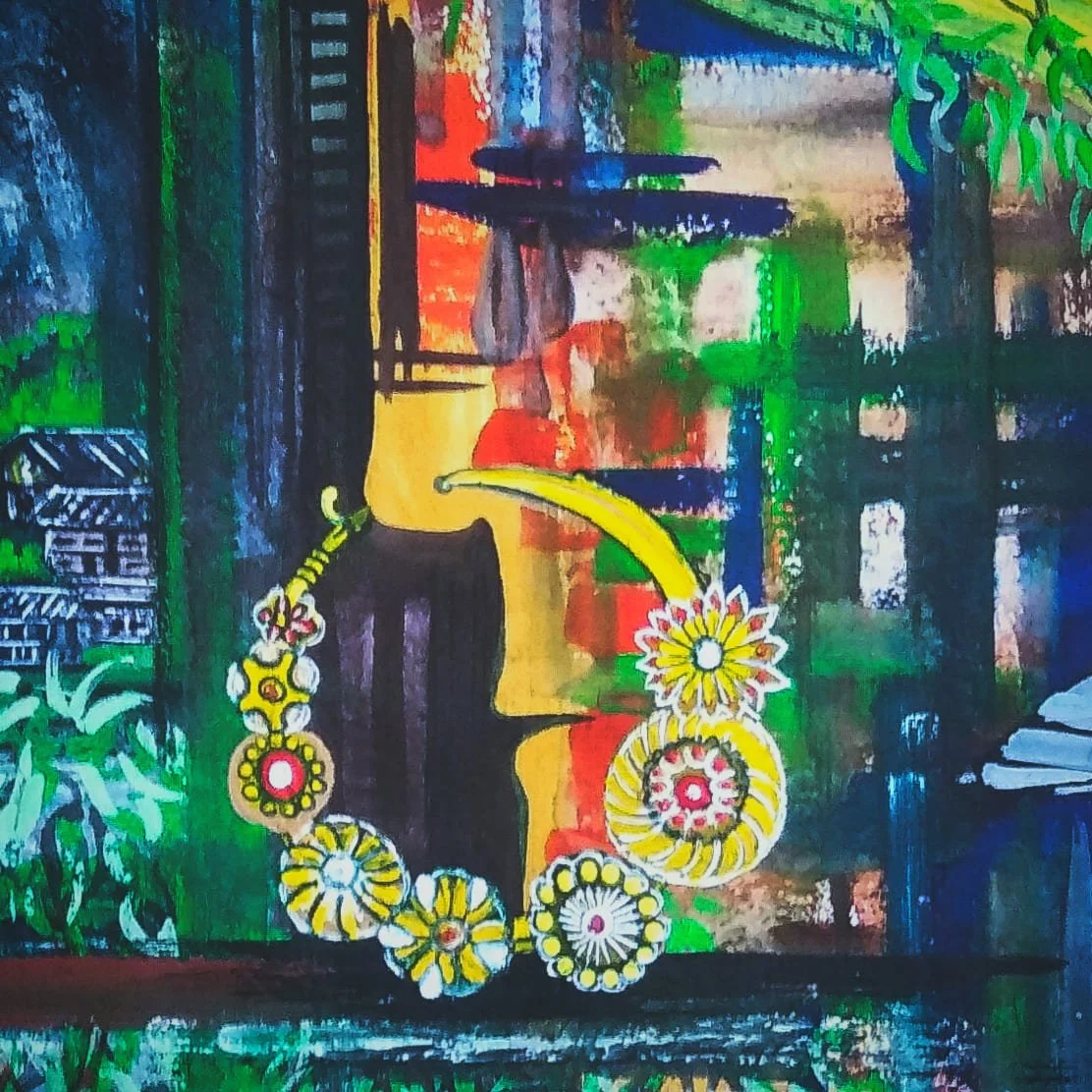
Vivek Chandra Bisht. The Unbearable Pain, 2018. Watercolour on Paper. 22 × 22 in. Image Courtesy of the Artist.
My work has never been driven solely by the desire to create beautiful images. Instead, I have sought to understand how art can preserve cultural memory, inspire imagination, and encourage people to look more deeply at the places they call home. Every painting became an attempt to translate not only what I saw, but also what I felt—the quiet dialogue between landscapes and people, between history and the present, between memory and possibility.
The Himalayas taught me that landscapes are living narratives. They evolve with every generation, shaped by migration, changing lifestyles, environmental challenges, and the aspirations of young people seeking opportunities beyond the mountains. As villages transformed and many traditional homes fell into silence, I found myself asking a question that continues to guide my work:
What role can an artist play when a culture begins to disappear—not suddenly, but gradually, almost invisibly?
Rather than searching for answers through documentation alone, I turned to imagination.
Many of my paintings combine elements of real Himalayan architecture with imagined spaces inspired by vernacular traditions. Instead of reconstructing the past exactly as it was, I explore what heritage might become if it continues to evolve with dignity and creativity. In my work, traditional temples stand beside visionary structures, mountain villages expand into dreamlike cities, and sacred landscapes become spaces where memory and innovation coexist.
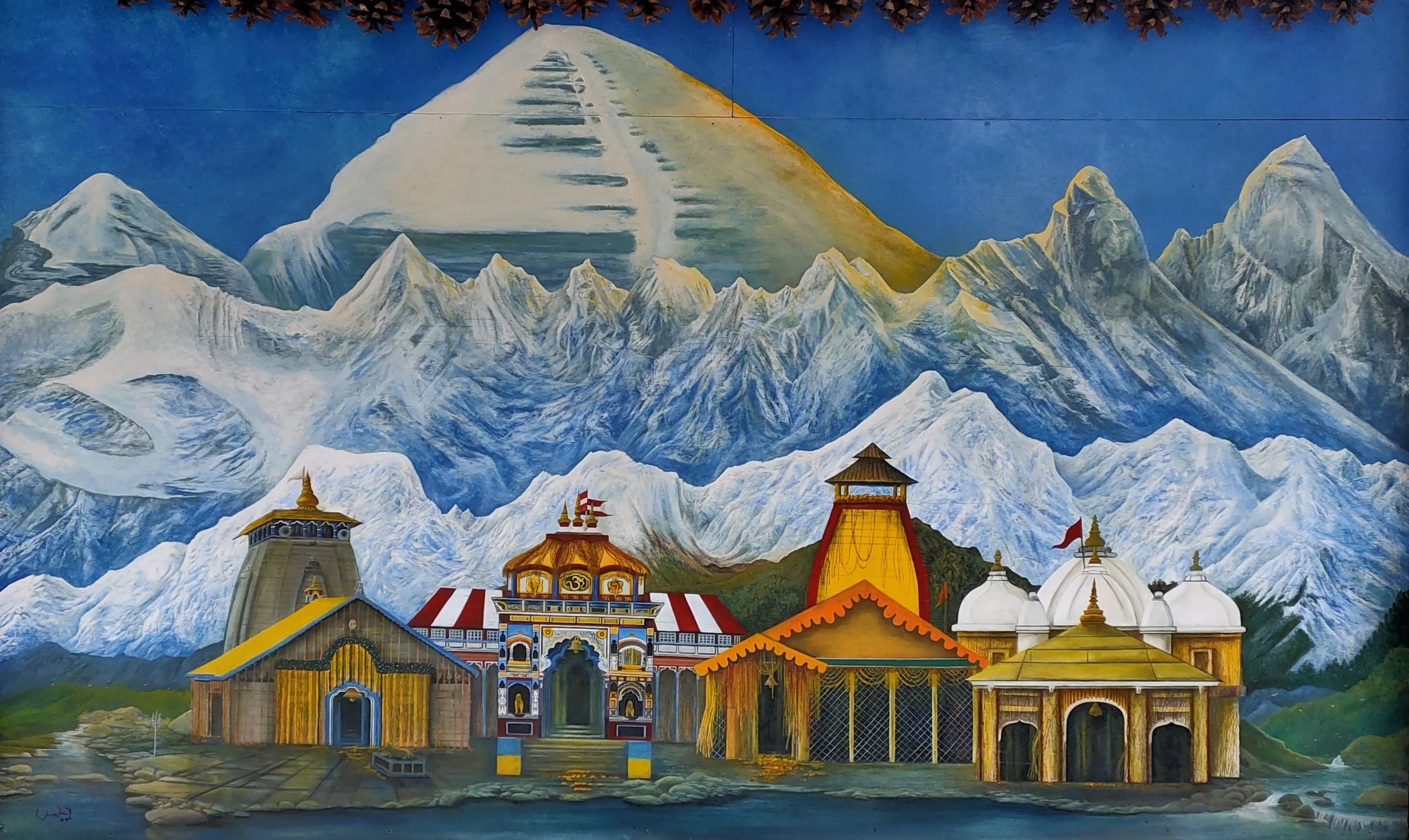
Vivek Chandra Bisht. The CharDham, 2022. Oilcolour on Wooden Panel. 60 × 72 in. Image Courtesy of the Artist.
This dialogue between observation and imagination gradually shaped my own artistic philosophy. I came to believe that preserving heritage does not mean freezing it in time. Living cultures survive because they continue to adapt. Art has the power to participate in that evolution by encouraging people to see familiar traditions through new perspectives.
Alongside my studio practice, I began sharing this philosophy through education.
Teaching art revealed something that painting alone could not. Every student carries a unique way of seeing the world. Technical skills can be taught, but curiosity must be awakened. Whether working with children discovering drawing for the first time or aspiring artists developing their own voices, I found that creativity grows strongest when students begin with their own surroundings.
A mountain path, a village courtyard, an old wooden window, or the changing light across a valley can become powerful lessons in observation, composition, history, and empathy. Through art, students learn not only how to draw, but also how to notice. They begin to understand that creativity starts with paying attention.
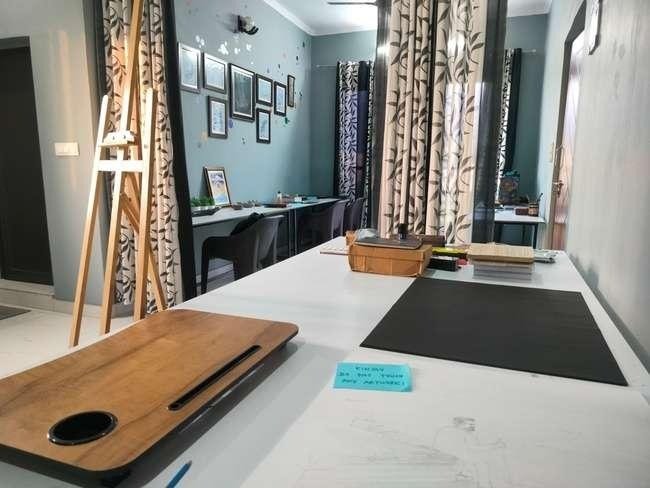
Vivek Chandra Bisht.The Astitvam Studio, Foundry and Mentorship, Image Courtesy of the Artist.
This conviction eventually led to the establishment of Astitvam Studio—a space dedicated to artistic learning, experimentation, and mentorship. More than a classroom, the studio became a place where technical practice met cultural exploration. Here, students are encouraged to develop their own artistic language while remaining connected to the traditions that shaped them. Every workshop, demonstration, and discussion reinforces a simple belief: creativity flourishes when rooted in identity rather than imitation.
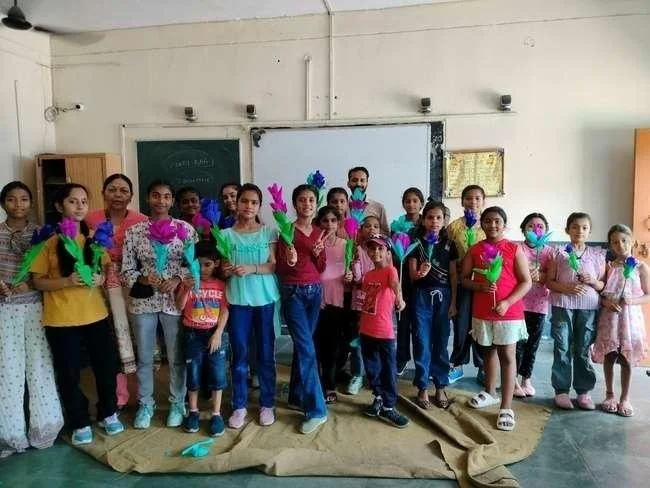
Vivek Chandra Bisht.Workshop with creative students, 2024. Craft to Art Installation. Image Courtesy of the Artist.
As my work evolved, I realised that artistic practice could also contribute beyond individual education. The questions emerging from my paintings—about heritage, sustainability, architecture, and community—naturally expanded into wider conversations.
This vision inspired the creation of Astitvam Foundation, a non-profit initiative committed to cultural preservation, creative education, environmental awareness, and community engagement. The Foundation reflects the belief that art should not remain confined within galleries; it should participate in society. Through educational activities, heritage awareness, and collaborative projects, it seeks to strengthen the relationship between people, culture, and place.
The Foundation's work is guided by the same principle that informs my paintings: preservation is not an act of nostalgia but an investment in the future.
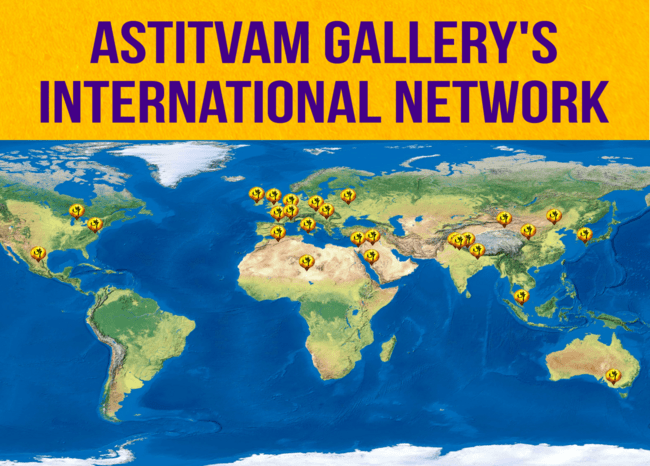
Vivek Chandra Bisht. Astitvam Gallery. Internationally Spreading Spiritual Awareness. Image Courtesy of the Artist.
Complementing this mission is Astitvam Gallery, which serves as a platform for exhibiting original artworks while fostering dialogue between artists, collectors, students, and the wider public. A gallery, in my view, is more than an exhibition space. It is a meeting point where ideas are exchanged, questions are raised, and creative journeys intersect. By presenting works inspired by Himalayan landscapes, architecture, spirituality, and cultural narratives, the gallery aims to connect local experiences with global conversations.
Together, the artist, the mentor, the studio, the gallery, and the Foundation are not separate identities. They are different expressions of the same purpose.
Whether I am standing before a blank canvas, guiding students through their first sketch, curating an exhibition, or discussing cultural preservation with community members, the intention remains unchanged: to encourage deeper connections between creativity, heritage, and human experience.
Looking back, I realise that my journey has never been solely about making art. It has been about learning to listen—to landscapes, to traditions, to communities, and to the quiet voices that often go unnoticed in an increasingly fast-moving world.
The Himalayas continue to teach that every mountain carries memory. The challenge for artists is not merely to represent those memories, but to ensure they continue to inspire the future.
Art as a Living Bridge Between Heritage and Tomorrow
The deeper I travelled into my artistic practice, the more I realised that every painting begins long before the first brushstroke. It begins with observation—with walking through mountain villages, listening to elders recount forgotten stories, studying the craftsmanship of wooden temples, watching clouds reshape familiar peaks, and understanding how architecture, ecology, and community have always existed in conversation with one another.
These experiences transformed my understanding of what it means to be an artist.
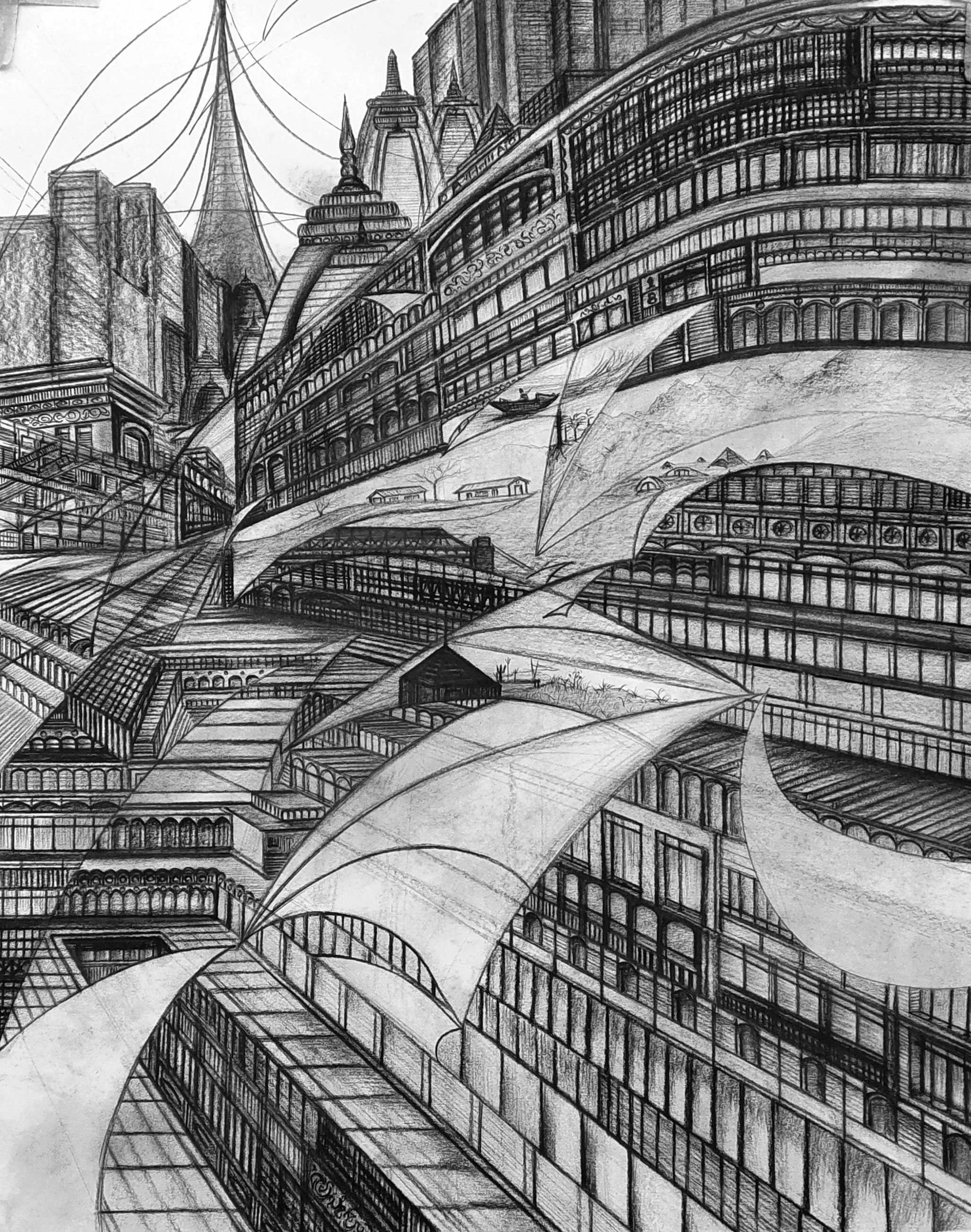
Vivek Chandra Bisht. The Galactic Mirror, 2023. Charcoal on Paper. 22 × 28 in. Image Courtesy of the Artist.
Too often, art is perceived as an individual pursuit, centred on personal expression or aesthetic achievement. While these elements remain important, I have come to believe that creativity also carries a social responsibility. Artists possess a unique ability to preserve memory, ask difficult questions, and imagine futures that have not yet been realised. In regions like the Himalayas, where cultural traditions are evolving under the pressures of migration, urbanisation, and environmental change, this role becomes especially significant.
Rather than documenting heritage as something that belongs exclusively to the past, I seek to explore how it can inspire the future. Traditional Himalayan architecture, for example, is far more than a collection of historic buildings. It represents generations of accumulated knowledge about climate, sustainability, craftsmanship, and community living. Every carved doorway, slate roof, and stone wall reflects an intimate understanding of the landscape.
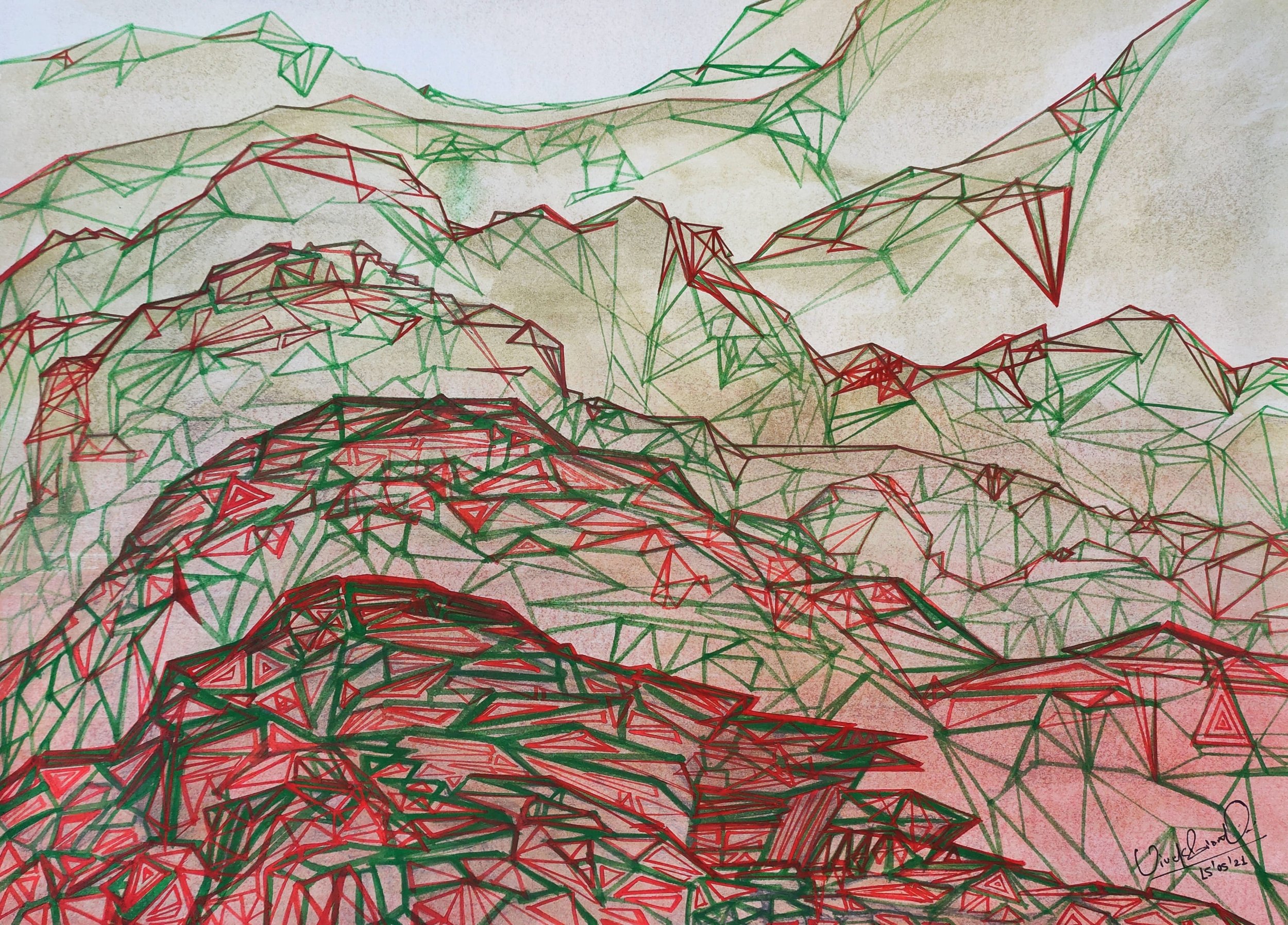
Vivek Chandra Bisht. Evolution Of The Mountains, 2021. Watercolour on Paper. 27 × 33 in. Image Courtesy of the Artist.
In my paintings, these architectural elements are often reimagined within visionary environments. Familiar village forms expand into dreamlike settlements, sacred spaces become symbols of collective memory, and landscapes evolve into imagined worlds where history and innovation coexist. These works are not architectural proposals in a literal sense; they are invitations to reconsider how traditional wisdom might inform contemporary life.
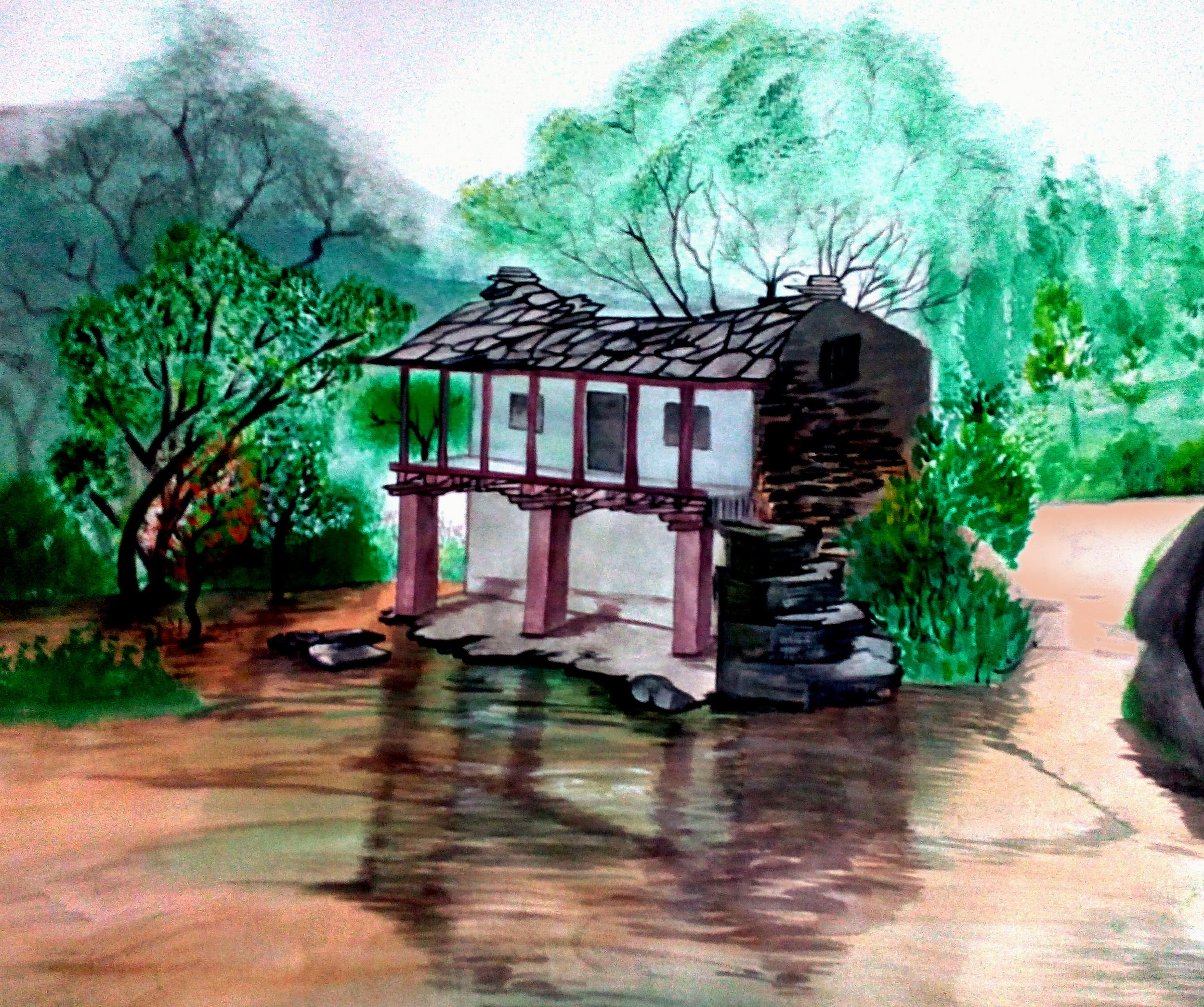
Vivek Chandra Bisht. Broken Home Of Memories, 2017. Watercolour on Paper. 24 × 28 in. Image Courtesy of the Artist.
This process of reimagining has also influenced the development of my artistic language. Rather than limiting myself to representation, I have become increasingly interested in creating visual narratives that combine realism with imagination, observation with symbolism, and cultural memory with conceptual exploration. Each series grows from a dialogue between the visible world and the inner landscape of ideas.
What matters most is not whether a viewer recognises a particular village or monument, but whether the artwork evokes a sense of belonging, curiosity, or reflection. Art becomes meaningful when it encourages us to ask questions: What defines a place? What do we choose to preserve? How can creativity help communities remain connected to their roots while embracing change?
These questions extend beyond the canvas and into education.
Throughout my years as an art mentor, I have learned that teaching is one of the most enduring forms of artistic practice. A painting may inspire hundreds of viewers, but empowering young minds to observe create, and think independently can influence generations. Every student arrives with a unique imagination waiting to be nurtured. My role has never been to create artists in my own image, but to help individuals discover their own creative voice.
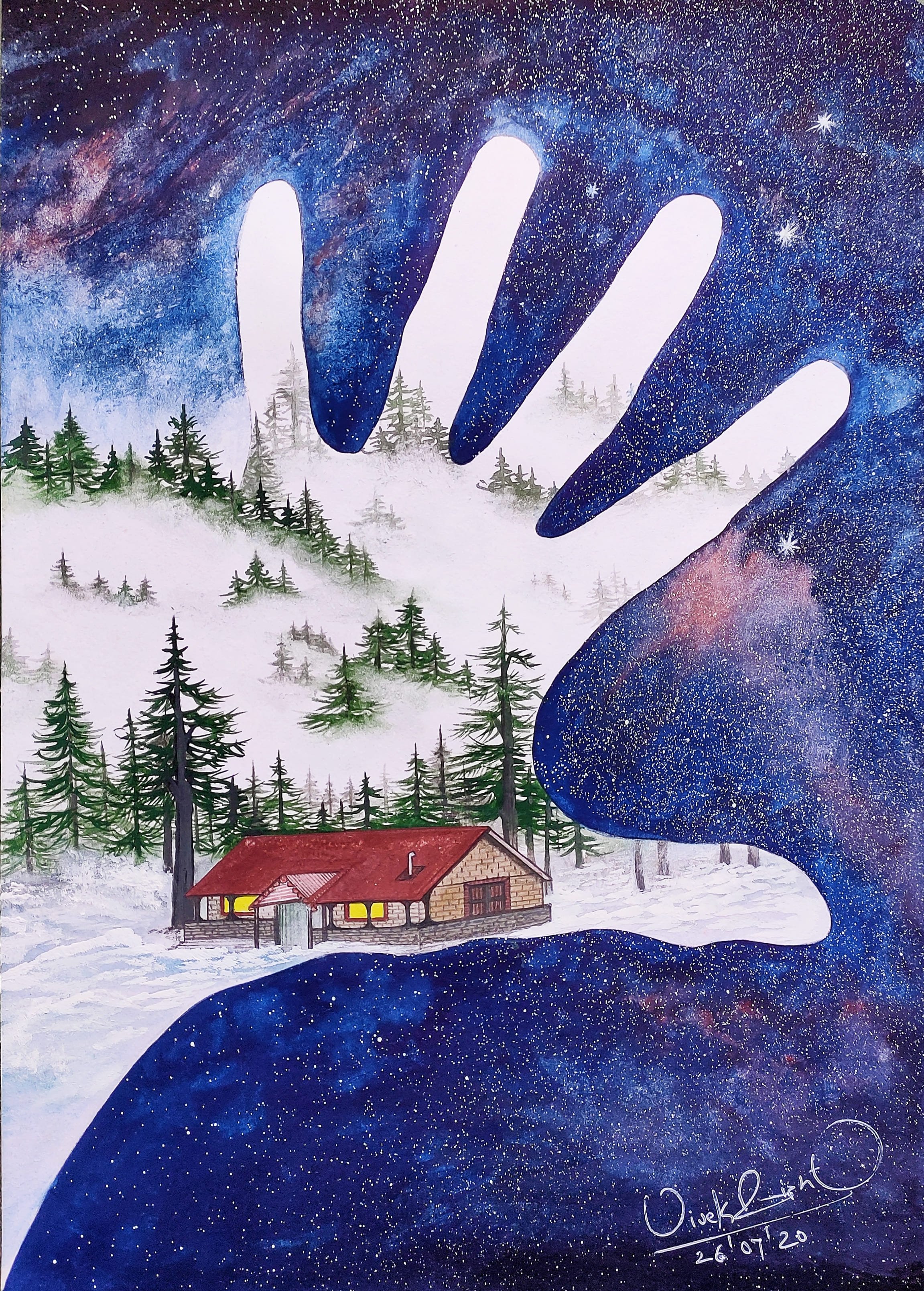
Vivek Chandra Bisht. My World, 2020. Watercolour on Paper. 18 × 26 in. Image Courtesy of the Artist.
Within Astitvam Studio, this philosophy guides every learning experience. Technical discipline is important, yet technique alone cannot produce meaningful art. Students are encouraged to explore drawing, painting, sculpture, mixed media, and conceptual thinking while remaining attentive to the stories embedded within their own surroundings. Creativity begins not with imitation, but with observation.
The same belief informs the work of Astitvam Foundation, where creative education is viewed as a catalyst for broader social and cultural engagement. Through initiatives that encourage heritage awareness, environmental responsibility, community participation, and artistic exploration, the Foundation seeks to demonstrate that creativity is not separate from society—it is one of its essential foundations.
Preserving culture does not simply mean protecting monuments or documenting traditions. It means creating opportunities for people to experience those traditions as living, evolving sources of inspiration. Workshops, exhibitions, conversations, and collaborative projects become spaces where knowledge is shared across generations, allowing heritage to remain dynamic rather than static.
Astitvam Gallery plays an equally important role within this vision. More than a venue for displaying original artworks, it serves as a meeting point between artists, collectors, students, researchers, and visitors who are interested in the cultural narratives of the Himalayas. Every exhibition becomes an opportunity to initiate dialogue—not only about artistic technique, but also about identity, sustainability, architecture, spirituality, and the evolving relationship between people and place.
While my work is deeply rooted in Uttarakhand, the themes it explores are universal. Around the world, communities are asking similar questions about cultural continuity, environmental stewardship, and the preservation of local identity in an increasingly interconnected age. The Himalayan experience therefore becomes part of a much larger conversation, reminding us that every region possesses its own landscapes of memory and its own traditions worth safeguarding.
Looking ahead, my aspiration is not simply to create more paintings. It is to contribute to a broader creative ecosystem in which artists, educators, architects, environmentalists, historians, and local communities collaborate to shape a more thoughtful future. I envision spaces where exhibitions become educational experiences, where young artists engage directly with traditional knowledge, and where creativity inspires meaningful conversations about sustainable development and cultural resilience.
I also hope to strengthen international dialogue around Himalayan art and heritage. Too often, the region is represented primarily through its dramatic scenery. While its natural beauty is extraordinary, the Himalayas also contain a rich intellectual, architectural, and artistic legacy that deserves greater global recognition. Contemporary artists have an opportunity to present these narratives in ways that resonate across cultures, demonstrating that local stories often carry universal significance.
As I reflect upon this journey, I realise that the most valuable lessons have not come from the completed artworks themselves, but from the relationships they have created. Conversations with students, collaborations with communities, encounters with fellow artists, and the quiet moments of observation within the mountains have continually reshaped my understanding of creativity.
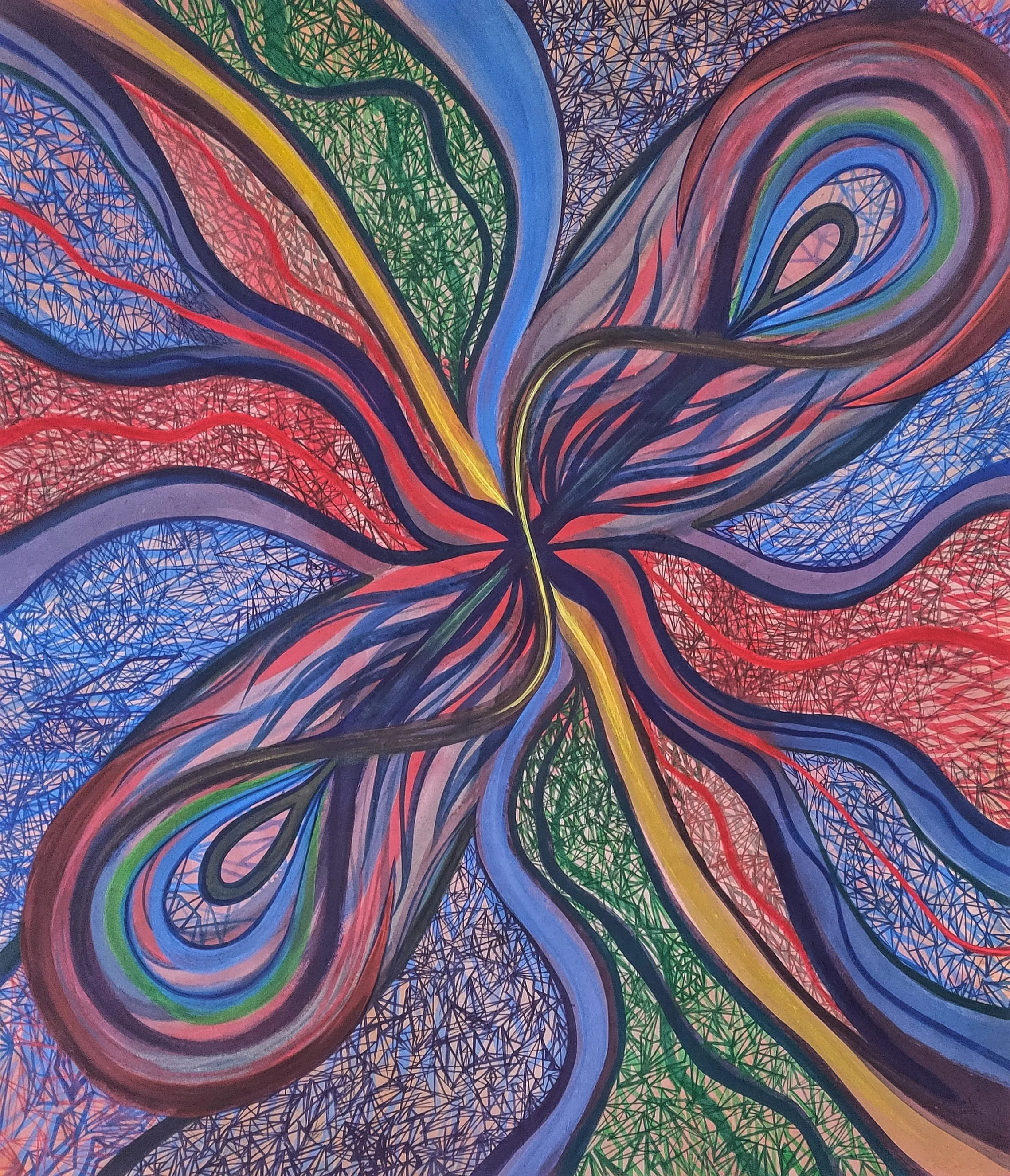
Vivek Chandra Bisht. Limitless Life, 2021. Watercolour on Paper. 22 × 25 in. Image Courtesy of the Artist.
The Himalayas have taught me that every landscape is a classroom, every tradition is a source of innovation, and every act of creation carries the possibility of preserving something far greater than a single image.
Art cannot stop time, nor can it prevent change. What it can do is encourage us to notice what is worth carrying forward. It can remind us that progress becomes more meaningful when it grows from memory rather than replacing it. It can inspire communities to rediscover pride in their heritage while imagining new possibilities for the future.
This, ultimately, is the purpose that continues to guide my work—not simply to paint the Himalayas, but to participate in an ongoing conversation between people, place, and possibility.
Every brushstroke is an echo of the mountains that shaped me. Every lesson shared with a student is an investment in a future where creativity and compassion grow together. Every exhibition is an invitation to look more closely at the stories hidden within our landscapes. And every initiative undertaken through Astitvam Foundation, Astitvam Gallery, and Astitvam Studio is part of a larger belief that art is not only something we create—it is something we live.
If these echoes continue to travel beyond the valleys where they first began, inspiring even a handful of people to see their own cultures with renewed curiosity and care, then the journey has already found its greatest reward.