The Future We’re Carving
When We Allow Wonder to Redefine Boundaries
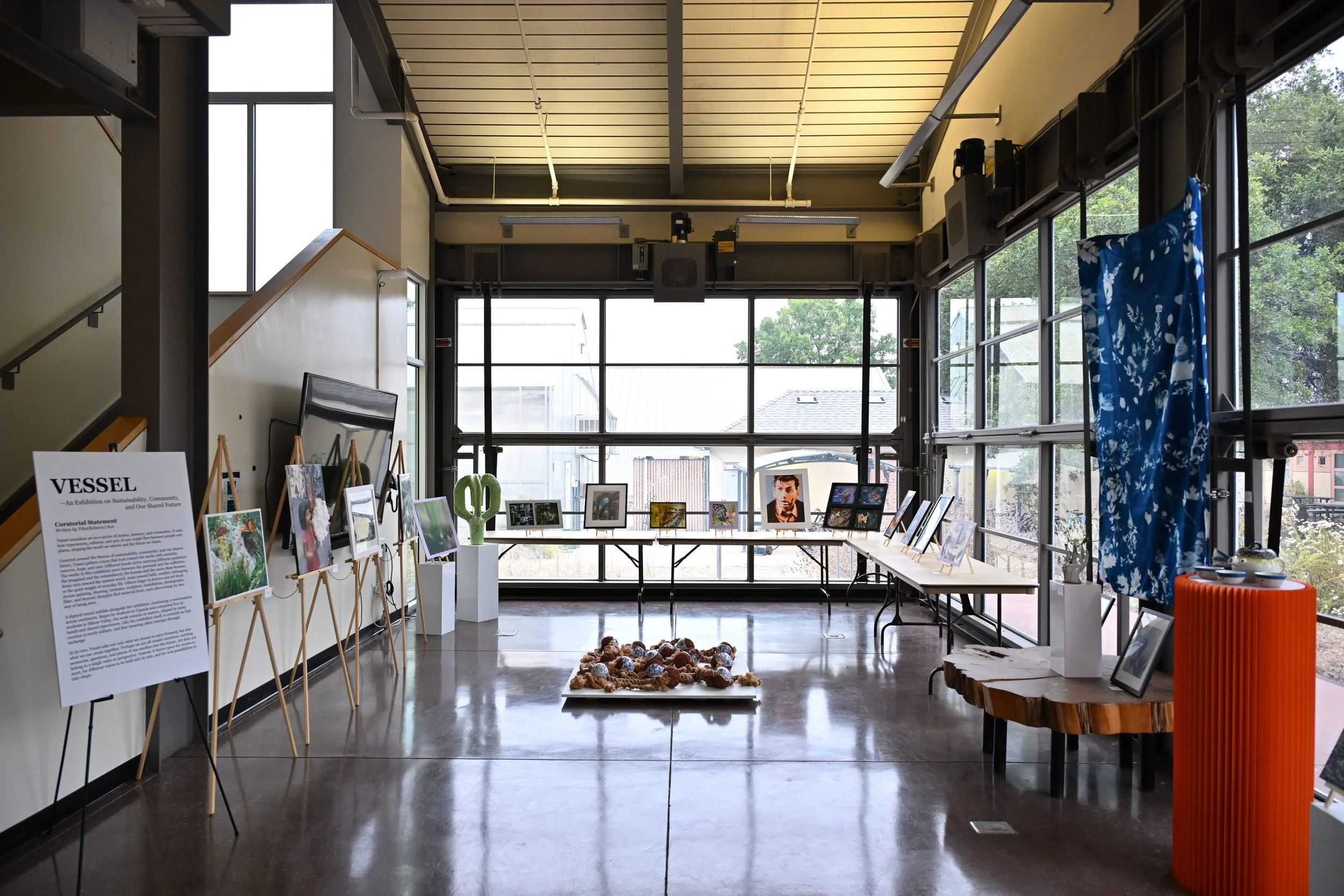
Installation view of VESSEL, 2026. Image Courtesy of the artist and curator.
When I was a kid, I colored the sky purple. I thought tea leaves grew from every tree if the sun hit them right. I believed monsters would strike me if I turned my closet light off. As a young adult, it seems obvious to me now that these beliefs were unfounded, but that doesn’t change the fact that they felt real to me then. Between childhood and adulthood, imagination gives way to reality, and the ways we once saw the world form our daily choices, and in turn, the world we create for ourselves and each other. People become vessels for past generations, our peers, our loves, our mini worlds, and our sweet, sweet memories. We let them linger, allowing them to inform the futures we imagine for ourselves and one another.
Yilin “Rebecca” Sun’s VESSEL brings 22 artists together to explore the past, present, and future as one long, continuous thread connecting people, places, and possibilities. Spanning mediums from ceramics to photography to fiber, the exhibition presents each work as a vessel for the personal story each artist wants to tell about the world we inhabit together. Vessel sets out to capture and extend a sense of community, global collaboration, and a “shared future.” In the process, amidst the individual snapshots, so many of its pieces carry forward their pasts into their futures through the art of remembrance. While VESSEL frames itself around global collaboration and shared futures, many of its artists suggest that those futures are sustained through quieter acts of transmission—of memory, curiosity, and imagination. Through animation of the ordinary, remnants of youth in adulthood, and acts of cross-cultural collaboration, the artists ask us to reconsider what is worth preserving from the past, childhood, our personal histories.
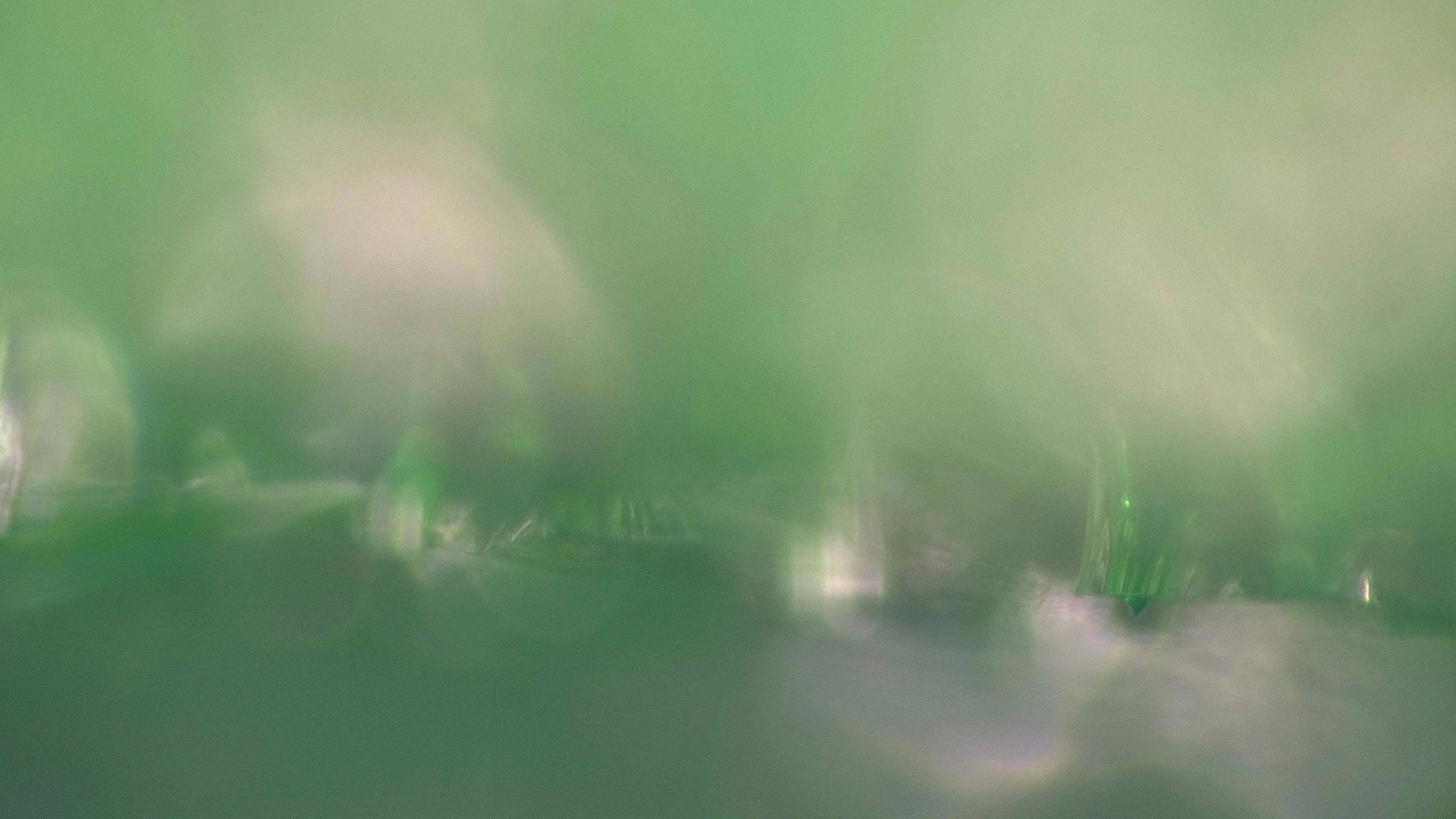
Yijia (Jerry) Sun. Landscape With Two Sponges, Spring, 2025. Archival inkjet print. 16 x 20 in. Image Courtesy of the artist.
Yijia Sun’s micro lens photography is one of the many forms that bring VESSEL to life. The micro lens itself allows us to gaze into a tiny universe the human eye cannot usually touch. In doing so, we're introduced to the sponge as its own dimension. The wispy, almost disorienting texture, the different shades of green blurring together to create a dreamy landscape, and the curiously dainty specks of white allow us to briefly forget where we are and view something beyond its inherent use. Sun stretches our imagination and perception beyond what is meant to be grounded in reality. When I initially think of a sponge, I remember my least favorite chore growing up: washing dishes. To me, it was something I only associated with cleaning; it was something I didn’t even want to touch, but Sun takes that and remasters it through a different lens. What started as utility and necessity transforms into an unfiltered landscape. The transformation feels simple, yet it quietly suggests that changing the future begins with changing the way we see the world immediately around us.
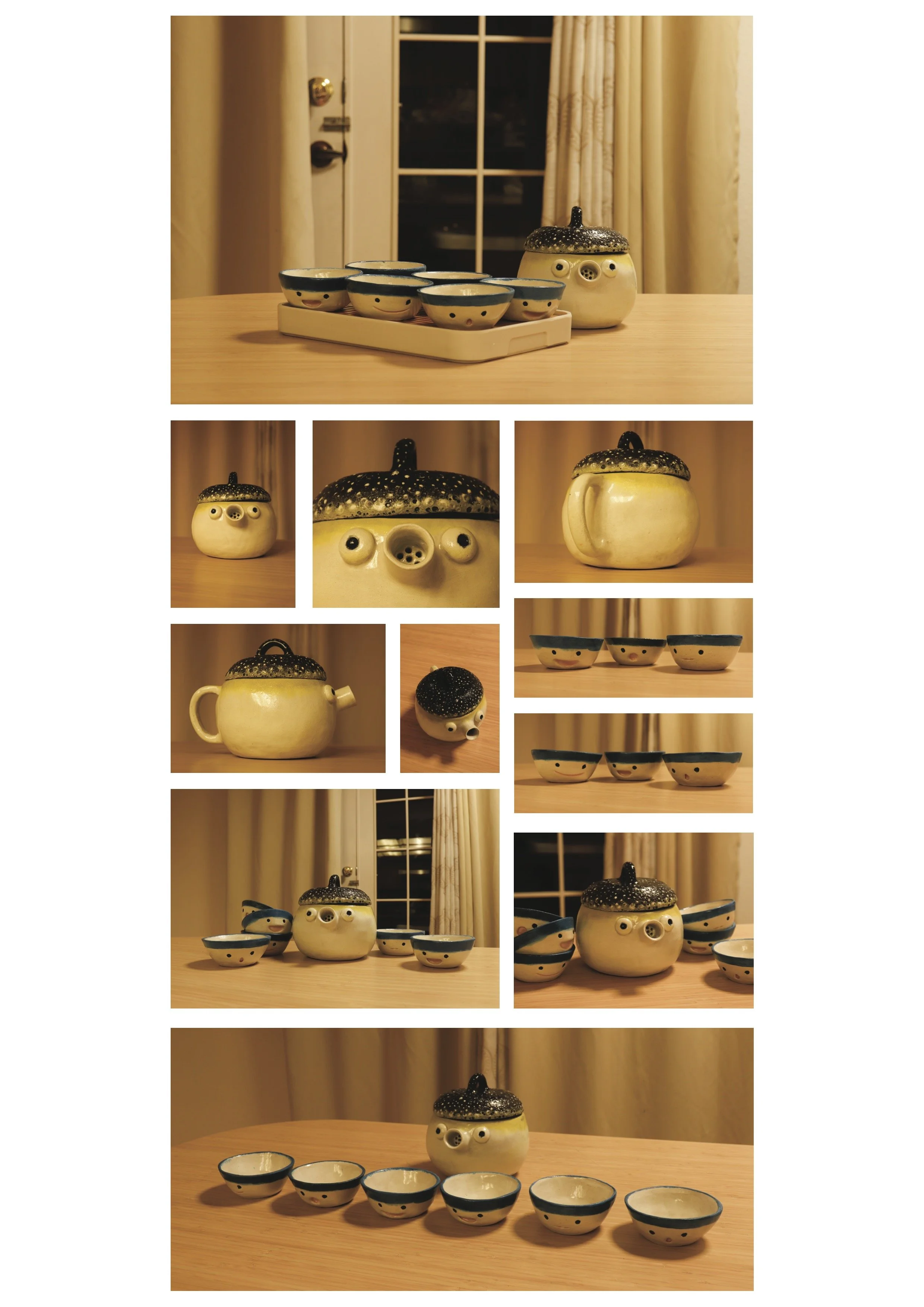
Kai Liu. Whispers of Gentle Tea, 2025. Ceramics. 6 x 8 x 6 in. (teapot). 5 x 5 x 3 inches (teacup). Image Courtesy of the artist.
Liu’s Whispers of a Gentle Tea is the embodiment of wonder and animation in the everyday. Inspired by Hayao Miyazaki’s animated films, Liu uses the ritual of sharing tea, the familiar, as a springboard for bringing life into everyday objects. The playful expressions carved into the bowls personify them as creatures that exude joy: the surprised faces, the smiles, and the rounded, fugu-shaped teapot at the center of it all. Their work is fueled by the idea that ordinary practices and habits still have room for wonder and belong in the world. In Liu’s world, the “mere” object disappears and instead becomes a vessel for innocence, curiosity, color, and imagination. Giving the inanimate object a “spirit” reveals another layer of complexity that may have otherwise gone unrealized. Liu and Sun both reject the notion of intended use, finding new ways to breathe life into the everyday.
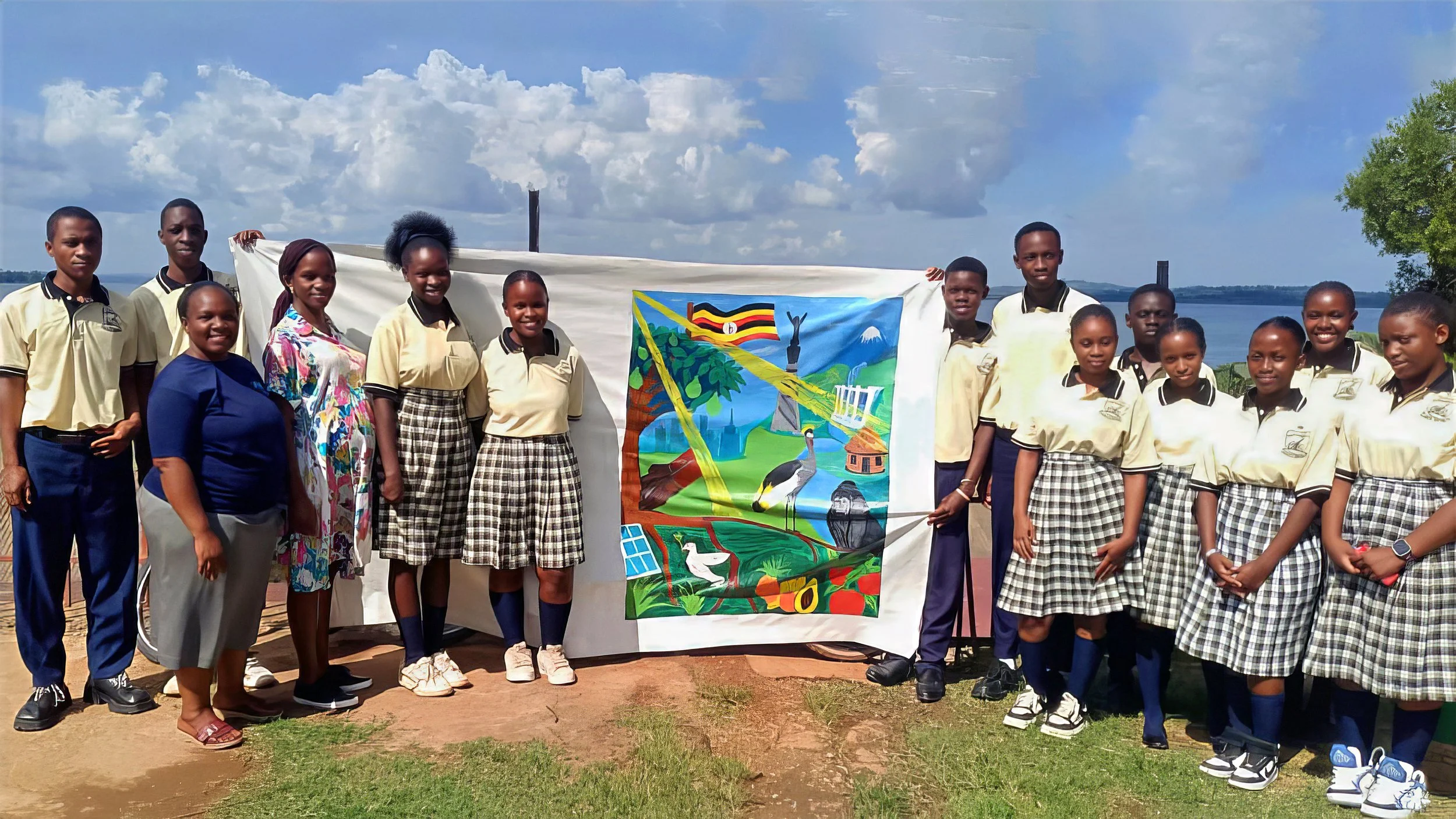
Students in Uganda with their mural for VESSEL. Image Courtesy of the artist.
What started as a mural project by kids in Uganda became a through line, connecting all the way to Silicon Valley. The mural imagines what collaboration can look like before inherited boundaries and ideas take hold, allowing students separated by continents to contribute to the same visual conversation. In the painting, each side depicts life under the same sun and hands reach toward a central tree. The shades of yellows, browns, and blues slightly differ, but they light up the same canvas and the two cultures begin to map their history with one another. Together, these students start and sustain a conversation across continents. The picture shows both flags waving proudly on their respective sides, followed by cultural and landscape markers: grey-crowned crane and bald eagles, Golden Gate Bridge and snowcapped mountains, California poppies and plentiful fruits. There is no true distance between the two places on the map.
In this sense, community thrives and “shared futures” emerge but not without the help of the children who chose to see the world through their lens, unaffected by language, territory, etc. They are unbothered by politics or borders; they simply want to paint a picture of their homes together.
Through active imaginations, vivid memories, and tiny hands, the art becomes its own language, its own vessel. The artists of this exhibit don’t tell us to go back in time again. Instead, it’s about learning to be attentive to what we choose to see, what we gravitate toward, what lingers in our memories and how those ways of seeing shape the future we create together.
A future that we can create alongside our little selves.
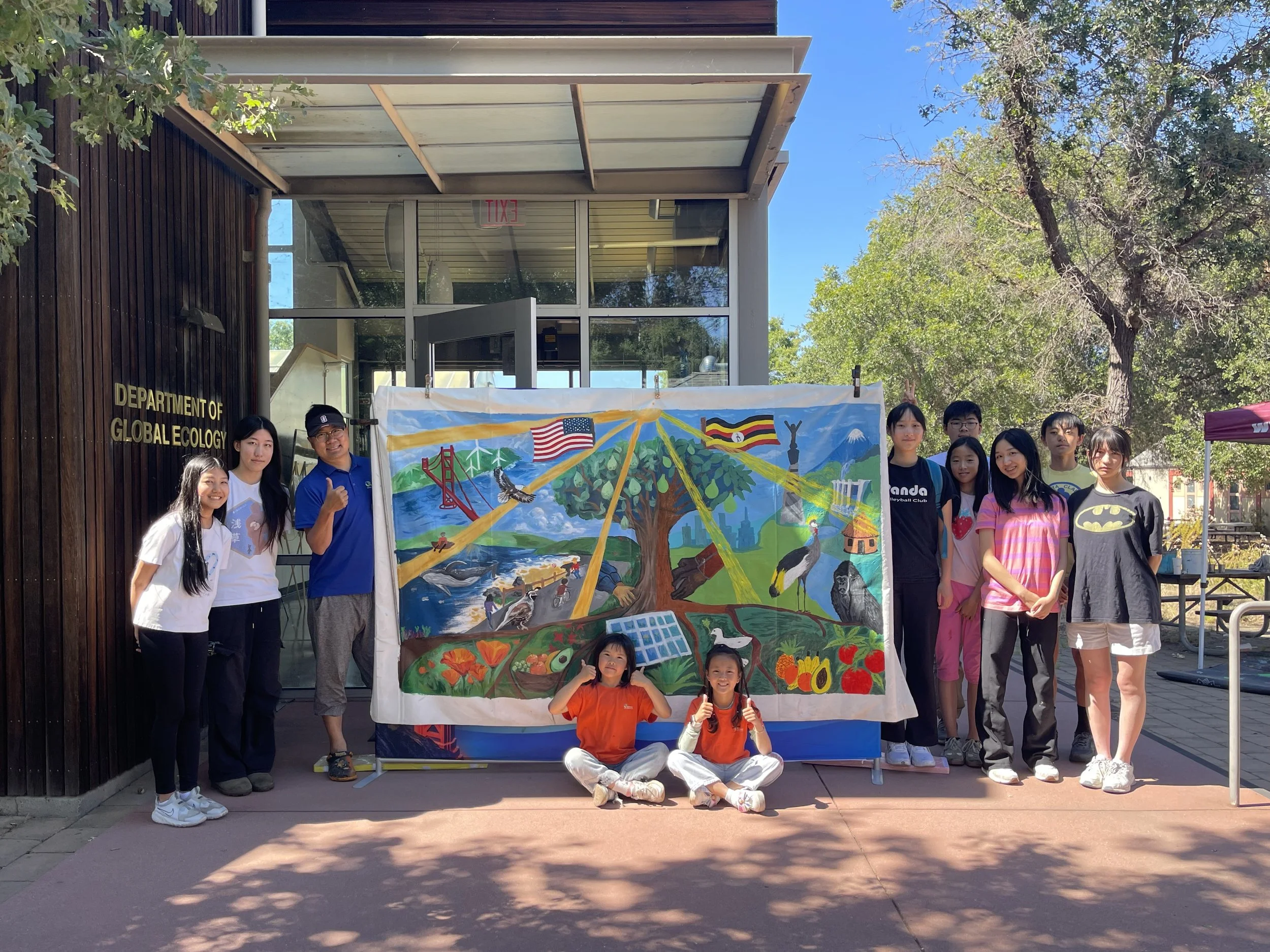
Students in Silicon Valley with their mural for VESSEL. Image Courtesy of the artist.