An interview Communicating across the Oceans
1. Introduction
Chun:
Could you introduce yourself? Where are you from, and where did you study art? When did you first begin to think of yourself as an artist?
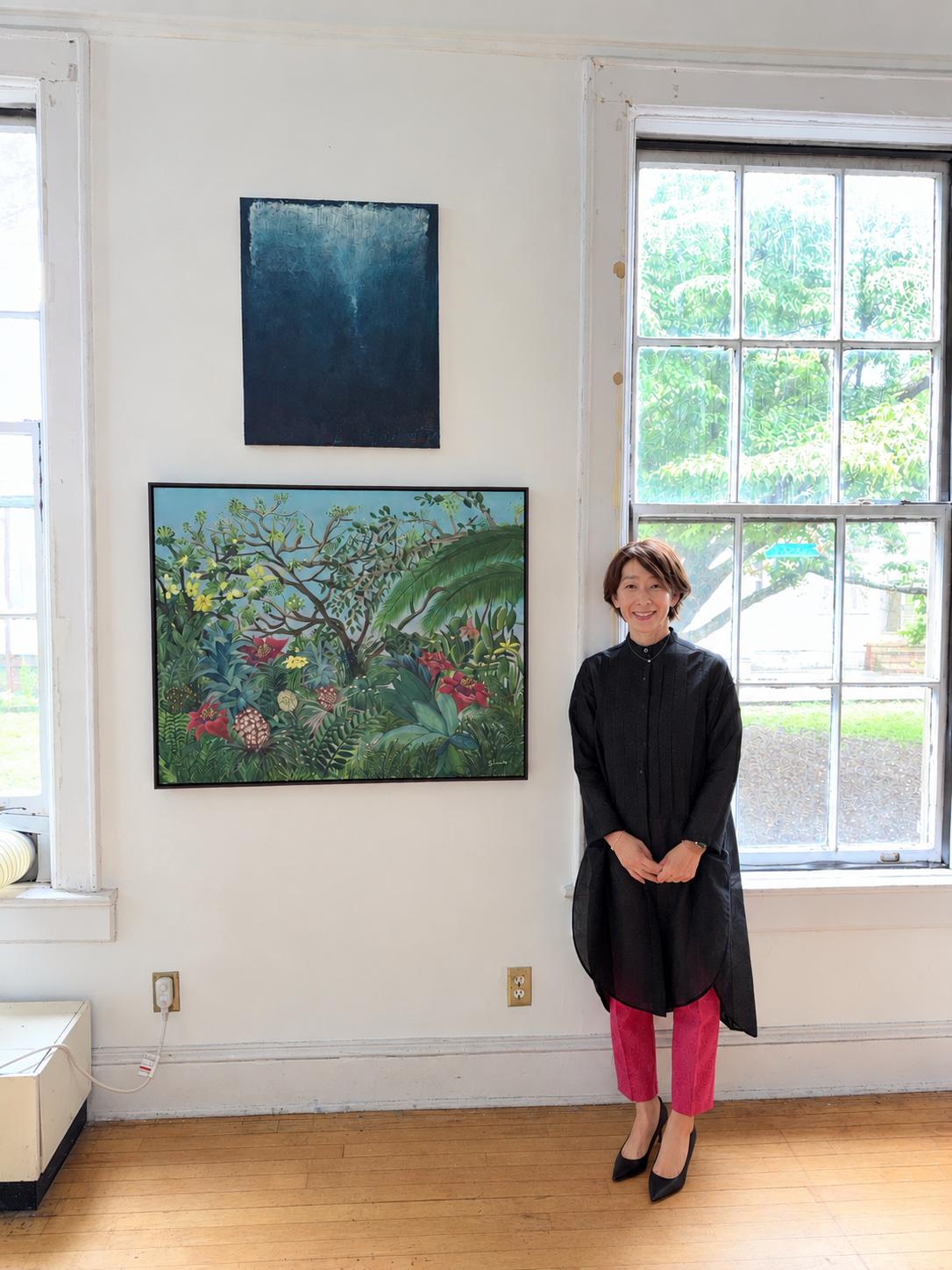
Shinobu Yamada and her work, “Tropical Breath.”
Shinobu:
I am from Wakayama Prefecture, Japan. I have never formally studied art, and I began painting on my own in 2020.
However, I grew up with calligraphy because my mother was a calligraphy teacher. Handling ink and brushes, and sensing the beauty of a line and the life that can reside in a single stroke, were part of my everyday life. I believe that Japanese traditional culture and aesthetics naturally became ingrained in me through these experiences.
I began to think of myself as an artist around 2024. As I continued making art and looking more deeply within myself, I became newly aware of the stillness I feel when drawing a line and the excitement that comes when applying color. I began to feel strongly that I wanted to continue this form of expression throughout my life, and that I hoped my work might leave something meaningful in someone’s heart, however small. That desire was an important turning point in my journey as an artist.
2. Illness and Healing Through Art
Chun:
I understand that your experience with illness led you to artmaking as a form of healing. Could you tell us how this came about?
Shinobu:
The experience of being told, “If we had realized it one day later, your life might have been in danger,” made the act of living feel immediate and profoundly real. I began to recognize how people, plants, and animals were each striving to live, even in landscapes I had previously taken for granted. At times, I could even sense the traces of human activity and the passage of time in seemingly impersonal buildings. These subtle impressions gradually accumulated within me.
Then the COVID-19 pandemic began, a time when everyone was trying to protect their own lives and those of the people they loved. As I spent more time at home, I looked for a way to express the feelings accumulating inside me. One day, almost on a whim, I bought paints online. That was the starting point of my painting practice.
The first thing I painted was a head of broccoli from my refrigerator. I felt an indescribable sense of wonder and excitement as an object before me seemed to come alive once again on paper through my own hand. From then on, I began painting all kinds of things around the house.
When the pandemic eased and I was able to reconnect with the outside world, I took my paintings to an art studio and asked for guidance. Gradually releasing through painting the sense of being alive that had accumulated inside me has become, for me, a profound source of healing and solace.
Chun:
Do you see a connection between your experience and the Japanese concept of shinrin-yoku, or “forest bathing”? What similarities and differences do you see between them?
Shinobu:
I had never directly connected my own experience with the idea of forest bathing. However, I feel there is a deep similarity in the way being in nature and receiving its presence through our senses can transform our inner selves and perceptions.
I enjoy hiking, and whenever I enter a forest, I feel the overwhelming power of life. The massive trunks, leaves swaying in the wind, carpets of moss underfoot, and the sound of wind moving through the trees all provide energy that is an important source for my work.
Yet what I receive from nature is not simply a gentle sense of peace. Last year, while I was on Yakushima as a typhoon approached, access restrictions were imposed shortly after we entered the mountains. I had the unusual opportunity to spend two days in a silent forest where there were probably only a few people. With no phone signal, I spent a night in a mountain shelter listening to thunder and violent rain and wind. The following morning, after the rain had stopped, I stood before a gigantic yakusugi cedar in the stillness and felt the overwhelming majesty of nature on a scale that seemed to open every pore of my body.
If forest bathing is an activity that gently restores the mind and body, then nature, for me, also confronts us with the limits of human power and the primal force of life that continues to thrive regardless. The almost awe-filled feeling I experienced that morning has not yet become a work of art, but it continues to wait quietly within me, like a seed awaiting the moment to sprout.
3. The Metaphors of “Breath” and “Flow”
Chun:
What significance do the metaphors of “Breath” and “Flow” have in your paintings? How are these two concepts connected?
Shinobu:
For me, “Breath” is the smallest unit of life and the beginning of the circulation that connects the inner and outer worlds. Inhaling and exhaling are the most primal proof that I am alive here and now, and the smallest dialogue through which I exchange life with the world.
“Flow,” on the other hand, is the continuity of time woven by breathing, the movement through which life circulates. As each breath accumulates, blood moves, emotions shift, and time passes; eventually, this expands into a broader relationship—a harmony—with all things.
The two cannot be separated. The quiet, individual movement of a point represented by “Breath” develops into the dynamic linear movement of “Flow.” In my paintings, the variations in the thickness of a single brushstroke and the movement of the paint embody “Breath.” When these elements emerge as the composition and rhythm that envelop the entire canvas, they become “Flow.” They express different aspects of life—the “momentary flash” of a point and the “eternal process” of a line—while resonating deeply with one another.
4. Tropical Breath (2025)
Chun:
Could you tell us about Tropical Breath (2025)? How did your visit to Sri Lanka affect you physically and emotionally, both as someone seeking healing and as an artist? What artistic influences shaped this work?
Shinobu:
The main purpose of my visit to Sri Lanka was to explore the buildings designed by architect Geoffrey Bawa and experience the spaces he created. During the trip, I also had the opportunity to visit Brief Garden, the garden created by his brother, Bevis Bawa.
The garden felt like a small forest with a will of its own. Although carefully maintained, it was a place where plants seemed free to flourish according to their own life force. Branches curved in broad arcs, vivid flowers glowed at ground level, and tropical plants spread their leaves toward the light, overlapping one another. Standing there, I could sense the long history accumulated in the garden, as well as the traces of the people who had once lived there.
I felt deeply nourished and, at the same time, as though I had been cleansed by the fresh energy of life. Through the vivid forms of the plants, the idea of “living”—which had previously existed in me as an abstract concept—suddenly became tangible and vivid.
Tropical Breath does not reproduce any one specific landscape. Instead, I reconstructed memories of the plants I encountered at Brief Garden, hotel gardens, and nature reserves. I brought the density of interwoven branches and leaves, and the interplay of their energies, into the composition. In this way, I gave form to the powerful breath of tropical life that I experienced during my travels.
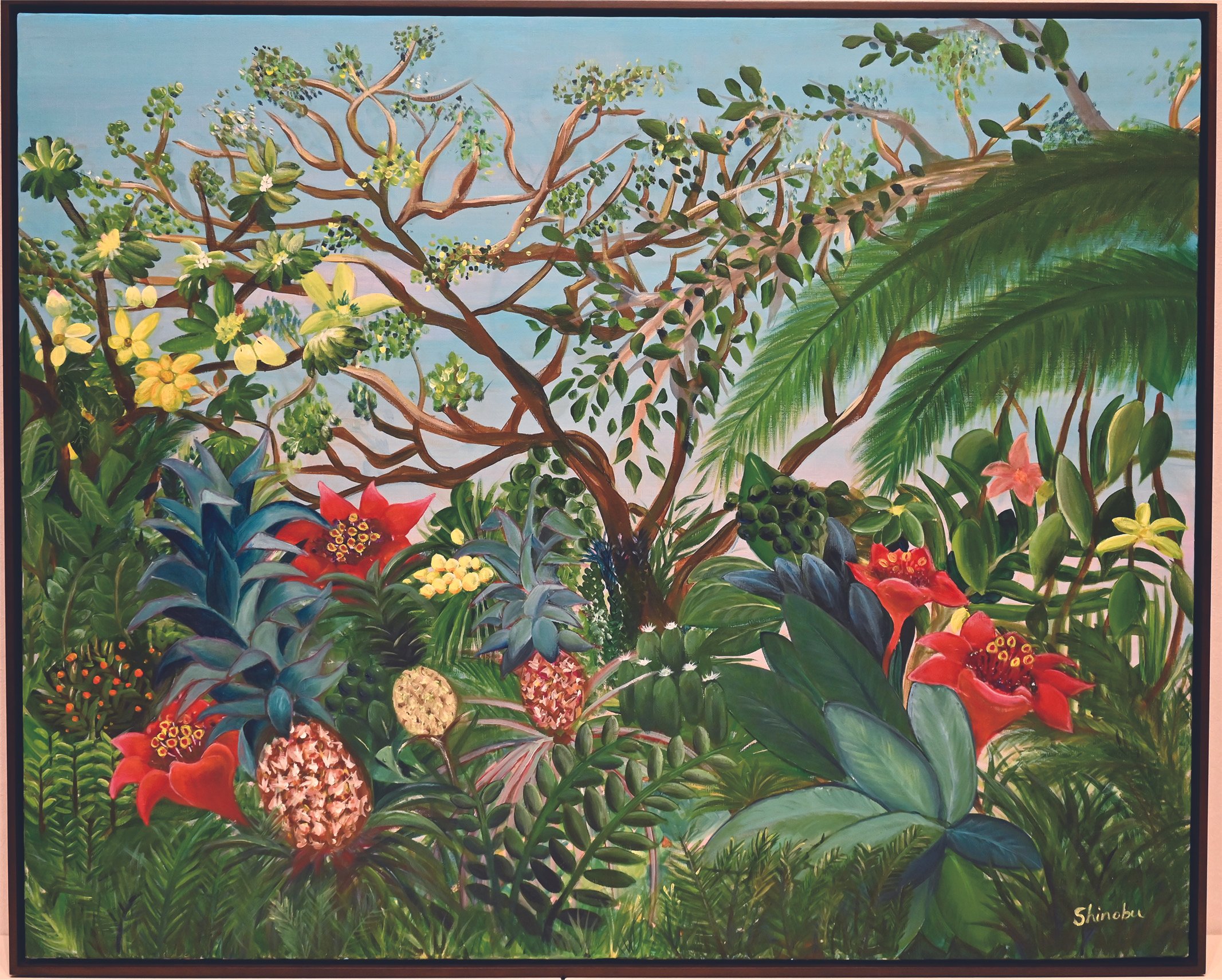
Shinobu Yamada - Tropical Breath (2025), acrylic on canvas, 43 × 35.8 inches.
5. His World (2024)
Chun:
Could you tell us about His World (2024)? Why are the bubbles underwater depicted like pebbles or rocks? What led you to give tangible, solid form to bubbles, which are usually fleeting phenomena that disappear in an instant?
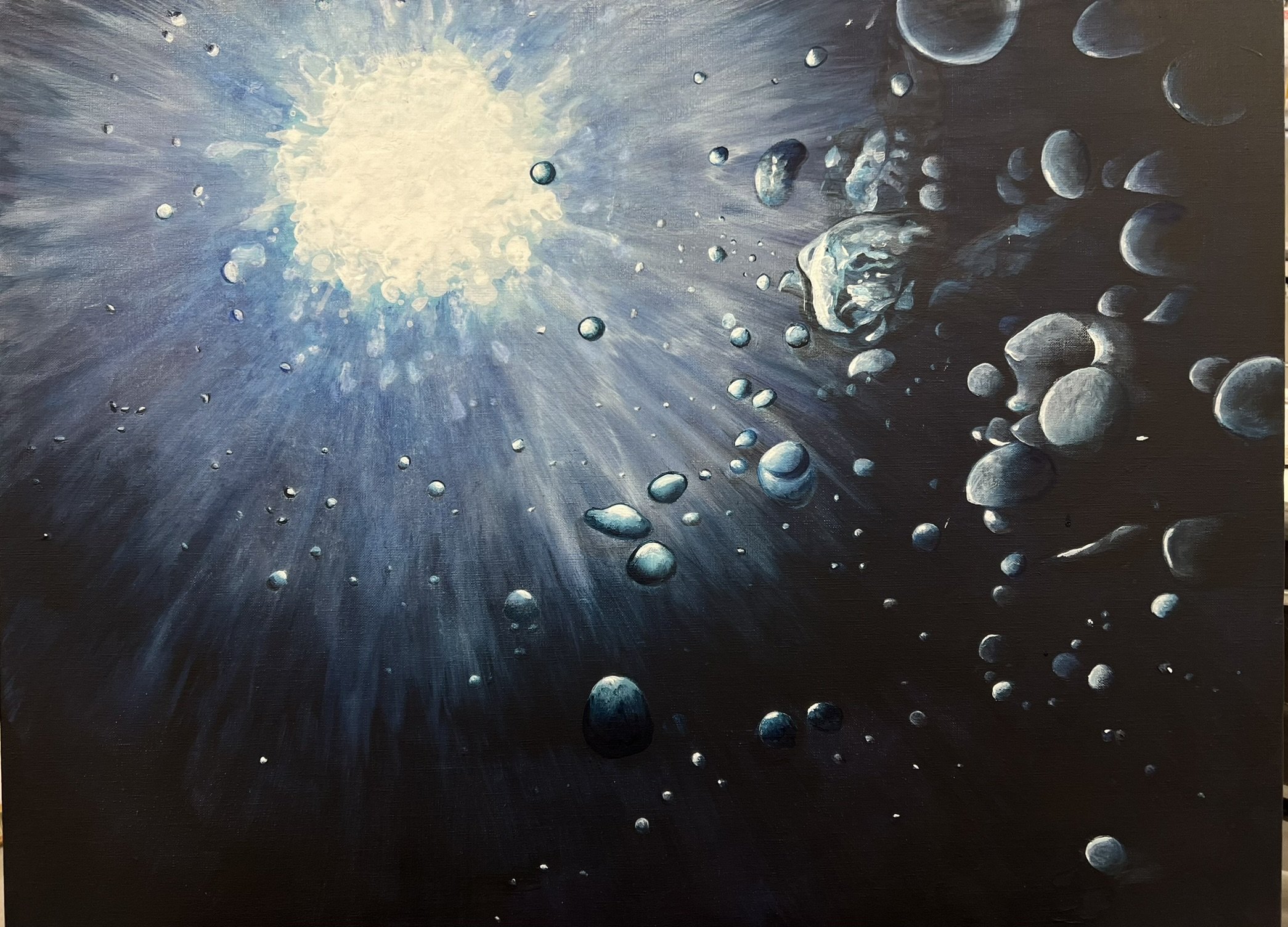
Shinobu Yamada - His World (2024), acrylic on canvas, 39.4 x 31.5 inches
Shinobu:
His World was inspired by an underwater photograph taken by my son, who loves diving. I initially began painting it because I wanted to understand what drew him so strongly to the sea. As I engaged with the photograph, however, I became captivated by that world myself and eventually began diving.
When I first went underwater, what moved me most was the sight of the bubbles from my own breath rising toward the surface. On land, we breathe unconsciously; underwater, breath becomes the only lifeline that sustains us, and it even affects our buoyancy and depth. I intuitively realized that the essence of being alive lies in this single breath.
Bubbles are extremely fleeting: they change shape within seconds and disappear when they reach the surface. Yet in that brief moment, they hold the light and rise with distinct contours, swaying delicately as if dancing. They possess a powerful presence, almost as though they could be touched.
I painted the bubbles on the canvas with the visual weight of pebbles or rocks, not because I wanted to turn them into minerals, but because I wanted to express the certainty of life and the weight of existence contained in a fleeting breath. The bubbles’ path toward the surface, wavering yet determined, also reminds me of the course of a human life.
Now, while other divers are drawn to fish and underwater terrain, I find myself watching the sparkle of the bubbles I release. For me, too, observing those momentary bubbles is a precious experience that allows me to feel deeply that I am alive in the present.
6. Echoes of a Presence (2026)
Chun:
Could you tell us about Echoes of a Presence (2026)? What aspects of New York City made a strong impression on you and changed how you perceive the world and yourself? How did you seek to express those thoughts and feelings in this painting?
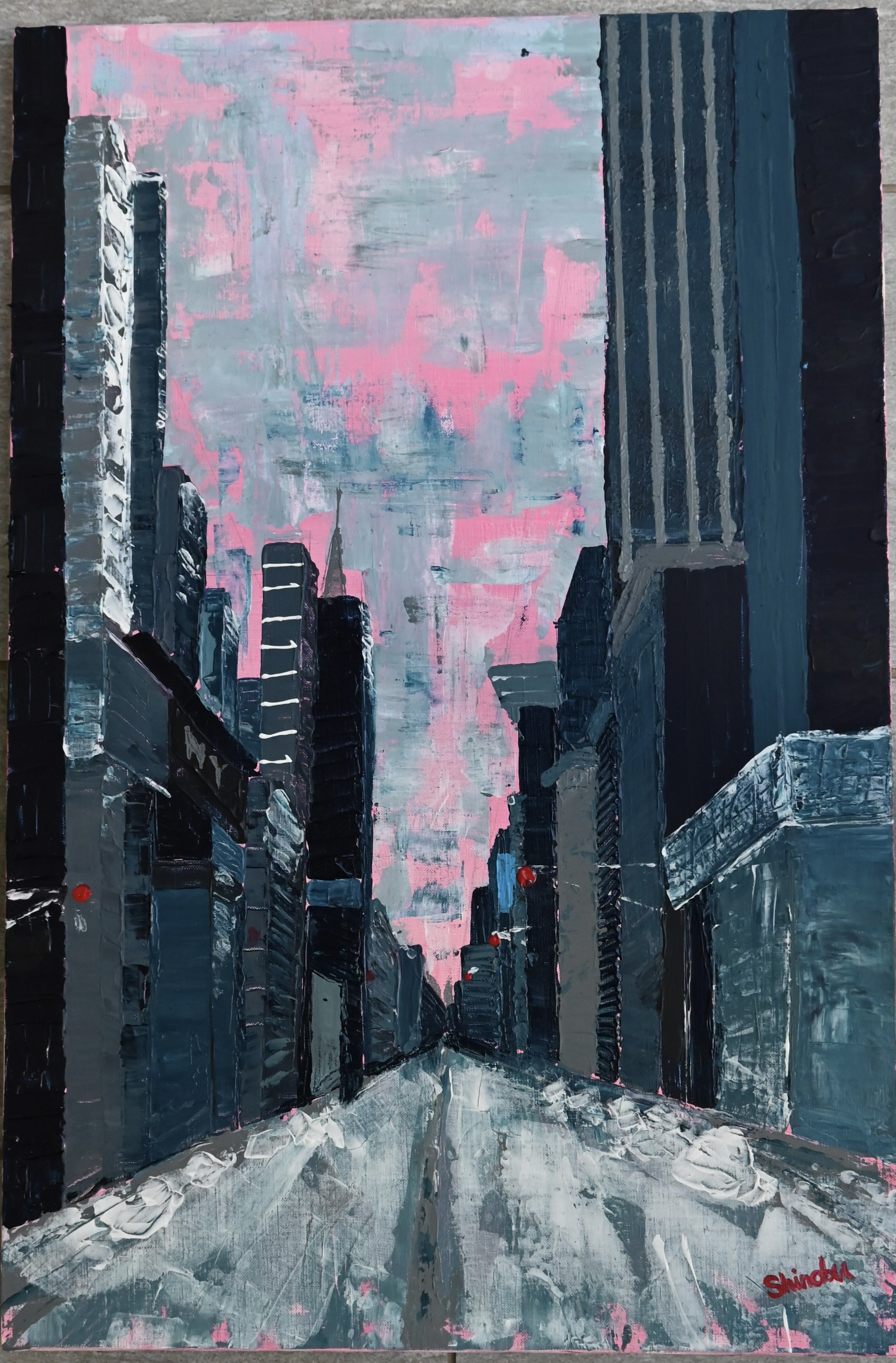
Shinobu Yamada - Echoes of a Presence (2026), mixed media on canvas, 20.9 x 31.7 inches.
Shinobu:
This work grew out of an experience I had while walking through the city in the early morning, after snow that had fallen throughout the night finally stopped.
New York is known as “the city that never sleeps,” but in the hours before dawn, a moment of silence arrives—a deep breath before a new day begins. Just before people start moving, the streets hold a crystalline tension. Faint light filters between skyscrapers, the sky changes color by the minute, and a quiet presence fills the streets. It all felt like the moment when an enormous living organism—the city itself—slowly begins to breathe.
That morning, I realized that immense life energy pulses not only in people and nature, but also in the very structure of a city. Even when unseen, the presence of the lives and activities of the people who inhabit it filled the entire city.
In the painting, I expressed movement rising from deep within the silence through the vivid contrast between deep indigo, which symbolizes the solidity of buildings, and the pink and pale light entering the sky. The city, wrapped in the stillness of snow, awakens and begins to beat powerfully once again. I sought to capture that quiet yet forceful breath—the echoes of its life.
7. Haru (2025)
Chun:
Haru (2025) depicts a vast landscape covered in snow or ice. Was it based on a landscape you saw in person or in a photograph, or did it emerge from memory or imagination? What artistic intention lies behind this beautiful landscape, which also feels cold and barren?
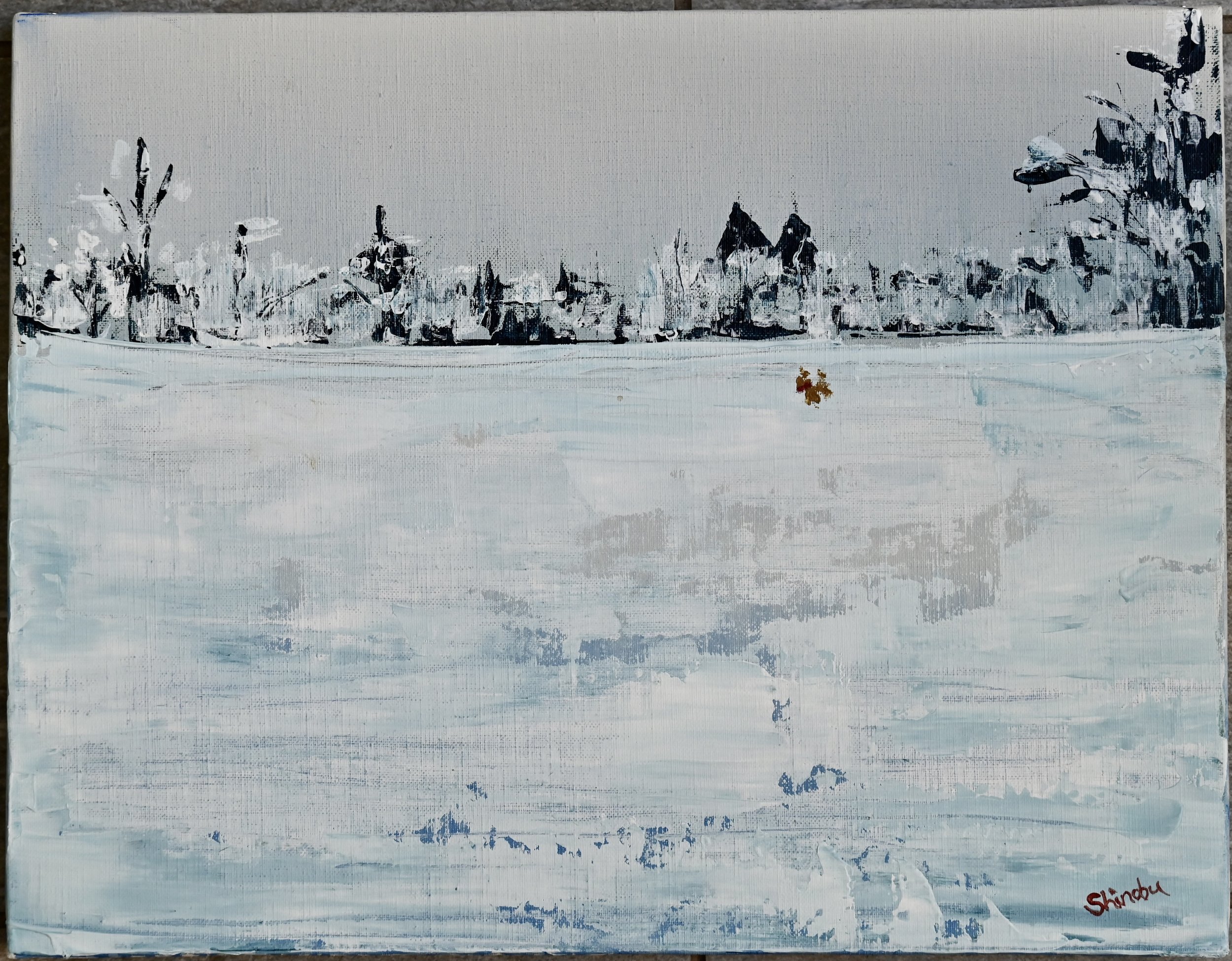
Shinobu Yamada - Haru (2025), acrylic on canvas, 16.1 × 12.6 inches.
Shinobu:
I based this work on a photograph of a landscape I saw in person. It captures the scene when I stepped out with my dog, Haru, into a seemingly endless silver-white world after heavy snow had fallen all night. The following morning, heavy clouds still hung overhead.
Haru is a large dog, yet against the vast snowfield stretching in every direction and the deep forest looming behind it, he looked surprisingly small and fragile. As I watched him run into the white expanse, I felt a fleeting fear that he might be swallowed up and disappear into the overwhelming natural world. But Haru was enjoying the snow with his whole body, running around full of joy. Seeing his vitality filled me with deep affection and gratitude for being able to live within nature’s embrace.
In the painting, I carefully rendered the straight lines formed by the snowfield and forest, the intricate contours of the snow’s surface, and the subtle gradations where the sky and snow seem to dissolve into one another.
Even within the austere natural world, with its freezing cold and desolation, the joy of life is undeniably pulsing. The painting captures the beauty of that morning, when the overwhelming grandeur of nature—against which humans cannot prevail—and the preciousness of a small life shining powerfully within it intersected.
8. Between Abstraction and Representation
Chun:
Do you consider yourself an abstract or a representational painter? Or do you prefer not to be confined to a particular form or category, in order to preserve your freedom as an artist?
Shinobu:
When I approach a work, I have never thought of myself in terms of the categories of “abstract” or “representational.” What matters most to me is not classification, but what I receive from the subject before me and how I can bring its invisible essence to life on the canvas. The starting point is an experience that moves me deeply—something I find endearing, beautiful, or intriguing. Yet I want to paint more than the subject’s outward form: I want to convey the air and light surrounding it, the passage of time, and the subtle presence that quietly lingers.
Even when I paint recognizable subjects such as plants or city streets, what I truly want to express is the life force and breath I sense within them. As I move my brush in pursuit of these invisible sensations, the concrete forms may remain intact, or the colors, lines, and material textures themselves may take center stage and become abstract.
Rather than placing myself within an existing category, I want to explore freely, each time, the means of expression best suited to the theme or feeling I wish to convey. For me, abstraction and representation are not opposites; they exist along a continuum in the process of translating sensation into expression.
9. Artists Who Have Influenced You
Chun:
Which Japanese and non-Japanese artists do you particularly admire, and why? How have their artistic ideas and works influenced your own practice?
Shinobu:
Three artists who deeply inspire me are Japanese painter Isson Tanaka, Mark Rothko, and Henri Rousseau.
In Isson Tanaka’s work, I feel that the plants and birds he painted amid the nature of Amami are vividly alive, each possessing its own precious life. I admire his sincere, deeply attentive gaze toward his subjects, and I too hope to portray not only the forms of plants but also the dignity of life that lies within them.
Mark Rothko’s paintings have an extraordinary power to act directly on the viewer’s inner world through color itself. The experience of colors overlapping and expanding, resonating emotionally beyond verbal explanation or recognizable form, is an important guide as I try to paint things without a visible form, such as “Breath” and “the presence of existence.”
The jungles and plants in Henri Rousseau’s paintings have an intense presence, as if every leaf were alive with its own will, and they evoke a world of distinctive fantasy. I am deeply drawn to his ability to create a vivid world of life within a painting rather than merely reproducing reality.
I do not seek to imitate any particular technique from these three artists. Rather, through engaging with their work, I rediscover what moves my soul in art. I hope to continue painting visible forms while carefully expressing the “wordless melody of life” that lies deep within them.
10. Future Directions and Lessons Learned
Chun:
Where would you like to go from here as an artist? How do you imagine yourself five years from now? What are the most important lessons or insights you have gained through your artistic experience?
Shinobu:
I want to continue exploring the fundamental themes of “being alive” and “breath” through my own experiences. Whether in the profound workings of nature or amid the bustle of a large city, there are moments when the presence of life suddenly becomes vivid. I want to remain attentive to these delicate sensations and continue developing my ability to express them more deeply and vividly through color, line, and material texture.
Another theme I hope to explore further is the fusion of Eastern materials, such as washi paper and sumi ink, which I have known since childhood, with the global sensibility I experience through the sea and the landscapes I encounter on my travels. I am interested in how the natural traces held within the materials resonate with the abstract lines and colors I add by hand, creating new spaces.
I have not set a fixed image of who I will be five years from now. I hope to remain an artist with a firm inner compass while staying flexible and open to unfamiliar experiences and encounters. Whenever my work is exhibited, I want to see how the “breath of life” embedded in it reaches and resonates with people from different cultures and backgrounds.
The deepest insight I have gained through making art is that “it is only through the act of painting that I come to understand what I have perceived.” Feelings within me that I could not put into words gradually reveal their true form as I apply color to the canvas and move the brush. For me, painting is an act akin to prayer: a way to understand myself more deeply while reaffirming my connection to the world.
I will continue to face the truths of life that I encounter at each moment, and to create works with depth that allow viewers to quietly bring their own memories and sensations to the experience.