Review: Rachel Macfarlane’s Portraits of Mother Nature
A Painter of the Light and Shadow of Mother Nature's Embrace
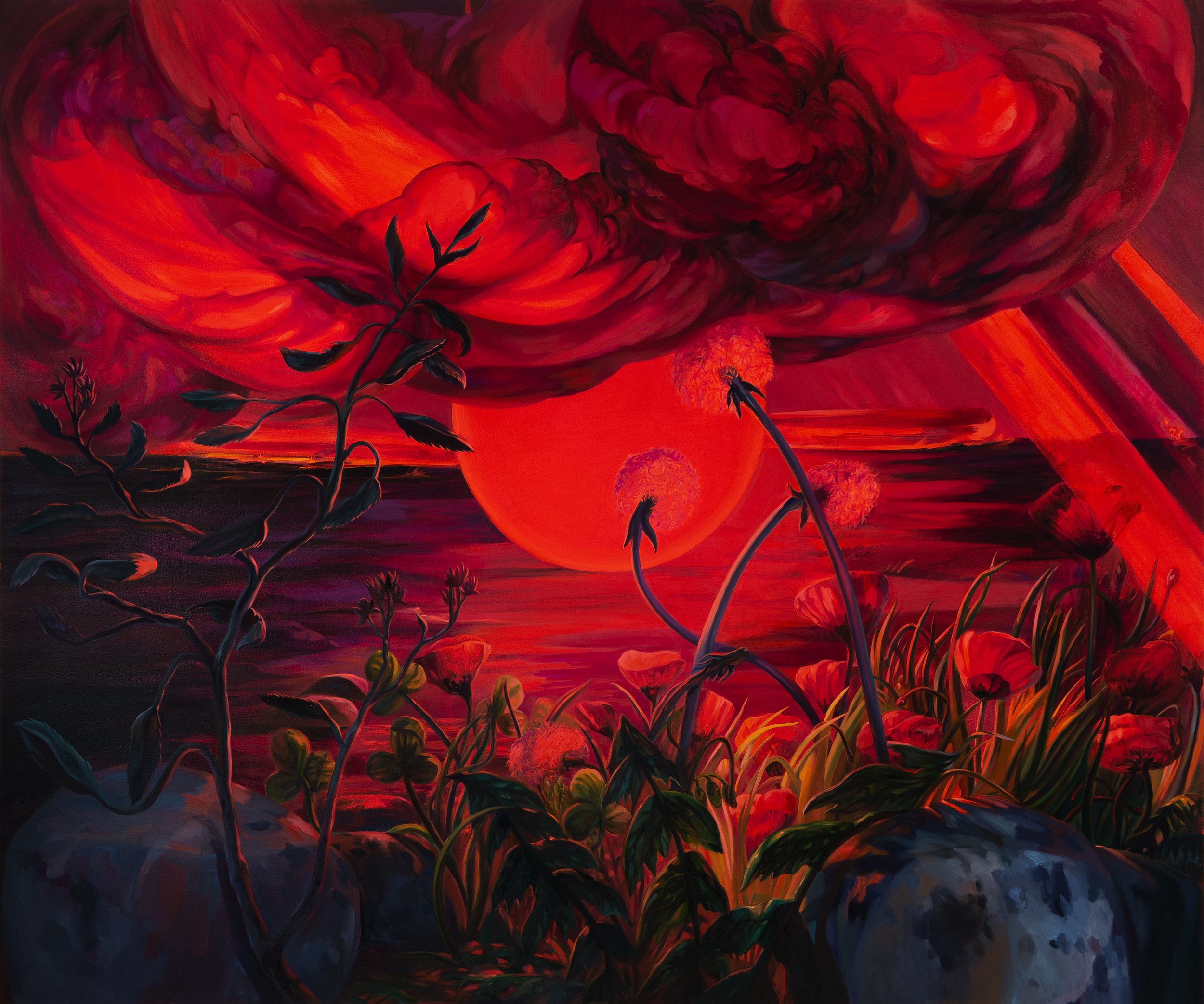
Rachel MacFarlane
The Change, 2025
Oil on canvas, 60 x 72 in. (152.4 x 182.9 cm)
Credit: Image provided by Hollis Taggart Downtown
Rachel Macfarlane’s showing of paintings at the Hollis Taggart Downtown is titled, “Afterlight,” and it is her second solo exhibition with the gallery. If the previous exhibition involved a concept about “before” at a level of subconscious (in the form of word association), then this show is intended as something “after” involving light.
We humans take light for granted, the same way we disrespect and disregard nature. Ever since Thomas Edison invented the commercially practical light bulb in 1879, we humans had the power to switch the light on and off with our fingertips. Before then, modern humans and cavemen relied on flint stones to light torches and campfires but otherwise the only source of light was the sun (as well as the moon and the stars).
The significance of the sunlight is overwhelming in Macfarlane’s paintings as the provider of energy, the enabler of vision, and the symbolic and spiritual signifier of truth that illuminates and liberates. Nature in the physical realm would not survive without light, and neither would we who depend on nature for sustenance.
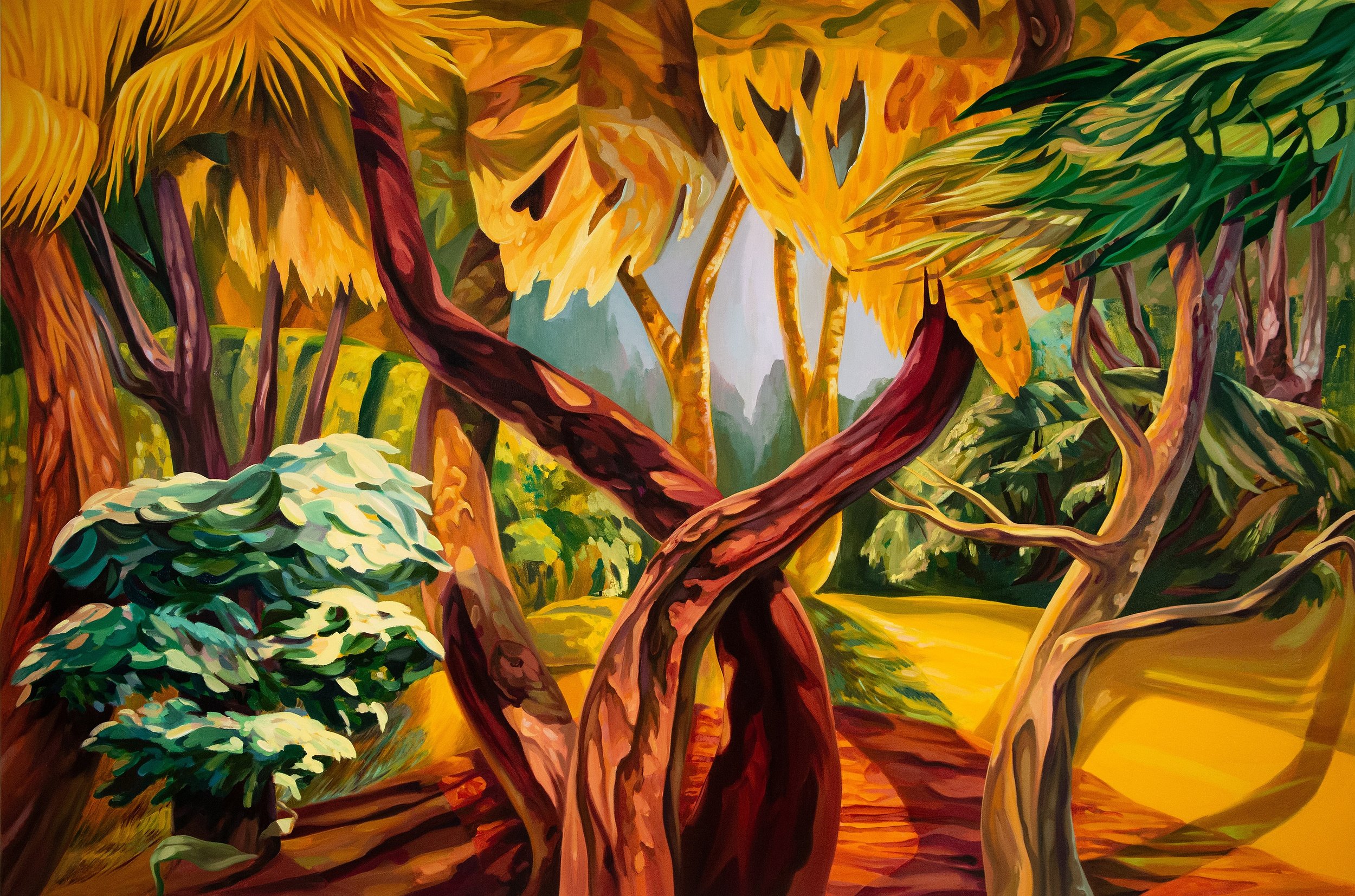
Rachel MacFarlane
At the Still Point of a Turning World, 2024
Oil on canvas, 48 x 72 in. (121.9 x 182.9 cm)
Credit: Image provided by Hollis Taggart Downtown
In Macfarlane's newer works, such as “Solid Rain” (2025), the beams radiate downward to earth, almost like meteoroid fragments or shards of crystal, carrying physical and object-like qualities. This is very different from her older works which depicted light as alternating energy fields that shift in color.
With Einstein’s famous equation (E = MC^2) being true, matter equates to energy, and rocks are essentially entrapped light. In Macfarlane’s investigation of light and nature, they too are the one and the same. This revelation is contrary to the assumption held by philosophers since the ancient times on the binary opposition between heaven and earth, and between light endowed with an ethereal and spiritual quality and objects that are tactile and material in essence.
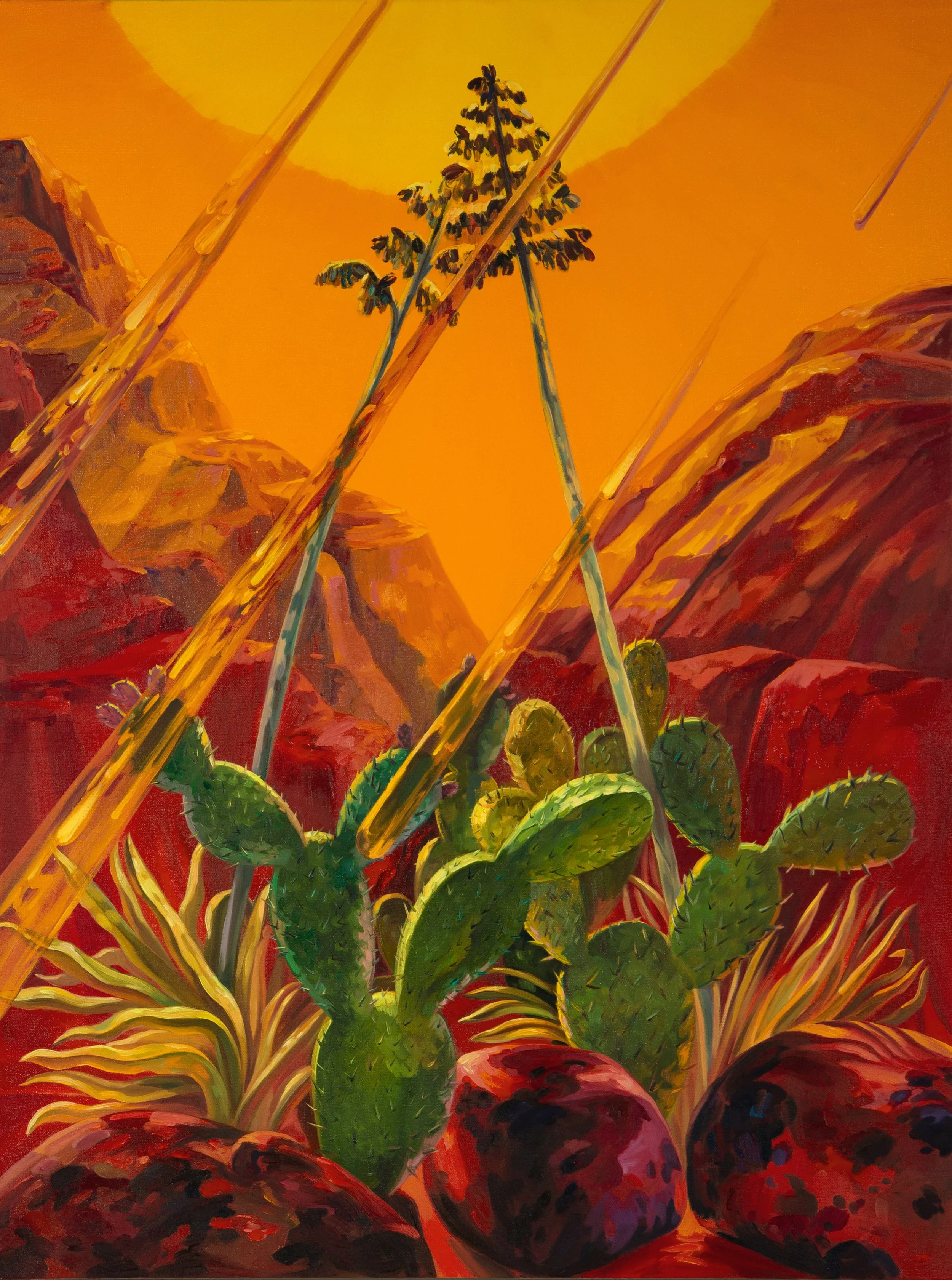
Rachel MacFarlane
Solid Rain, 2025
Oil on linen, 36 x 27 in. (91.4 x 68.6 cm)
Credit: Image provided by Hollis Taggart Downtown
There exists an interesting dichotomy between light and shadow in Macfarlane’s paintings: light penetrates and propagates, hitting on the surface of the objects that it encounters like drums, but objects merely fade away into shadows, which color the areas passively like gradations. Shadows in Macfarlane’s vocabulary are like dark energy zones or signifiers of mystery and hidden knowledge. They are helpless against light, which are really the active protagonists that activate illuminations and highlights over the parts that they encounter. Yet the overall image somehow balances itself with high dynamism as there appears to be equal amounts of light and shadow.
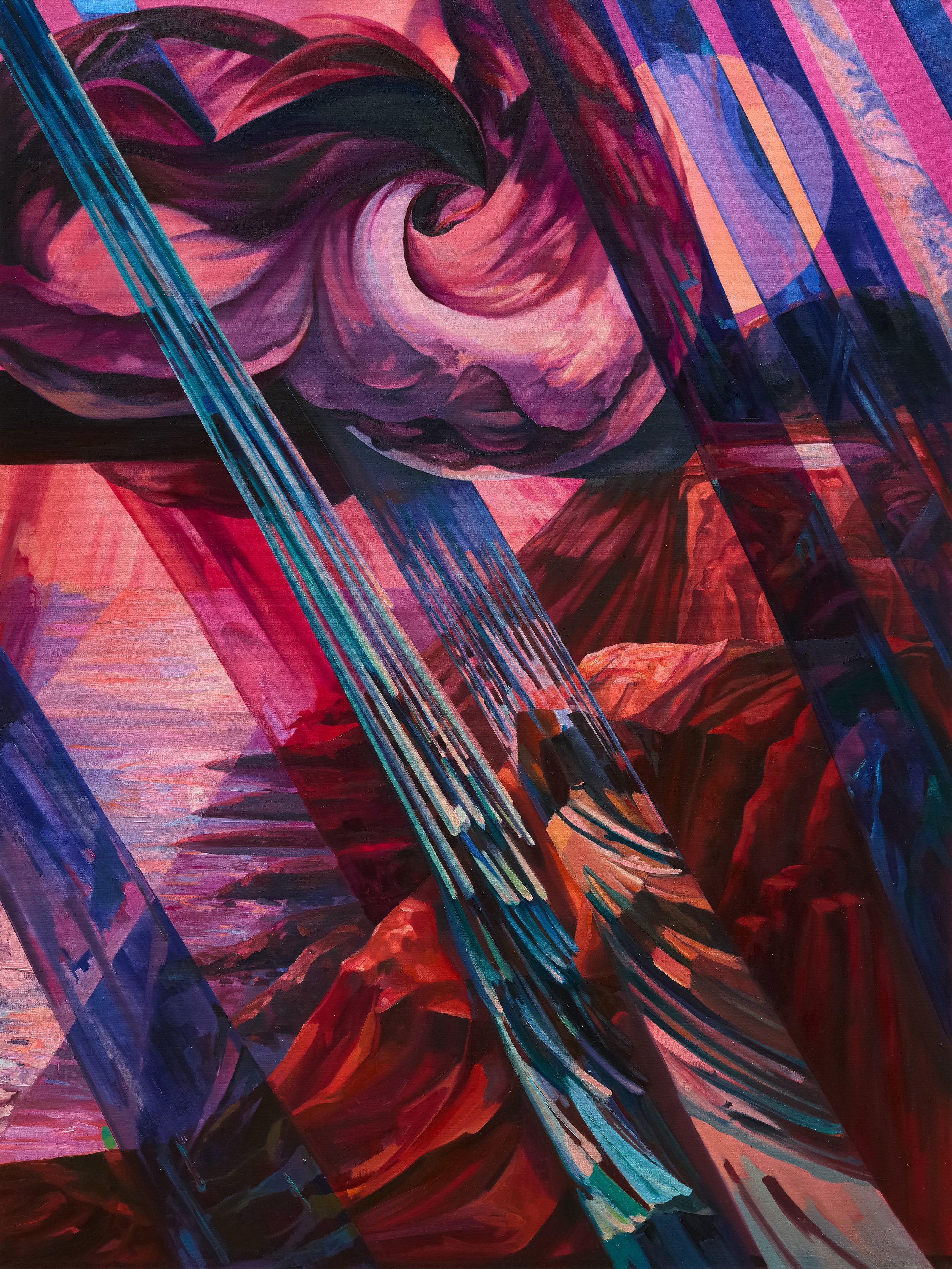
Rachel MacFarlane
Roar at Eventide, 2026
Oil on linen, 72 x 54 in. (182.9 x 137.2 cm)
Credit: Image provided by Hollis Taggart Downtown
Macfarlane’s paintings sing in rich broth of high dynamic range and full saturated colors because the artist has a rigorous understanding of light, color, and paint. There is an optimal range in which colors manifest themselves with full saturation before being overblown with white as highlights or muddied with black as shadows. When there are highlights, they grace their presence only when necessary with just the right mixture of white, yellow, and/or other colors, glistening in movement. Because yellow has a native luminosity of 98 relative to 100 of white, shifting the hues of the highlights towards yellow allows for fuller saturation and stronger chroma. This shifting of hue also avoids the use of too much white, which can desaturate the colors and the overall image. The darker tones also avoid unnecessary desaturation; they strike with deep blacks or blues and high contrast. Blue (close to a mixture of Ultramarine Blue and Cobalt Blue) has a native luminosity of 30, which is the darkest of all colors. Shifting the hue towards blue for the shadows also allows for greater saturation and image with fuller chroma.
Macfarlane does not paint landscape in the traditional sense but a portrait of landscape, in which the paint becomes the flesh of Mother Nature. This is in line with the posthumanist thought that recognizes the validity of all things and beings, including life and non-life entities such as machines. A portrait does not need to be contained within a human-like form. What would a landscape painting made like a portrait look like? Macfarlane’s works may carry the answer to this question, and Mother Nature would be greatly pleased by her gestures in painting.