
An Archaeological Reflection on the Feminine
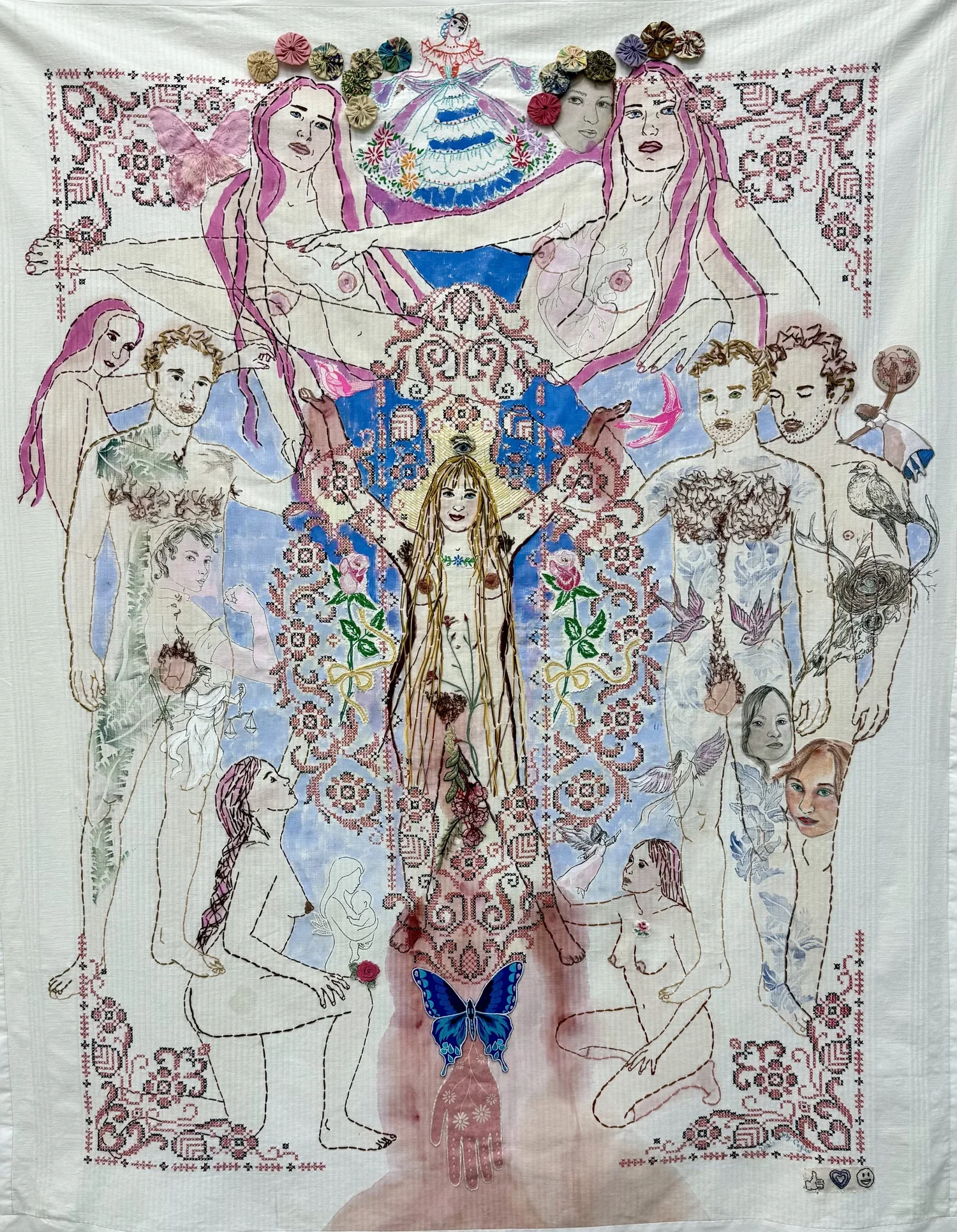
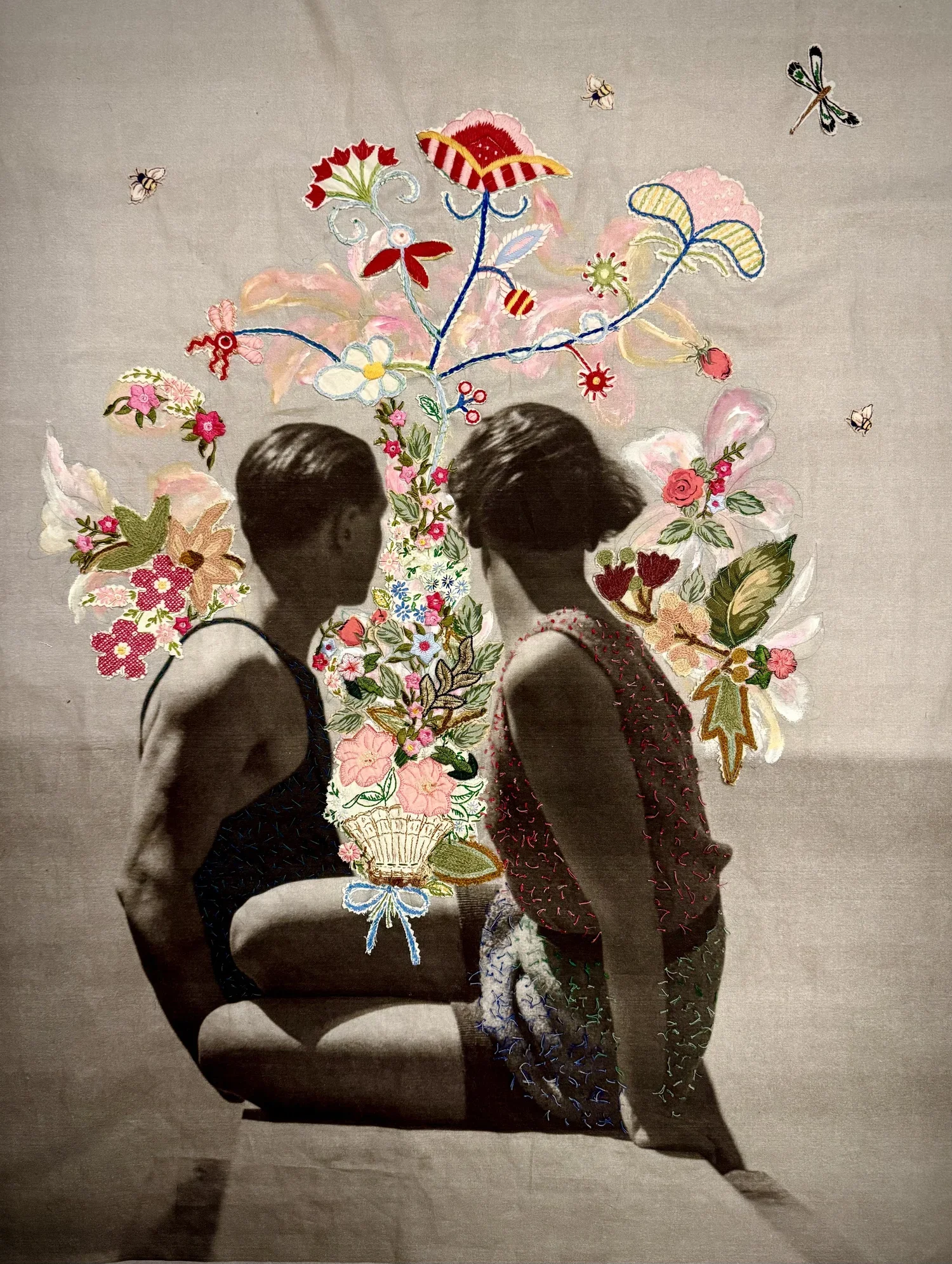
Orly Cogan, Painted into Being, 2026, hand stitched embroidery and applique on bed vintage linen, 64 x 57 in., courtesy of artist
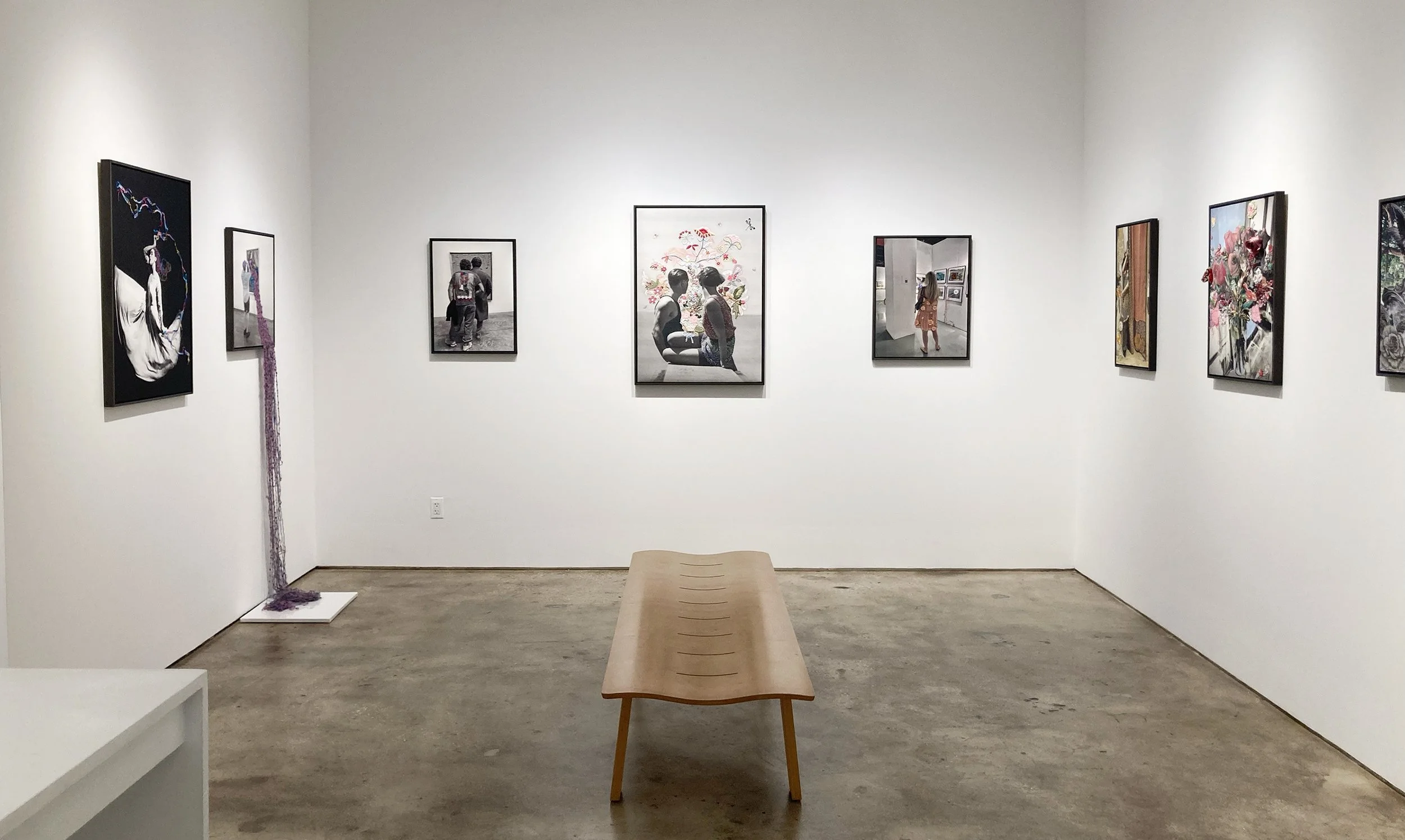
Orly Cogan, Exhibition View of “Behind the Lens and Through the Needle”, courtesy of Robert Mann Gallery
The English word “text” stems from the Latin “texere”, meaning “to weave”, connecting the structure of a written story with the physical act of weaving thread in textile manufacturing. Textiles, thus, are believed to be the oldest form of storytelling, dating back across history to Islamic and Ancient Greek civilizations. Tales and myths were woven directly into fabric, carrying ancient symbolism and wisdom, later passed down through communities and generations. The ancient language of thread holds labor, tradition, memory. In many civilizations, the weaving of fabric was closely associated with the weaving together of the universe itself. Orly Cogan, a New York- based artist, is well versed in this sacred art form, actively redefining the traditional art of weaving into a new mode of otherworldly communication. Cogan’s most recent solo exhibition “Behind the Lens and Through the Needle” was on display at the Robert Mann Gallery in New York from September 10 - October 24, 2026. With a background in drawing and painting, Cogan carefully blends photographs and hand-stitching in her newest exhibition. Bright strands of thread stand out to the viewer’s eye, highlighting specific aspects of the black-and-white photograph. The photographs depict everyday scenes and captured moments of intimacy. Cogan intentionally and meticulously braids threads throughout the scene, transforming the stillness of the photograph into something dynamic and playful. Throughout the exhibition, the use of flowers, winding patterns and various textures creates an almost fantastical atmosphere. Two different mediums come together into one, inviting new meaning and exploration of this unified configuration. Cogan makes flowers grow beyond the borders of the photograph and creates new dimensions for figures. Traditionally understood as a boundary, the photograph frame fades into the vibrant stitching, extending the subject of the image and gently erasing the barrier altogether. The threads invite a new realm of possibility, a colorful, mystical world beyond the stillness of the image.
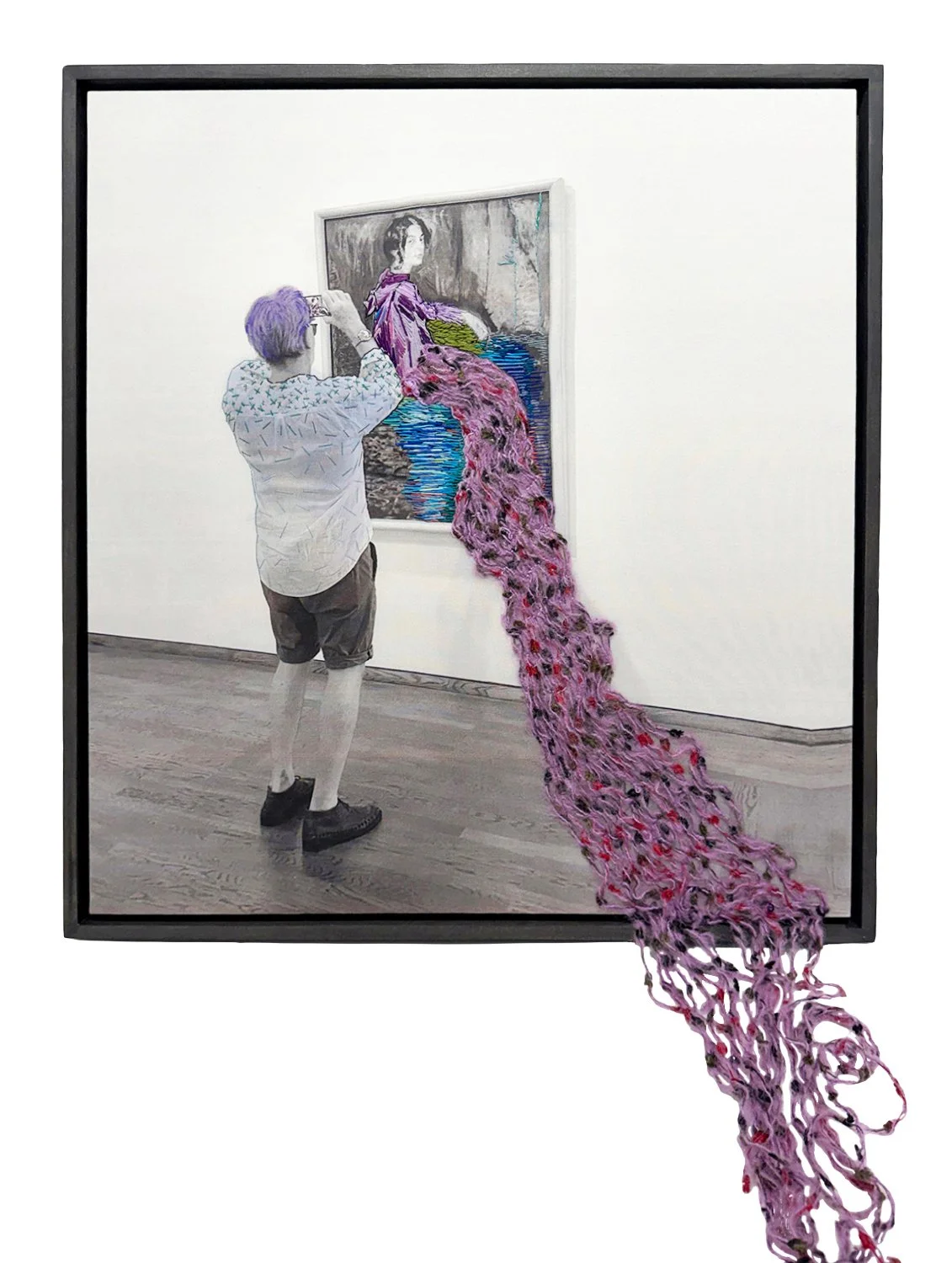
Orly Cogan, A Quiet Rebellion, 2026, hand stitched embroidery on printed textile, 20 1/2 x 19in., courtesy of Robert Mann Gallery
Among the most striking works in “Behind the Lens and Through the Needle” is “A Quiet Rebellion” (2026). Not only do the colorful threads extend beyond the boundaries of the photograph, but they spill onto the floor in a pile. Cogan disrupts the confines of the photograph and carries the piece into a different spatial location, adding a new layer of dimension to the piece. The thread challenges the world containing the photograph and escapes into the world outside of it. This subtle conflation of “subject” with “viewer” opens a contemplation on the roles and meaning of both, giving way to the possibility of occupying them simultaneously.
Cogan has been recognized for her exploration of the feminine through traditional textile art and embroidery, depicting women in intimate, ceremonial settings, redefining familiar roles and identities. Throughout all of Cogan’s artwork, one can notice a peculiar phenomenon occur. At first glance, the subject of a piece may appear childlike and innocent, until it morphs into an entirely different form the longer one observes.
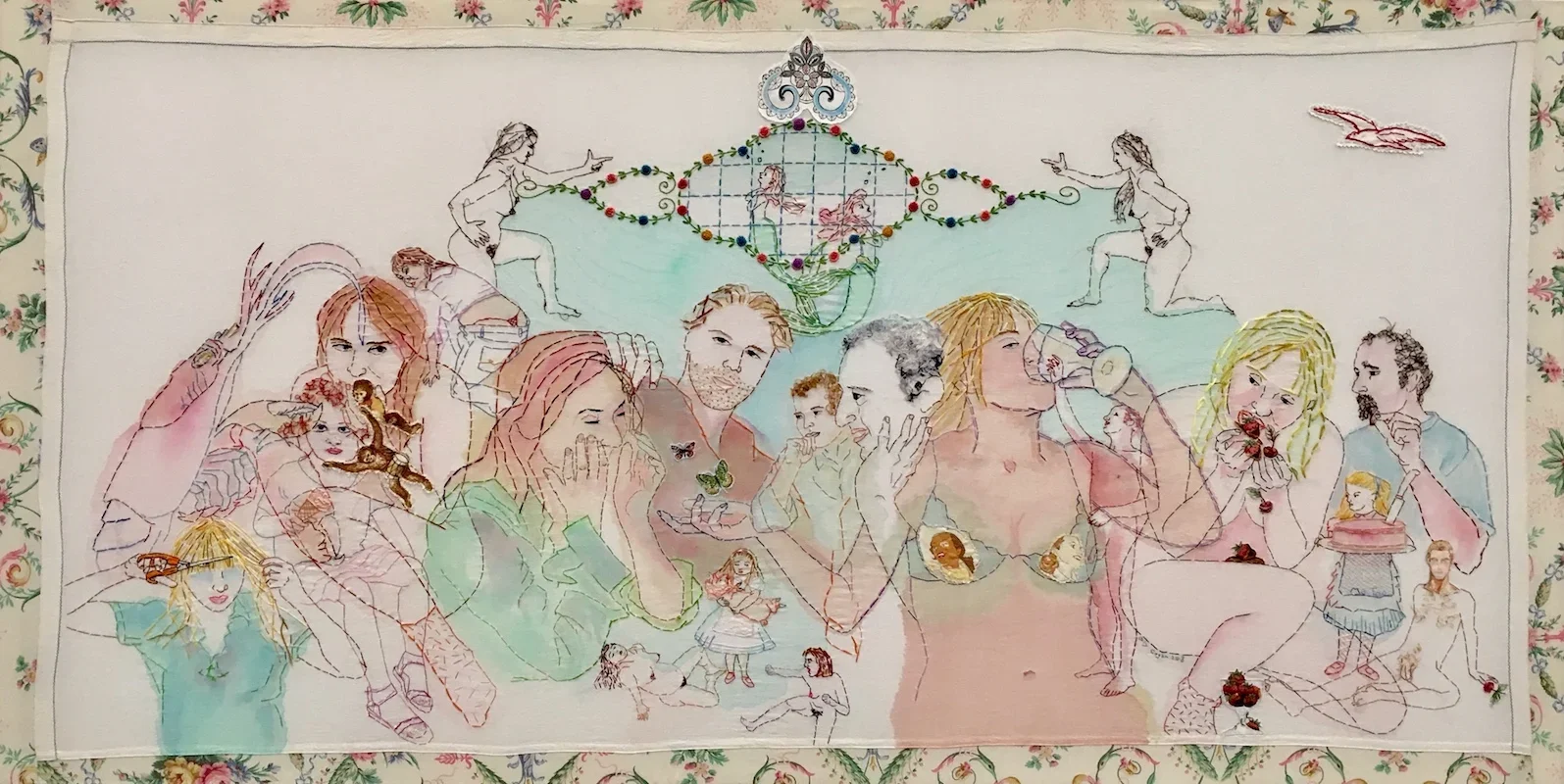
Orly Cogan, The Feast, 2018, hand stitched embroidery, appliquet and paint on vintage linen. 68 x 32in, courtesy of artist
One of Cogan’s captivating pieces, “The Feast” (2018), is a piece of theatre, of transformation. It is a piece that perfectly encapsulates the transformation that occurs when one is inspecting Cogan’s artwork. “The Feast” is hand-sewn directly onto vintage linen, containing and preserving its history and uses throughout time. Over a rich, established foundation of memory and tradition, Cogan stitches a gathering of figures in overlapping encounters. Women recline, lean forwards, raise glasses, cradle children, smell flowers. Men are seen occupying the background of the landscape. The figures are congregated below an ornamental, floral and weaving canopy, framing the scene in a gesture of ceremony and celebration. This initial interpretation gives way to a different type of scene, which morphs and changes shape the longer one looks at it. A woman stares beneath the brow with envy, crouching in a fetal-like position. Another raises fruit in both hands to meet her eager lips. Yet another grips red scissors in one hand, violently cutting through her hair. “The Feast” is an abundance of identities, sensations, relationships. A mythological congregation of female archetypes. Here, gentleness and care sit alongside voracity. The maternal and erotic exist in the same space, sitting by the same table. The familiar roles of mother, muse, wife, enchantress, are lost in the harmonious euphony of celebration and ritual. The women enjoying the feast are overlapping, dissolving, refusing compartmentalization.
Orly Cogan, Full Bloom, 2025, hand stitched embroidery and paint on printed fabric, 37.25 x 27in, courtesy of artist
Cogan is an archaeologist, resurrecting ancient archetypes and mythology through weaving together the fabric of past and present, excavating. The rhythmic act of hand-stitching becomes a form of worship and meditation. Down, under, out of sight, and then up again, breaking the surface. Cogan’s hand-stitching symbolizes a katabasis/anabasis of sorts: the hero’s journey. The gesture is small, repetitive, yet each stitch marks a passage between realms. The brave descent of katabasis into the under-world, a mystical, cryptic land. A penetration of the boundary separating the two worlds, a dive into the unknown. The act of stitching by hand creates a fully immersive experience, with Cogan directing the needle, conducting the needle, moving together alongside the needle. Anabasis is the counterpart to the former: the reintegration and emergence. Through anabasis, Cogan’s needle emerges carrying the thread along with it, extracting something vital from its time in the under-world and bringing it into the material. Throughout her artwork, Cogan builds a dialogue and deep interplay with two opposing elements, while preserving history and traditional labor. As in the journey of katabasis and anabasis, one cannot exist without the other. Orly Cogan blends barriers and transcends rigid isolation, both through the subjects depicted in her artwork, and through her masterful act of stitching itself.
