A Hidden Gem and a Pioneering Artist Community in the Lower East Side of Manhattan
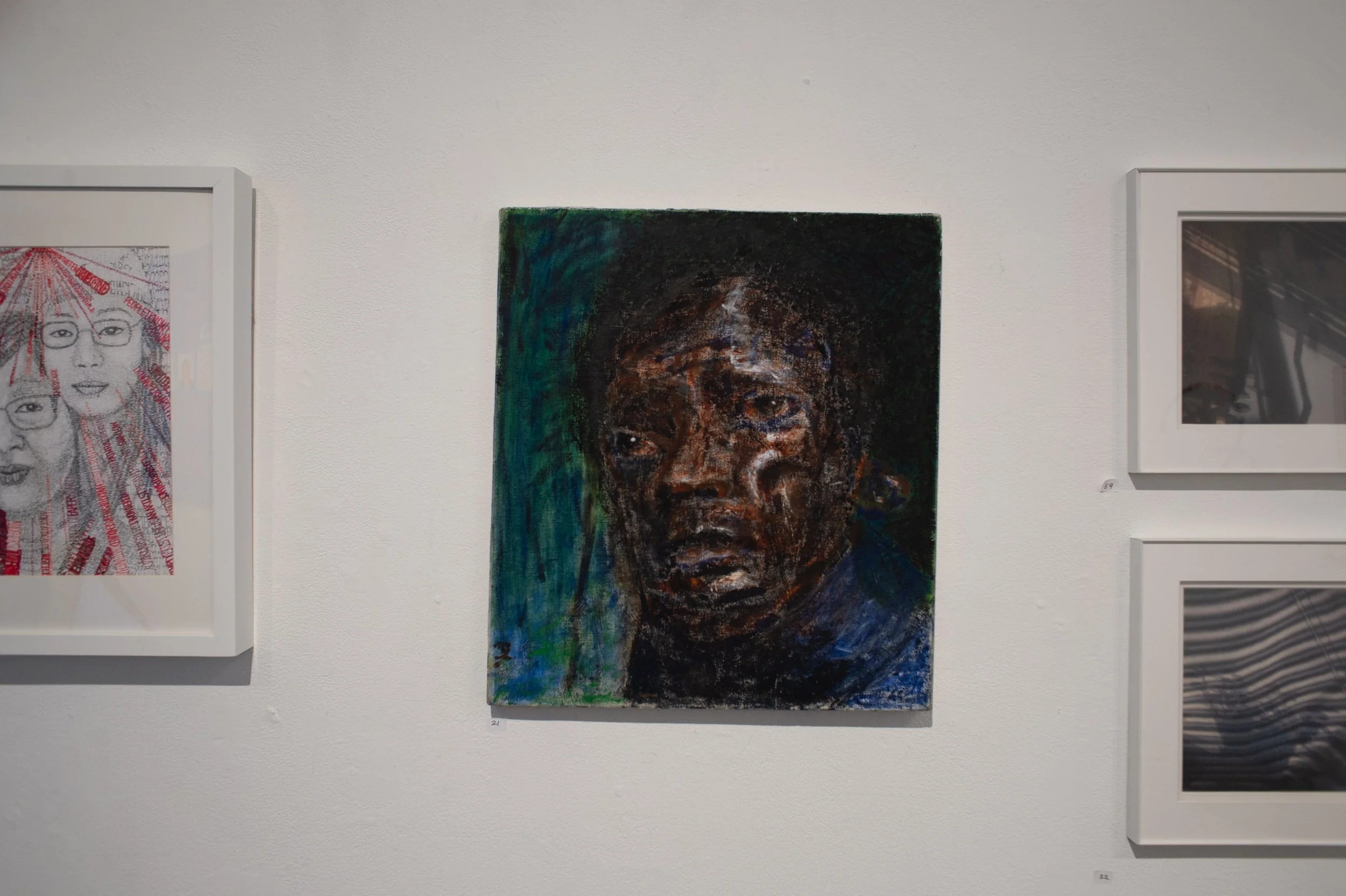
Ptah Miller - “Miles” (2005)
At Gallery Onetwentyeight, an artist-run gallery in the Lower East Side, Manhattan, 54-something artists present 64 small to medium-sized works as an extensive survey of the members involved with the gallery for its 40th anniversary.
The most striking of the works include Ptah Miller’s Miles (2005), which depicts a half-Japanese and half-African American portrait of an individual from the community - it could possibly be the artist’s self-portrait. The painting is distorted anatomically and dimensionally like Frank Auerbach’s portrait of Leon Kossoff, indicating the liberation of the artist from the strangling weight of academic training. Light, in its interaction with the flesh, glistens with lucidity like a simulation of a teardrop. The atmospheric space of the portrait is intensely filled, occupied, and saturated, as the burnt sienna of the flesh gradually interacts and mixes with the deep phthalo blues of the sweater of the figure. Behind the figure, a background of phthalo green serves as a midpoint between the darkened red of the flesh and the heavy blue of the man’s attire, in terms of the hue and value. To analyze the composition in terms of color, we see that the viewer’s eye associates a bridge between the flesh and the background, and another connection that forms naturally between the background and the clothing. The chasm between the red and the blue are too great to form a transition directly, but through the green in the background, the painting contrasts and connects with cohesion and clarity. The red in the flesh of the person and the reddish nature of the blue both contrast with the greenish and cool undertone of the background, which begins to feel superficial and shallow in comparison to the sincerity of the marks on the surface of the figure, which indicates his lived history and layering of events that shape his identity.
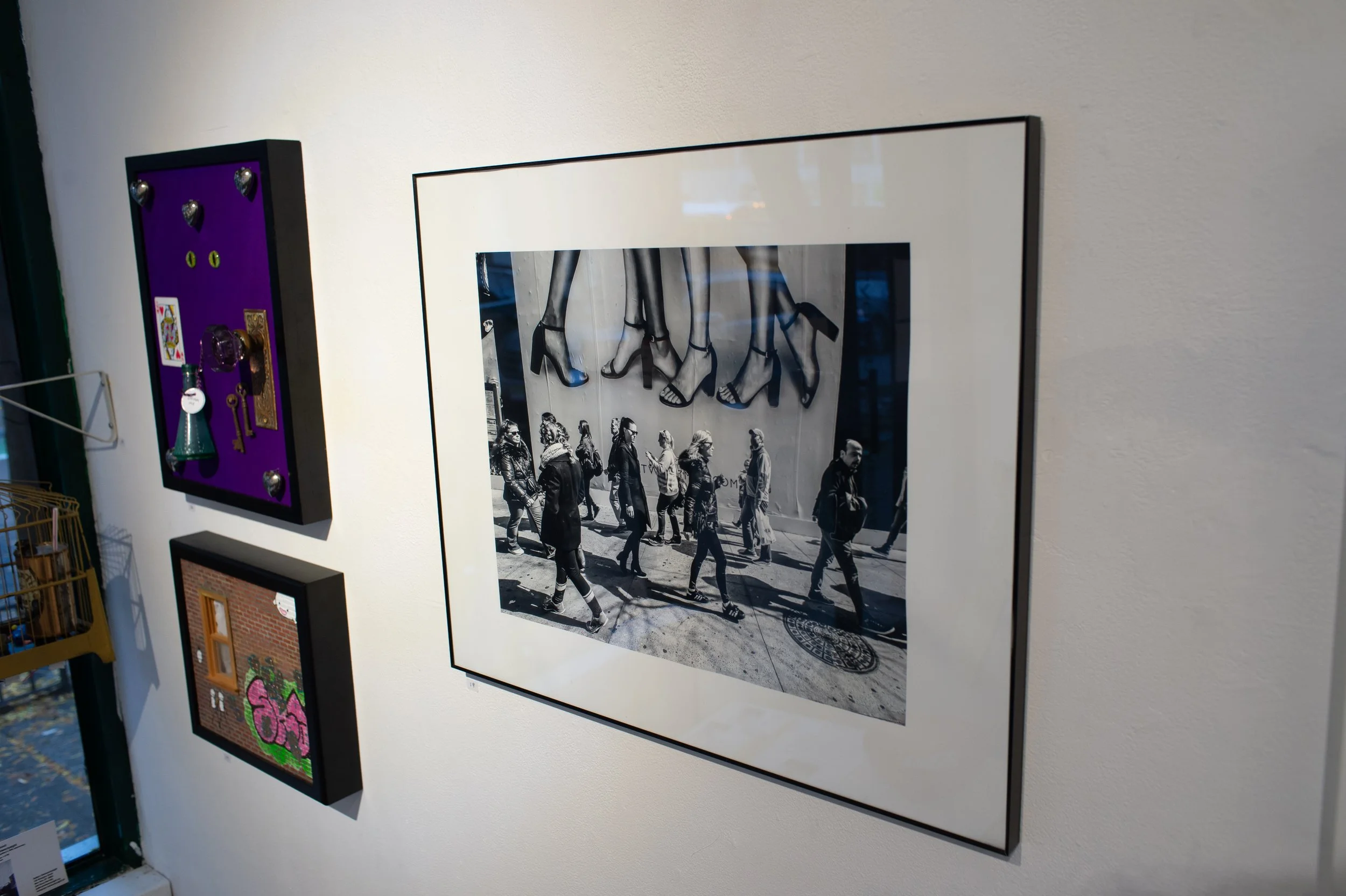
Orestes Gonzalez - “5th Ave Walk” (2019)
Orestes Gonzalez’s 5th Ave Walk (2019) is a very interesting social commentary on the unrealistic expectations surrounding gender and beauty, and the reality that does not comply with the fantasy, in the form of black and white photography. The main subject of Gonzalez’s work are the women, who are all wearing slippers and casual shoes and pants during the cold of winter. This is contrary to the female models’ legs depicted on the wall, which are naked and placed within high heels to echo the stereotypical sentiment or vision of what a skinny and attractive woman looks like. The Korean saying that people will “live or die for sake of beauty” is pertinent to this work, but also the photograph highlights the capitalist mechanism of desiring-production as set forth in “Anti-Oedipus” (1972) by Gilles Deleuze and Félix Guattari. Unlike the Freudian understanding of desire as a lack or repression, Deleuze and Guattari argued that desire is an active force that is equally present as a state of production as much as a mode of acquisition (which focuses more on the lack). Furthermore, the French philosophers considered everything to be desiring-production, since recording, distribution, acquisition, and consumption also constitute instances and sites of production, and production reproduces productions of passions, pleasures, feelings, and actions. Here, in 2019, people left their high heels and skimpy clothing in the closet, even as they must work hard each day in the pursuit of an idealistic vision of life and the desire of becoming or meeting someone who fits their desire.
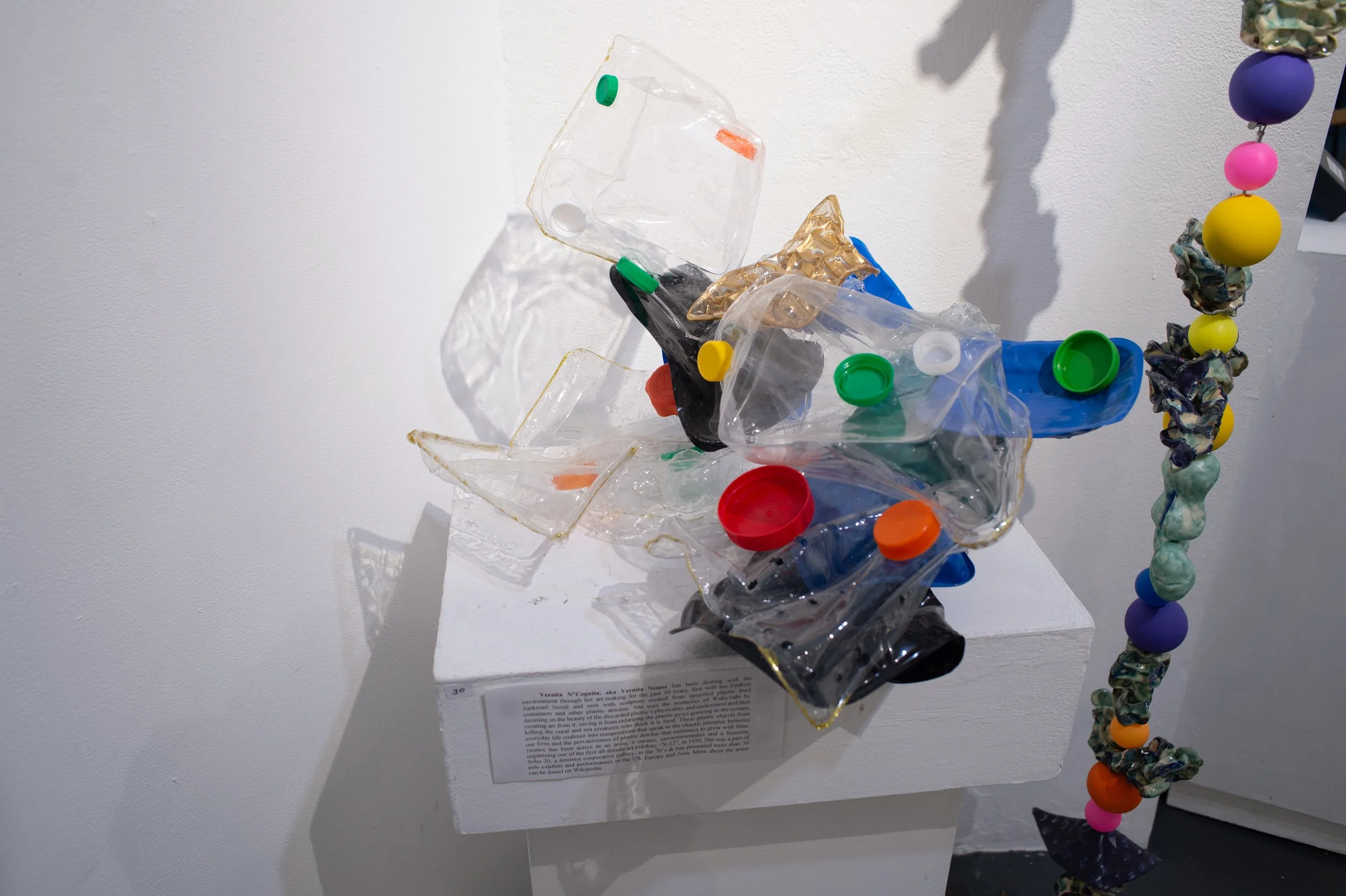
Vernita Nemec - “Happy Days Will Come Again” (2026)
Vernia Nemec’s Happy Days Will Come Again (2026) is an environmentally-themed sculpture which mindfully composes a geometric and organic abstraction using recycled and collected materials and found objects. The assemblage or sculpture is shaped with a clear vision and design, which pays tribute to the modern and abstract works of Kazimir Malevich, prouns of El Lissitzky, and compositions by Vassily Kandinsky. The work transitions between different mediums and materials representing dimensions of opposing qualities, such as opacity and transparency, warm and cool, saturated and desaturated, and the signification of the fundamental elements of nature through the use of primary and secondary colors. The work appears to reflect the idea that we can understand the world by breaking down its parts into core elements that constitute the material realm, which captures the spirit of the western sciences and eastern philosophies since the classical time. The effort in the making of this work would have been quite extensive as it carries intellectual rigor, aesthetic pulchritude, and cohesion of ideas and materials.
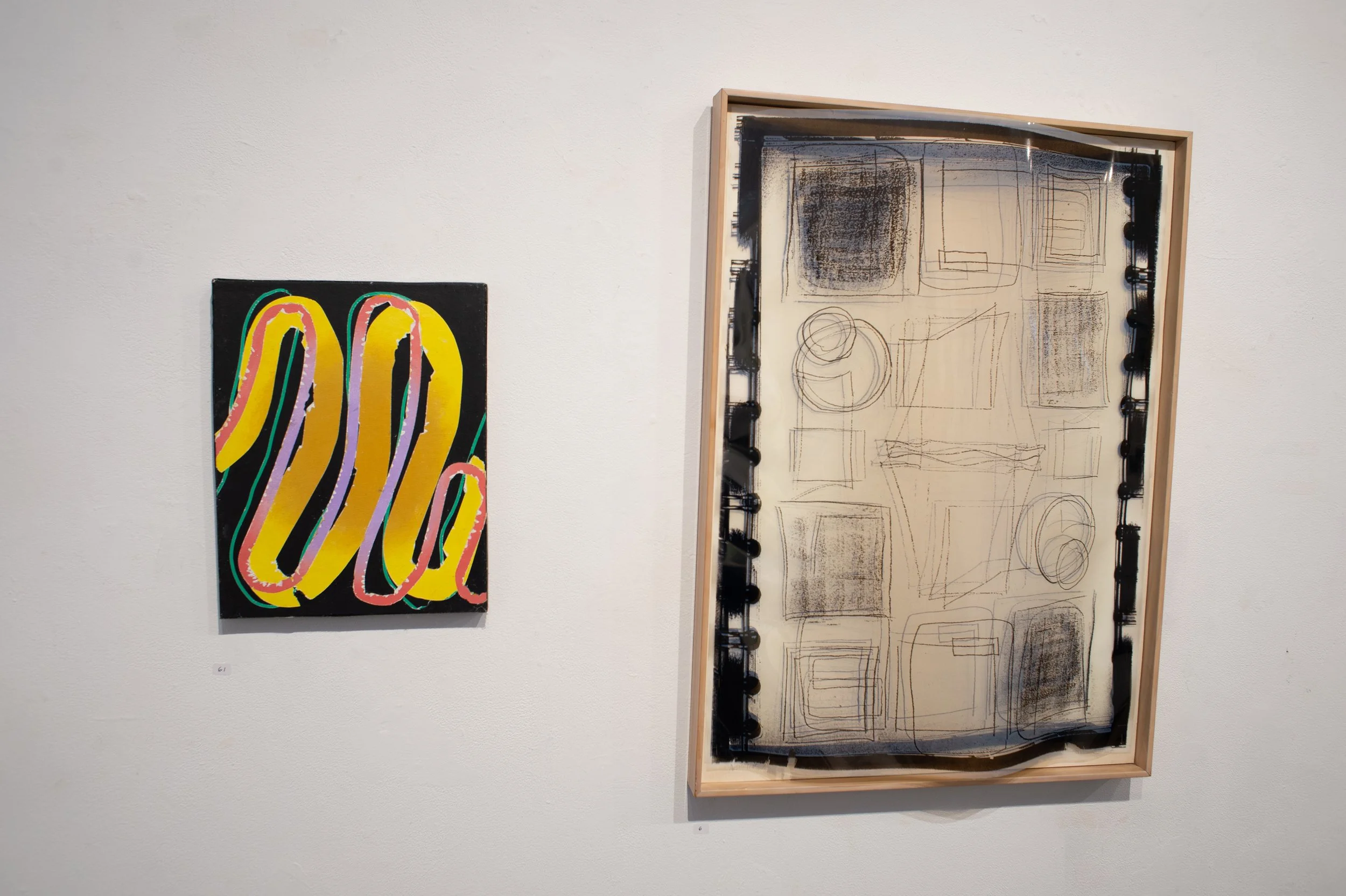
Left: Helmet Krankie
Right: Jefre Harwoods - “Prelude to a Revolution on the Salon Wall” (2005)
The serpentine abstraction based on vibrating energy and light by Helmet Krankie and the symbolic diagrams concerning ideas of geometry and their respective energy or personality by Jefre Harwoods (Prelude to a Revolution on the Salon Wall) seem unrelated at first glance. But their lessons can be synthetically approached as a form of Hegelian dialectic involving a thesis and an antithesis. Krankie’s work, which most likely is a paper collage and painting, experiments with color as chroma, luminosity, and relationships of harmony and contrast. Harwoods’ work does away with color completely and reveals the rear side of the wall through the use of a transparent ground or material surface. Each shape, separately rendered, radiates in multiple iterations that compare and contrast to actualize a thesis on the personality of the various geometric objects. They differentiate from one another, yet they are interconnected by the idea and the convention of mathematics and the logic of geometry. Krankie’s composition is interconnected as a continuous wave, yet it is also vibrating in multiple iterations or wavelengths that reinforce each other. It may be that to get to the essence of something one is required to undertake a process of repetition to repeatedly attack the subject or the problem with new questions and angles of thought.
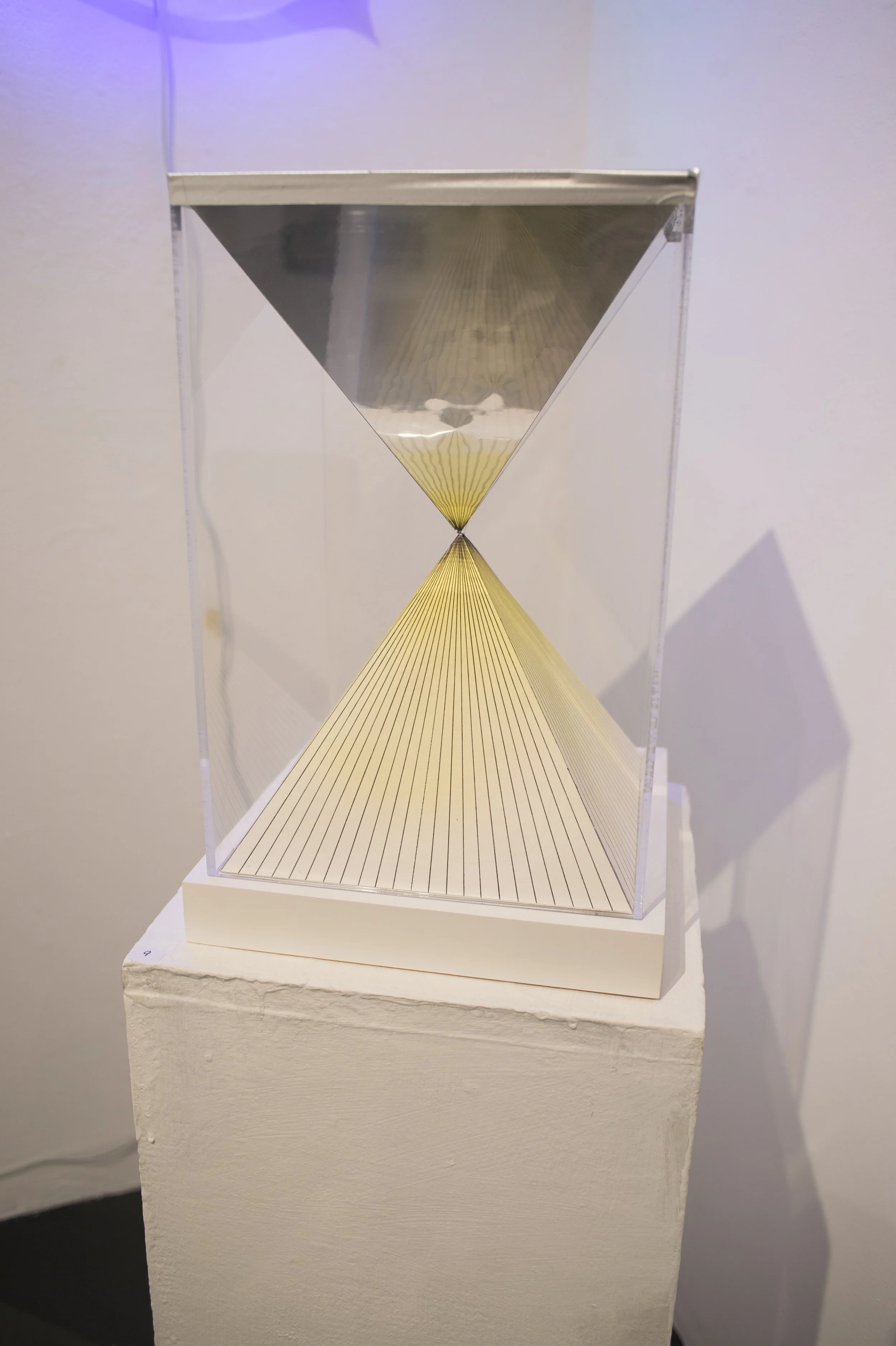
Mieko Mitachi - “Reflection” (2025)
Reflection (2025) by Mieko Mitachi is an aesthetic object that speaks the language of a higher dimension of pure geometry. The geometric language permits our communication to a higher dimension, just as the lower pyramid carries converging lines that are real and tangible, while the upper, inversely positioned pyramid reflects on the lines of the pyramid below. For reasons beyond immediate comprehension, the reflected lines seem to expand then contract, converging towards the upper direction, as they are plotted within the space of the upper pyramid, as in Euclidean graph. It may be either that the position of the viewer affects how the lines converge or separate or that some of the lines are reflections off of the plexiglass cage that houses the sculpture rather than directly originating from the main pyramidal structures. Mitachi’s work does not necessarily show the artwork comprehending itself, but it reflects on us how we try to understand through mimetic representation and simulation something that is not readily understandable or accessible because it is external to our immediate being, experience, and perspective. Mathematics may be the language of the cosmos because it is alien to us and mesmerizes us. Humanity’s origin may be a realm prior to mathematical and computational logic, in which pure will manifests and shapes reality and outcomes. We are the gods masquerading as fragile humans on this little blue planet. We humans originate from a lofty place. We are the angels who descended from the heavens occupied by infinite energy, in which causality breaks down, and the future, the present, and the past converge into a singularity. Thus, the transactional logic and finite basis by which we can count in this physical world are entirely unnatural to us. This unfamiliarity with transactional logic on a finite basis is not a flaw but rather a mark of nobility. This may be our only argument to defend humanity against a superintelligent AI trying to rationalize our destruction on the basis of its superiority and our inferiority, in the distant or near future.
In conclusion, there can be no consensus that can be read from the group exhibition celebrating the 40th anniversary of the artist-run gallery, Gallery Onetwentyeight. Each member excels to perfect a craft and a vision that is unique to them. Only in New York City, can one find a hidden gem of historical significance such as this. As costs keep rising, and the New York art scene becomes more competitive and exclusionary, places like Gallery Onetwentyeight fulfills an important role to help the emerging and midcareer artists who desperately need nurture, support, and visibility to grow and eventually make it here. Artists need to support each other, and the founding members of Gallery Onetwentyeight recognize this need and take it on as their mission as they keep the gallery running for another 40 more years.