The Visitor Who Makes the World Strange
Guest Robert Ortbal Writer Edgar Zhang
Photography + Videography + Editing Edgar Zhang
Robert Ortbal’s Instagram handle is @eccentric.behaviors. It is not wrong.
His feed might show a man in a full astroturf suit riding a bicycle past a sculpture garden, or a group of strangers in enormous handmade animal heads dancing through a shopping mall. Ortbal himself is somewhere nearby… orchestrating, wearing, wandering.
At 63, Ortbal has been making things his whole life. Sculptor, Professor at California State University Sacramento, recipient of the Eureka Fellowship — one of the largest prizes for individual artists in the Bay Area — his résumé is distinguished. But what drives him is harder to name than any award, he describes his studio method as elliptical: a core set of ideas at the center, individual works orbiting them, some close to the light, some distant and isolated. The thread between them, he insists, is always there if you take the time to look. His thinking, as he once put it in Artillery Magazine, takes place in “the bending of a wire, the coating of a surface, or the juxtaposition of forms.”
Summer in 2025, that thread became visible through an exhibition at the Pence Gallery in Davis, for a solo show called Encounters, and through a body of work that had been quietly building for years: the Samaritans.
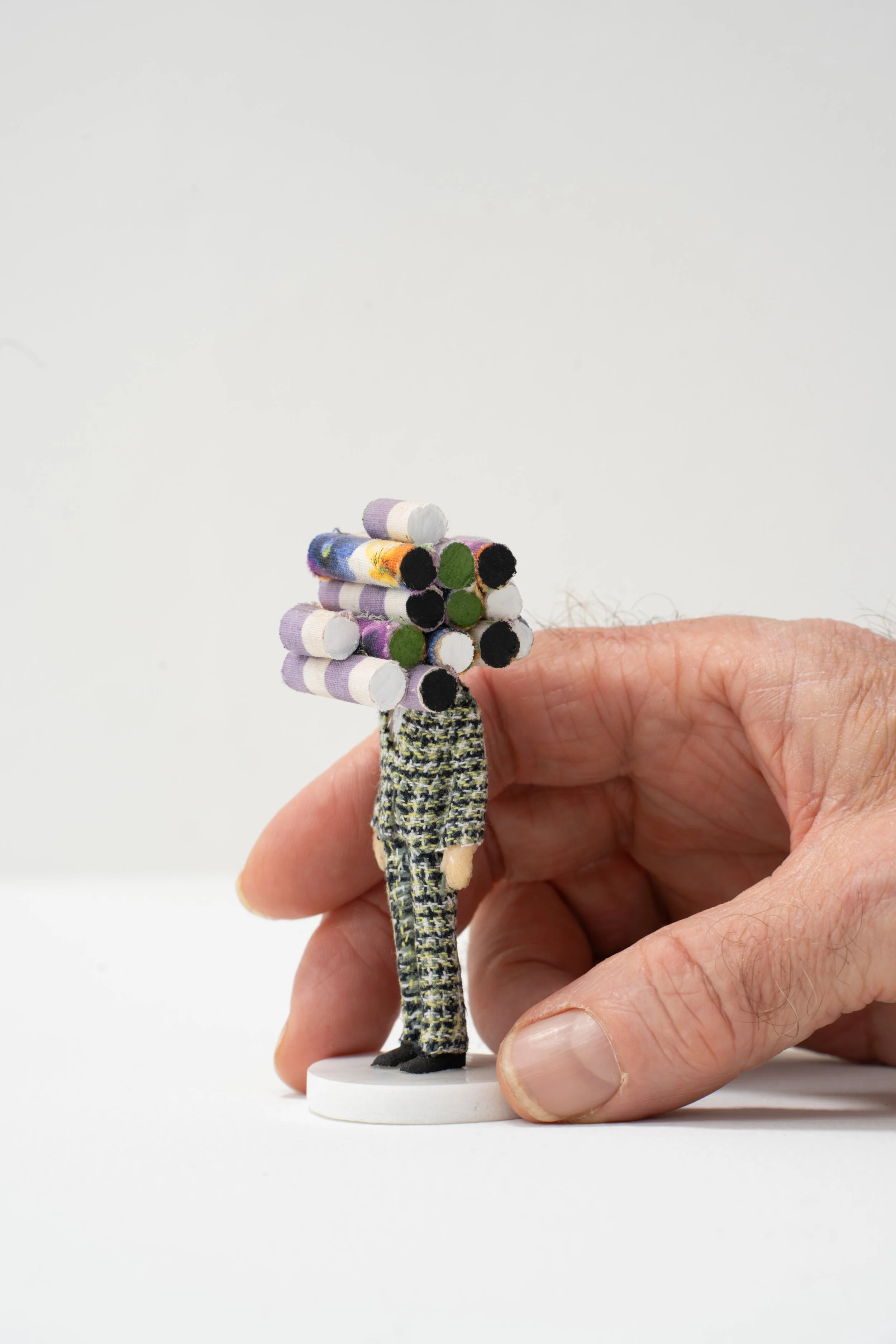
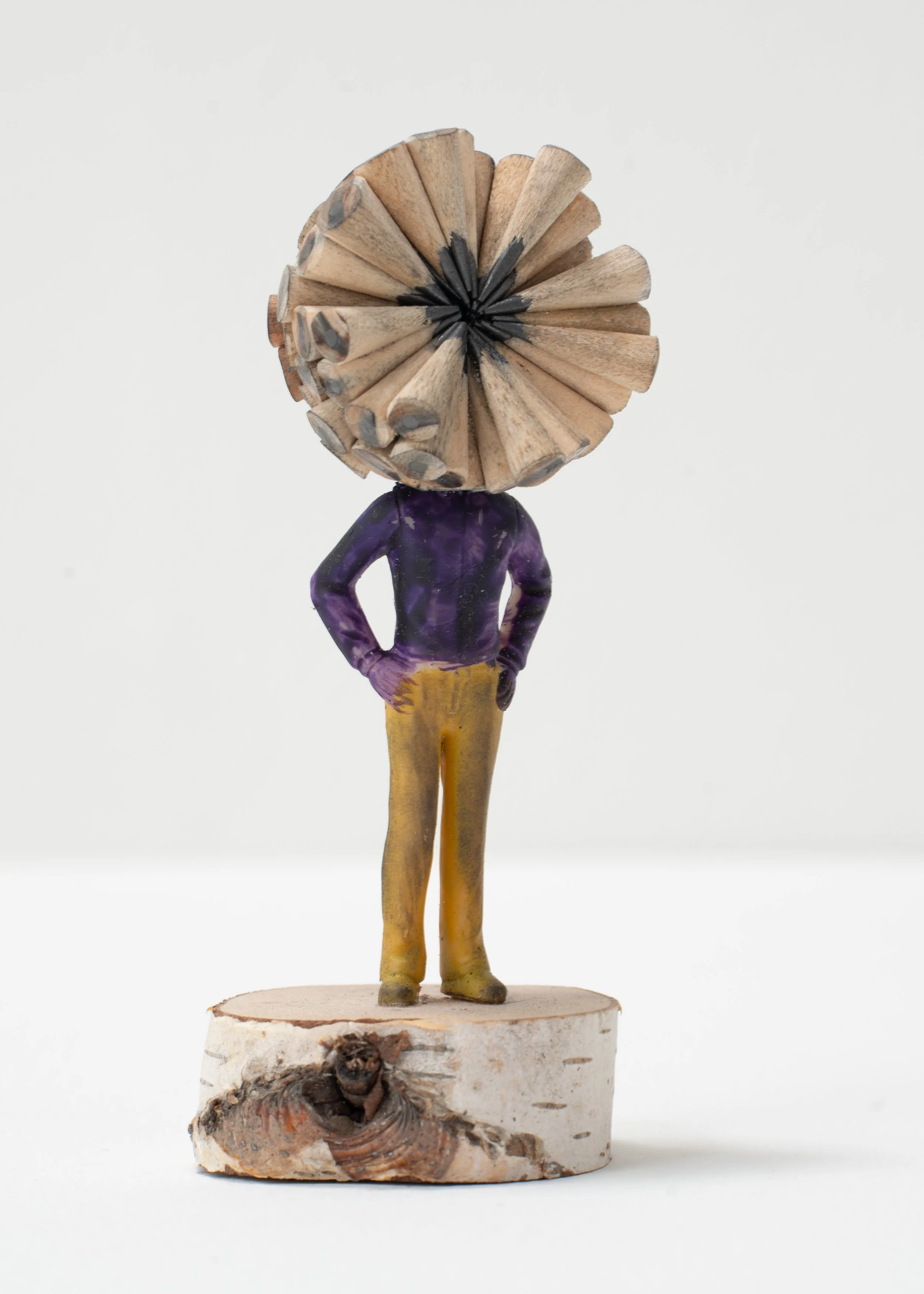
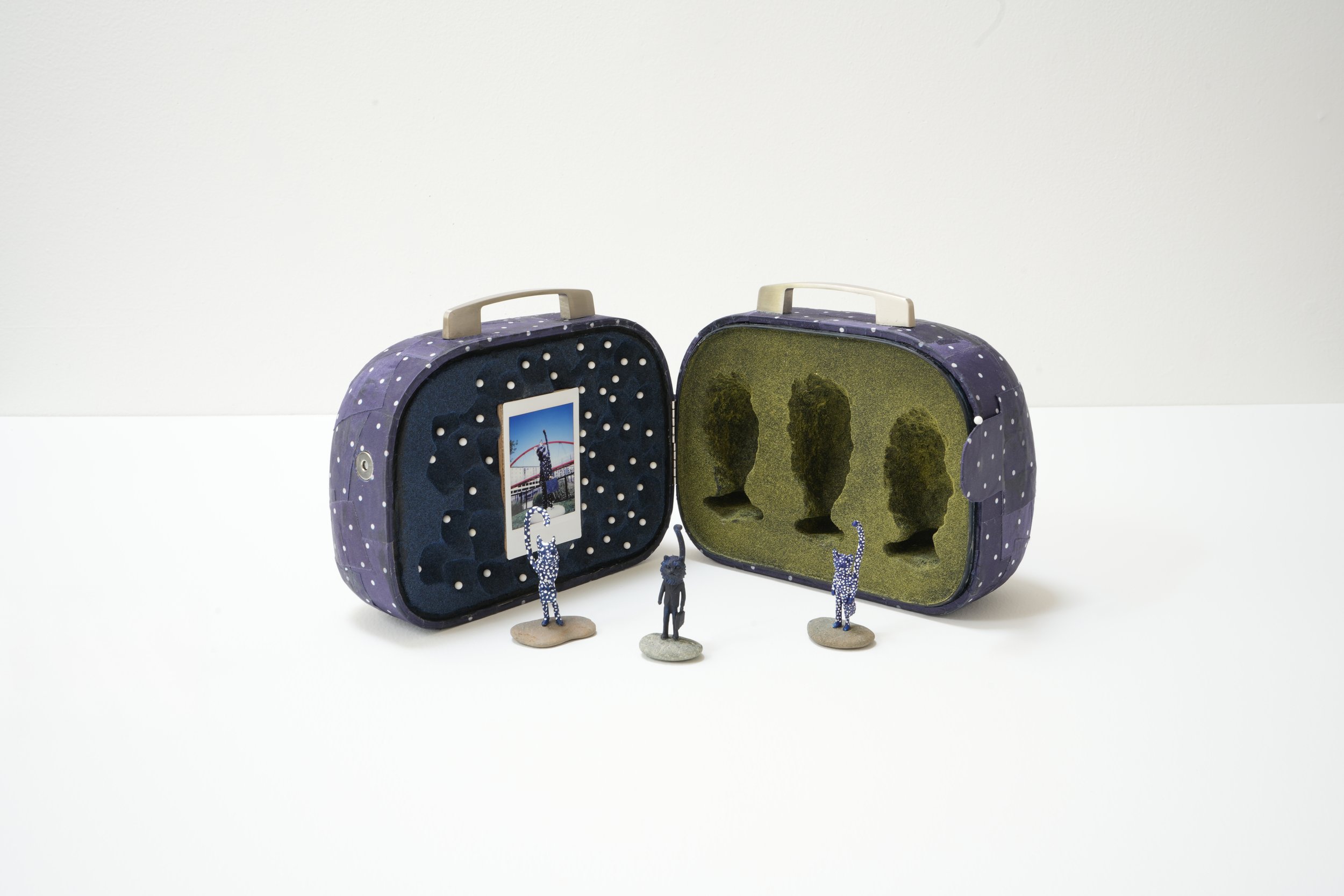
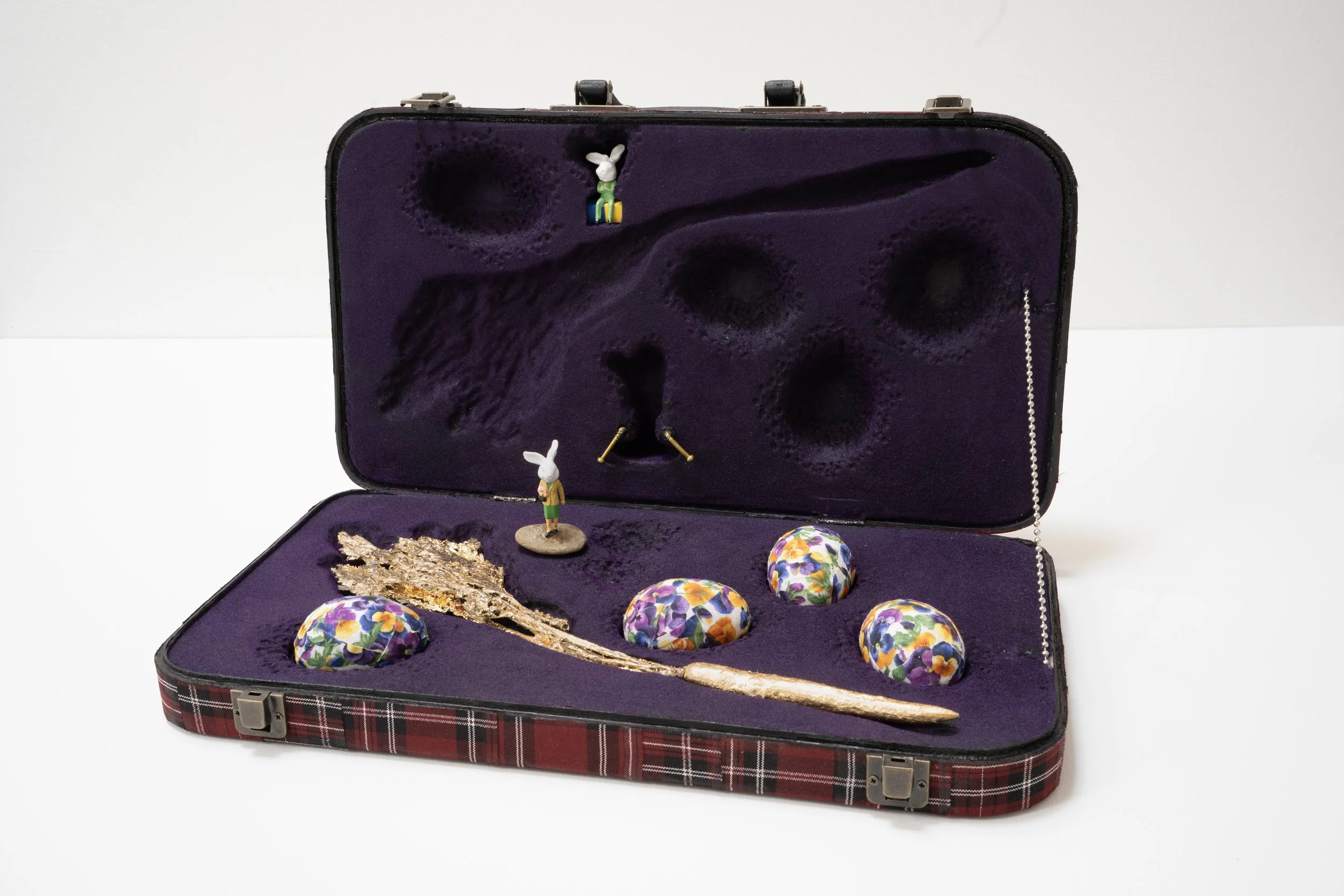
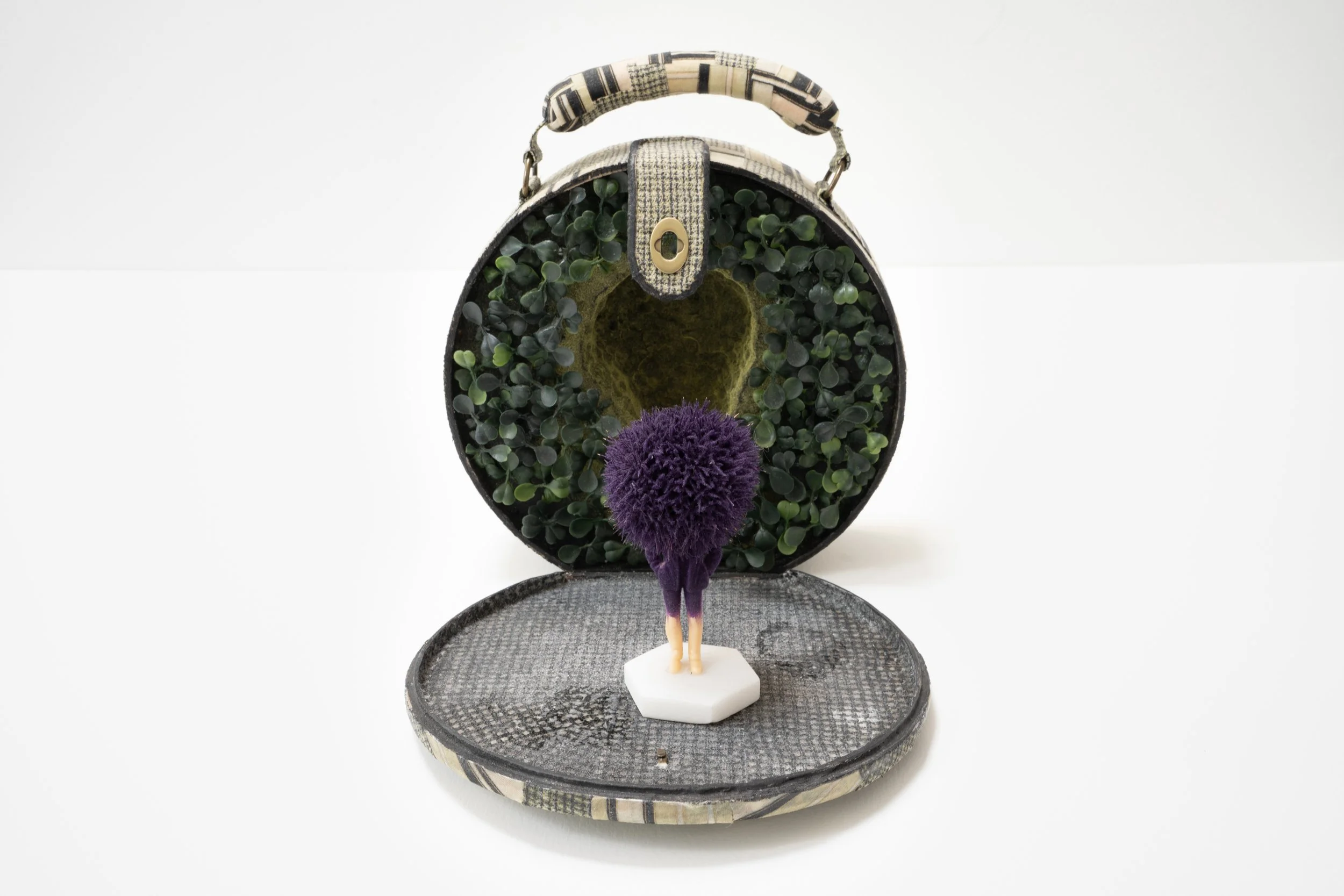
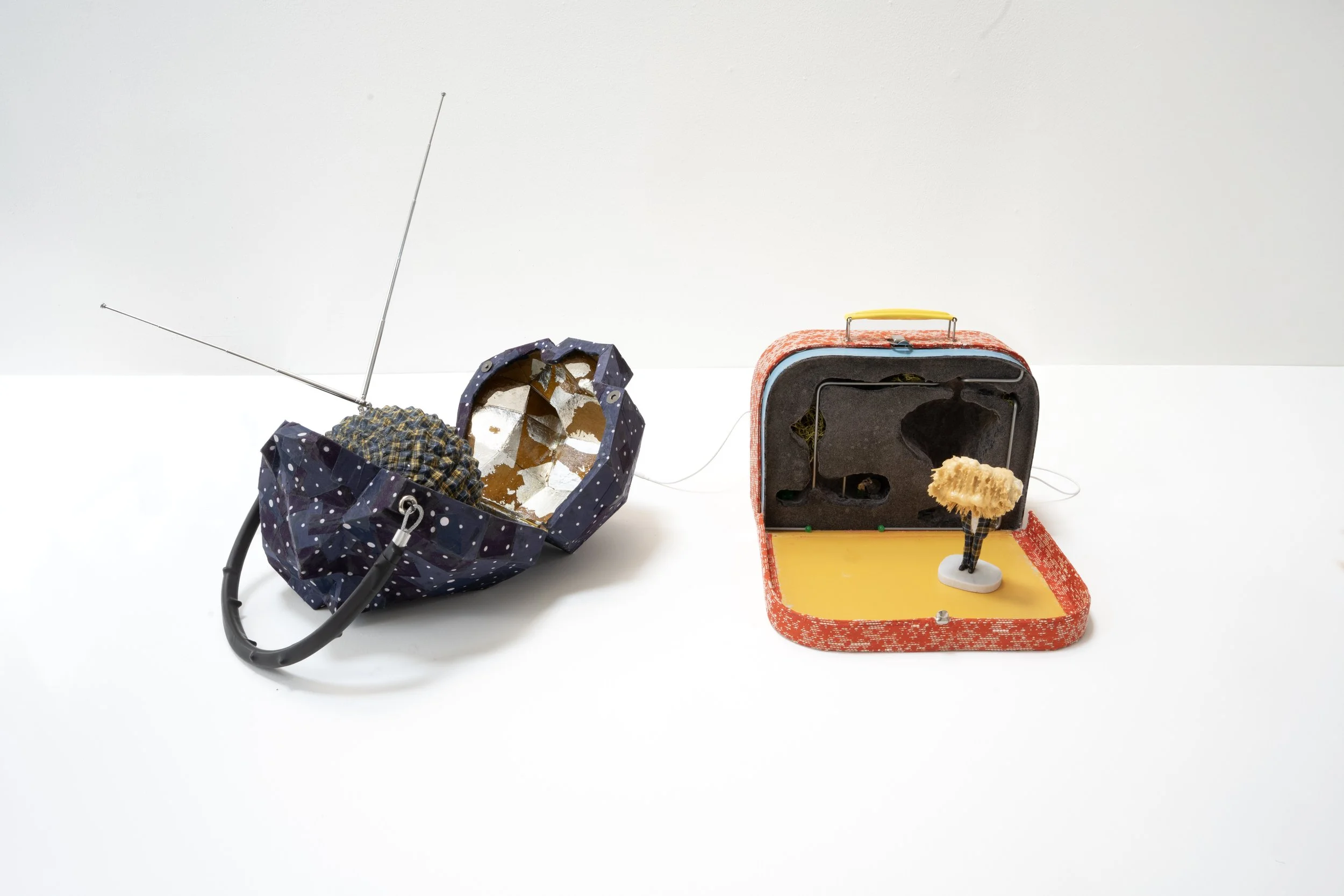
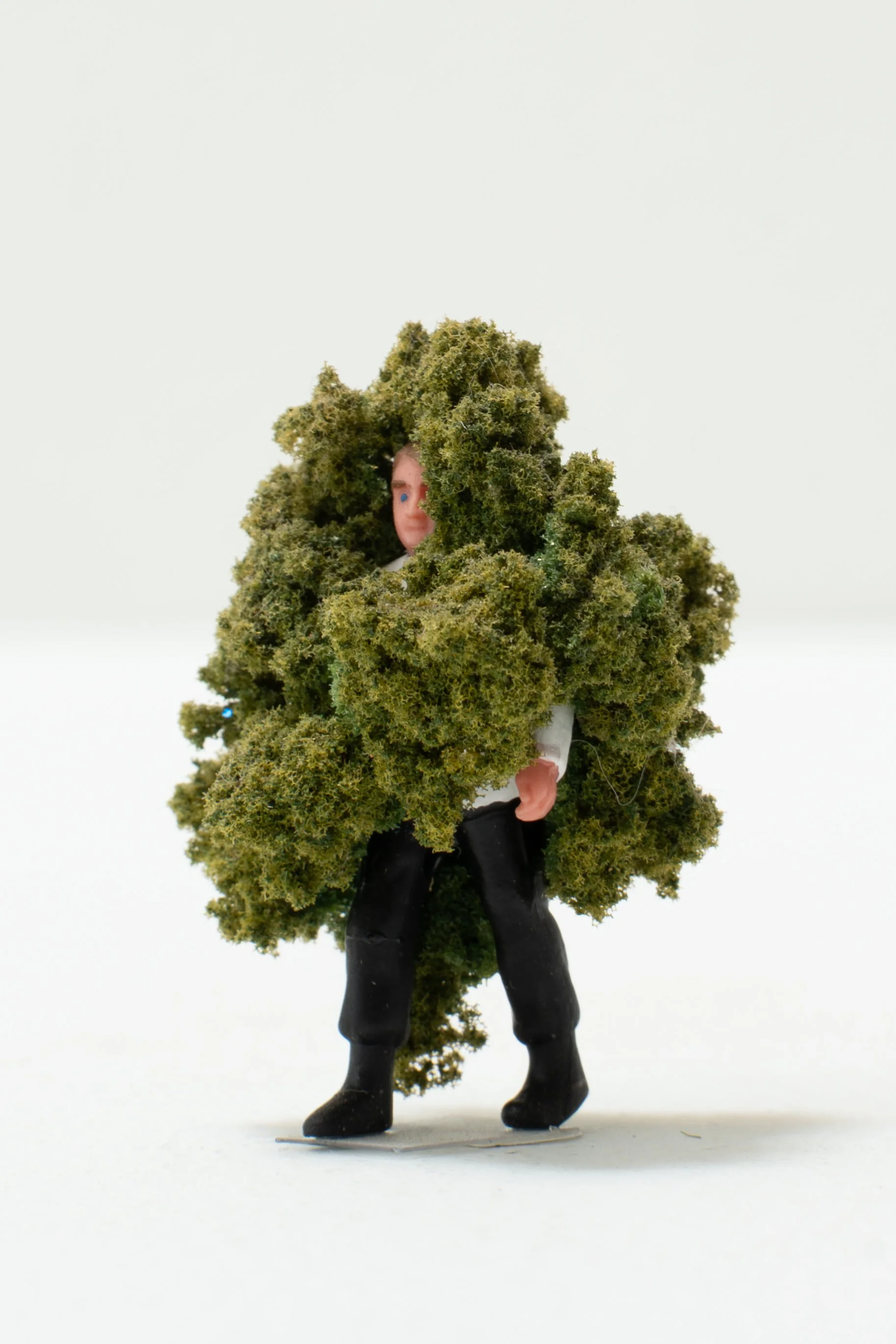
They are impossibly small; Human figures standing two to three inches high, each one topped not with a head but with something else entirely: an orange pinecone, a tangle of green wire, a gray sphere, a fat pink rabbits ear. They wear suits and work clothes and carry small objects, some stand on pebbles, held between two fingers, each one is a complete world. Ortbal displays them in exhibitions and installations and he houses them in traveling cases he fabricates. The cases are clad with patterned fabrics like his old plaid boxer underwear or a favorite worn out shirt; when opened, they reveal a miniature tableaux. Some look like caves inside, others look like strange scientific apparatus, the kind that might measure something that doesn’t exist yet. The cases have handles, they are made to be carried.
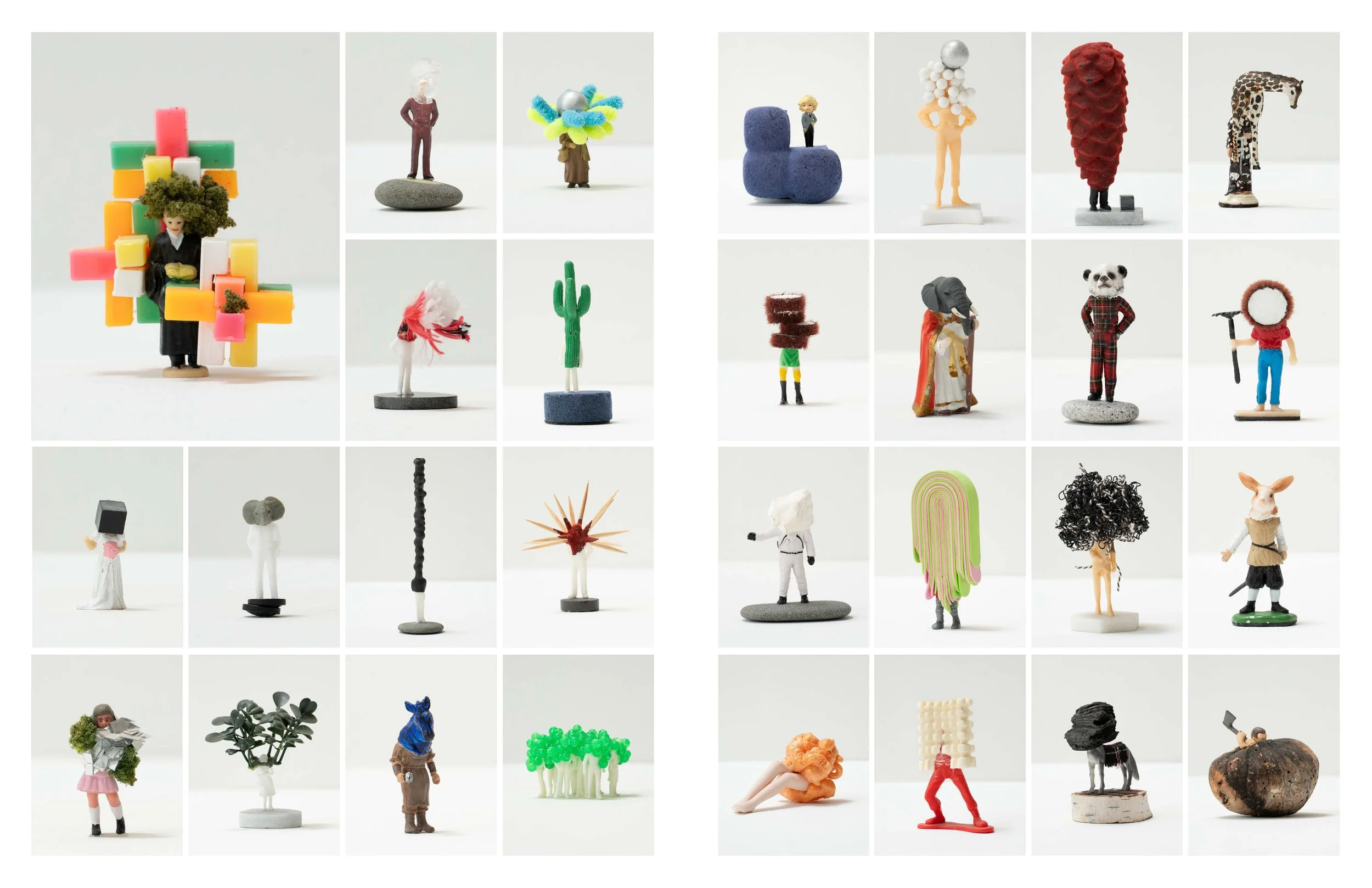
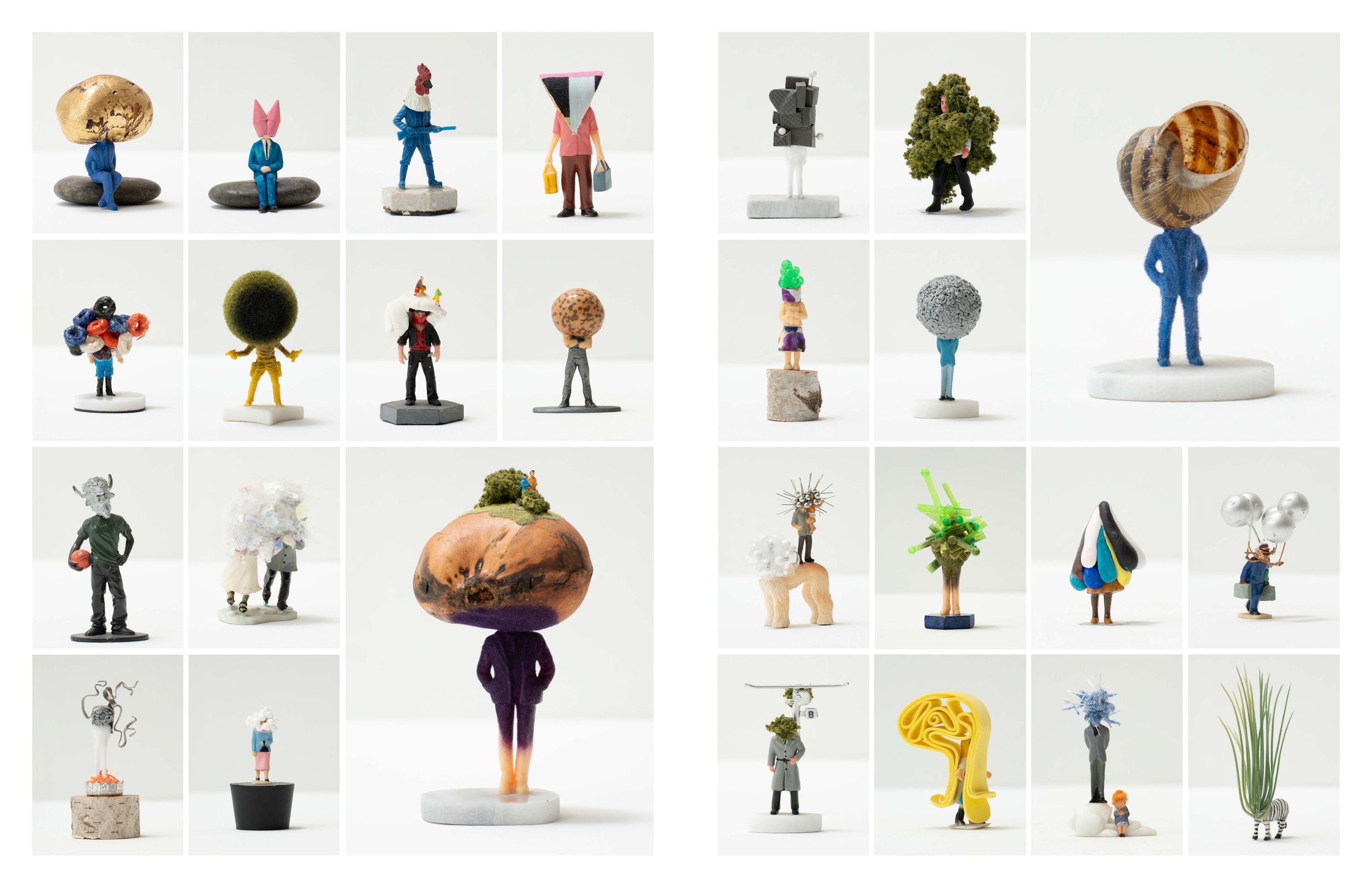
The name Samaritan appears without its familiar prefix. No “Good.” Ortbal strips the word of its moral freight deliberately, leaving only the figure itself: a traveler, a stranger, someone passing through from somewhere else. The question of whether they are good is beside the point, what matters is how they appear and are experienced.
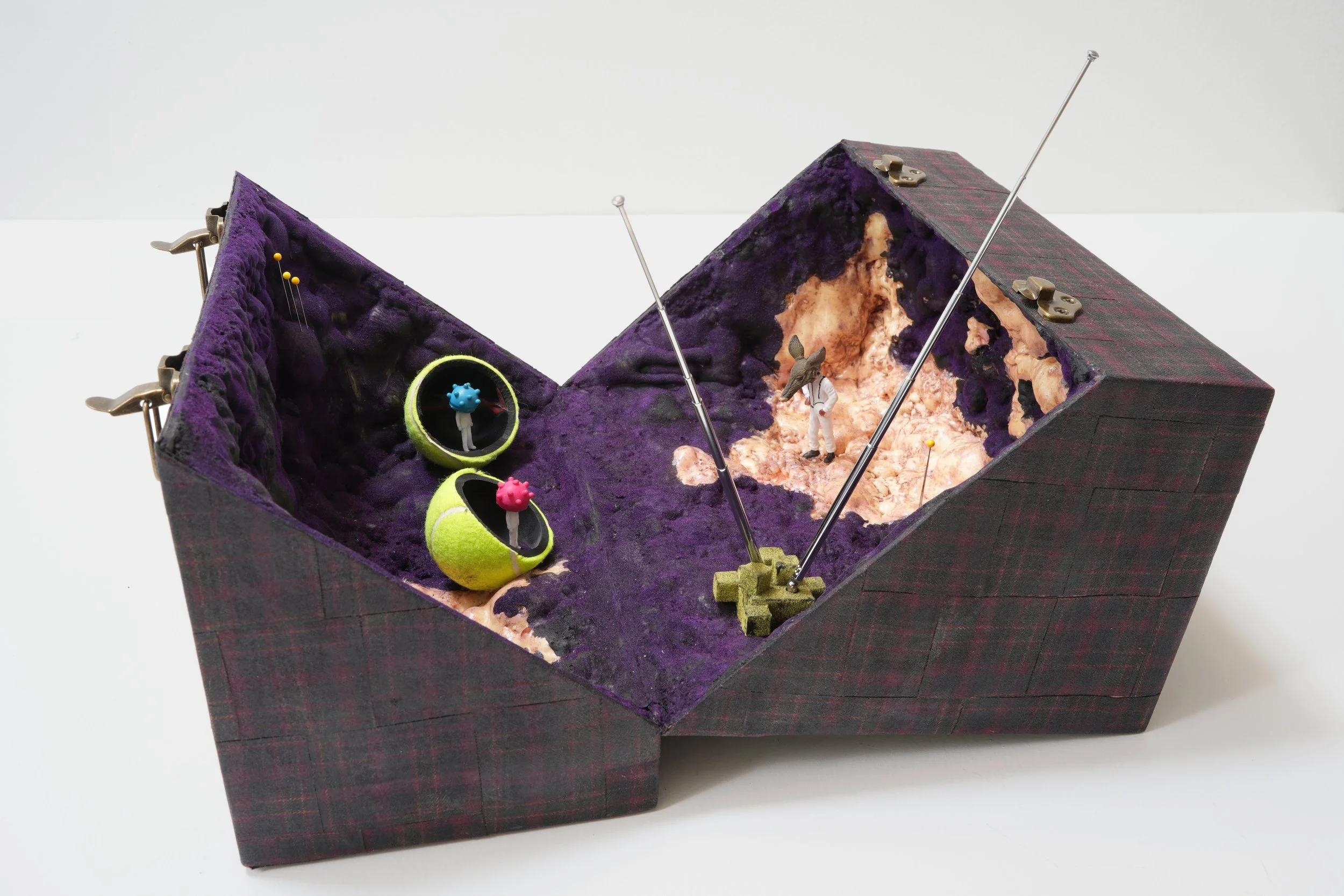
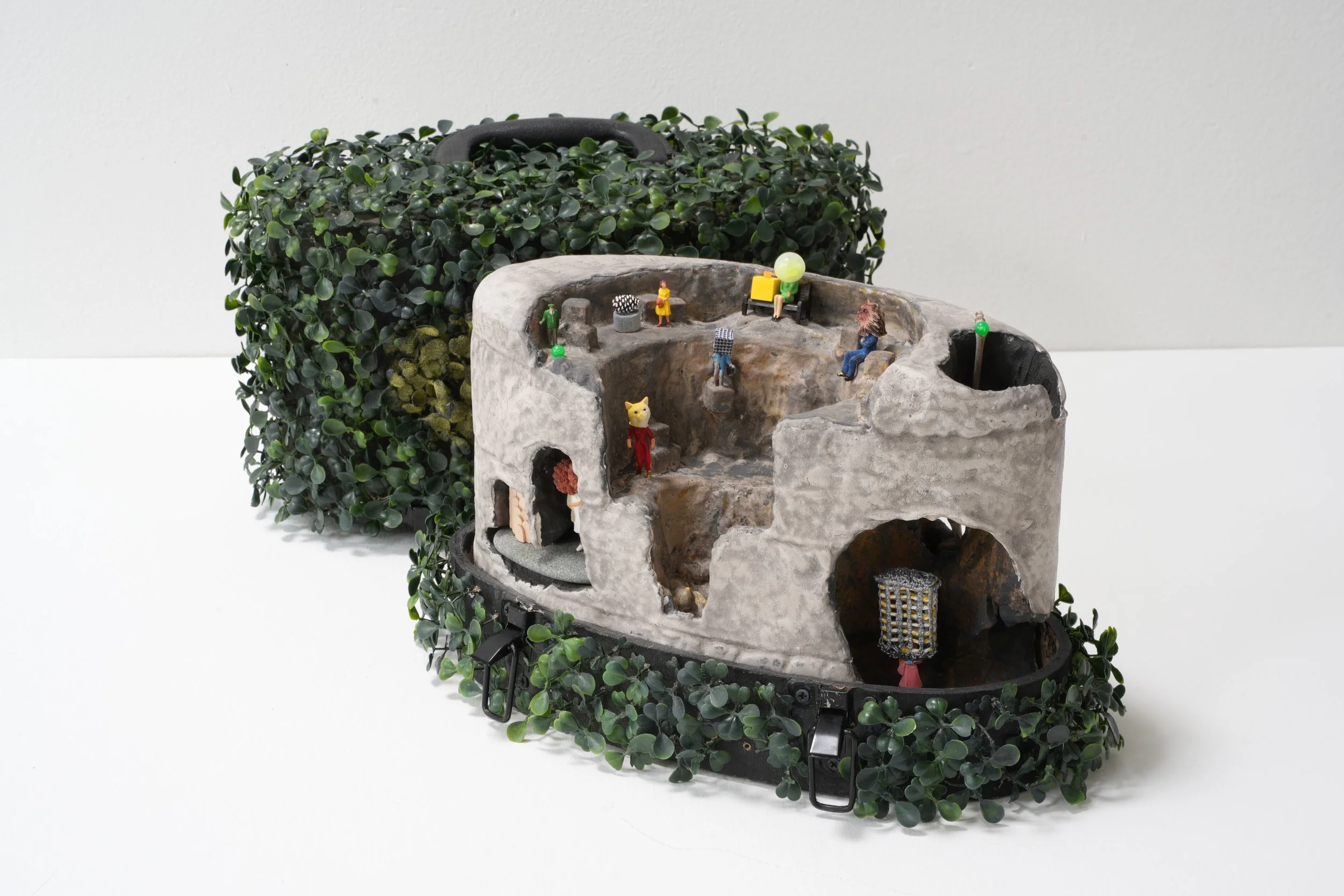
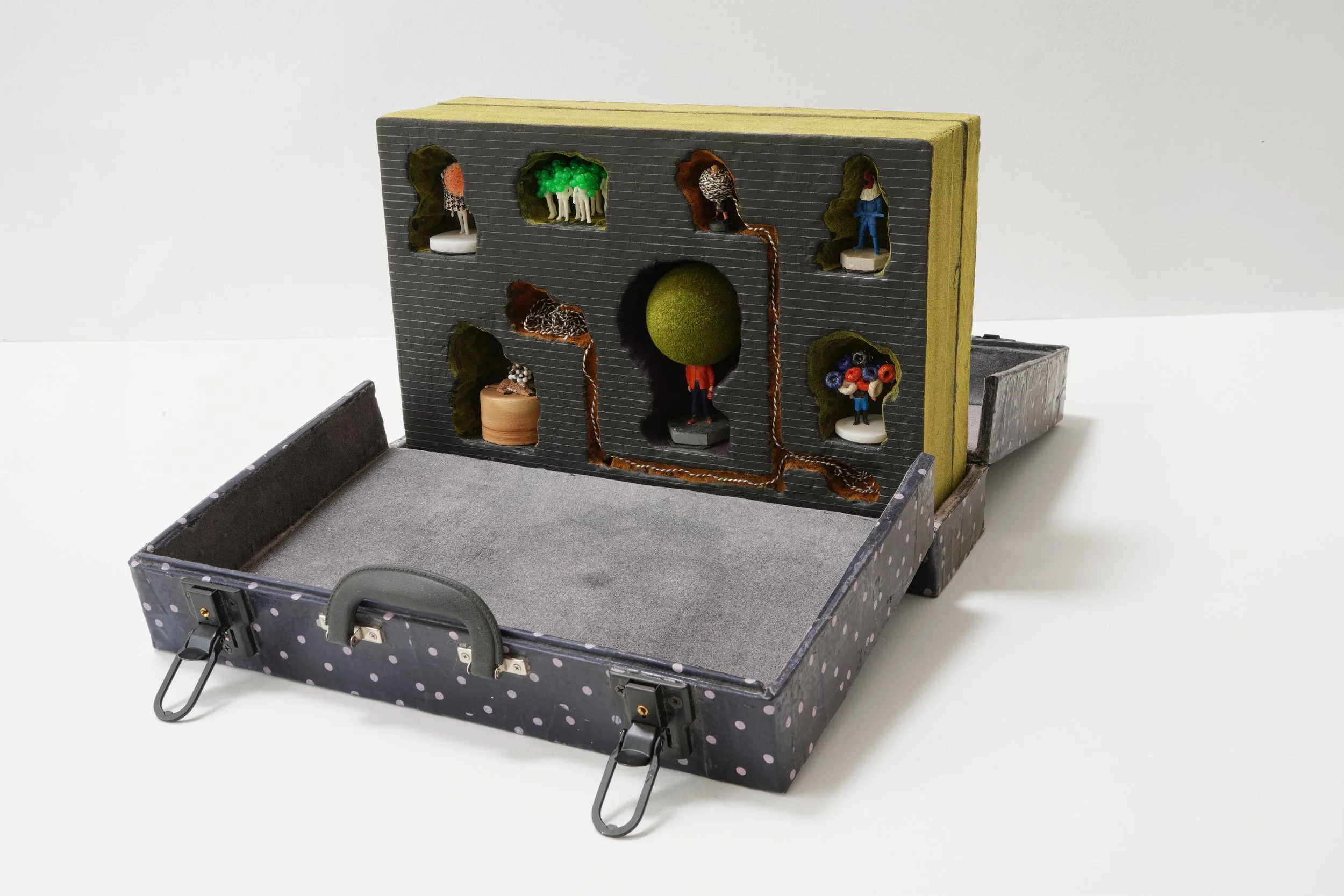
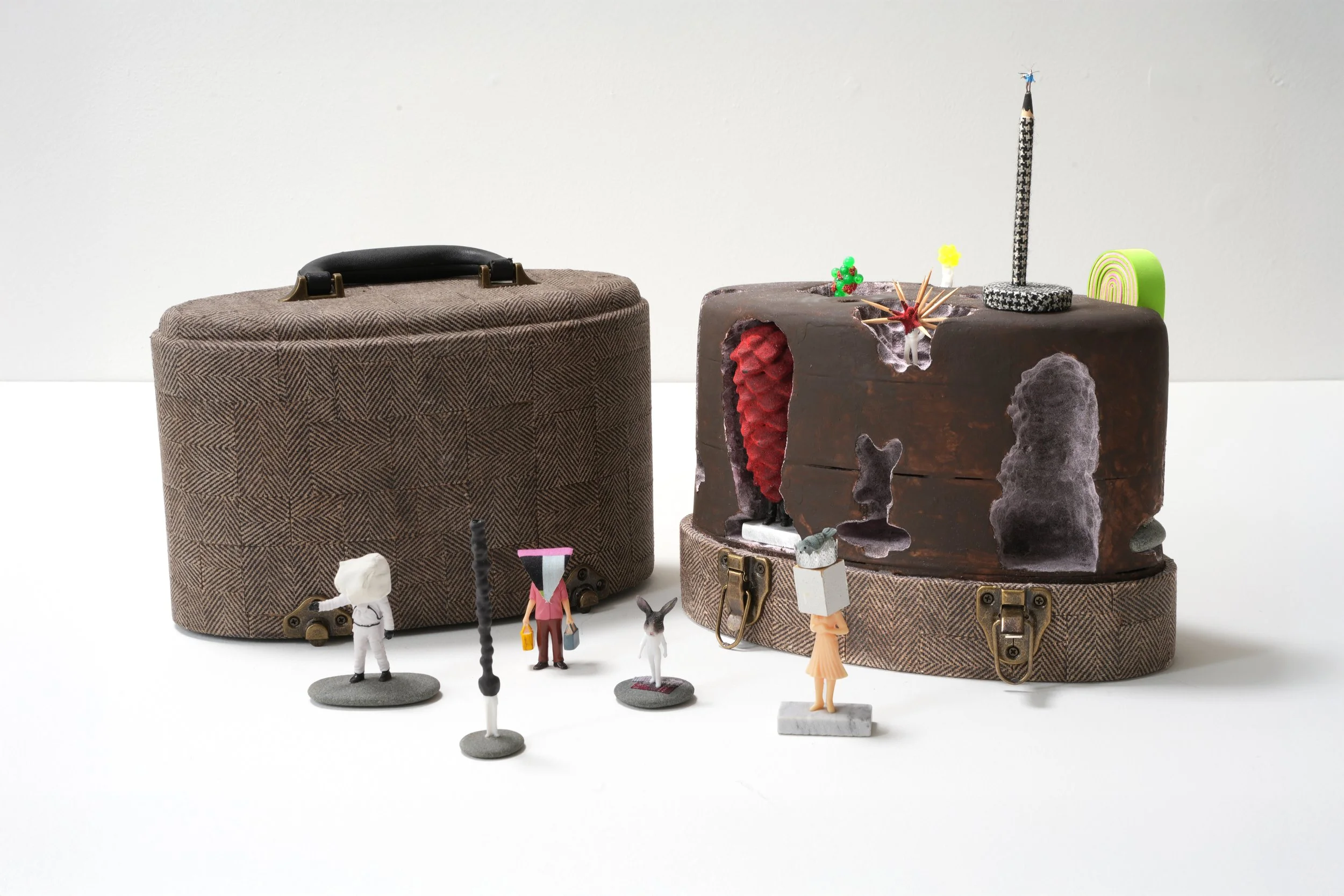
The center piece of Encounters, however, was something new.
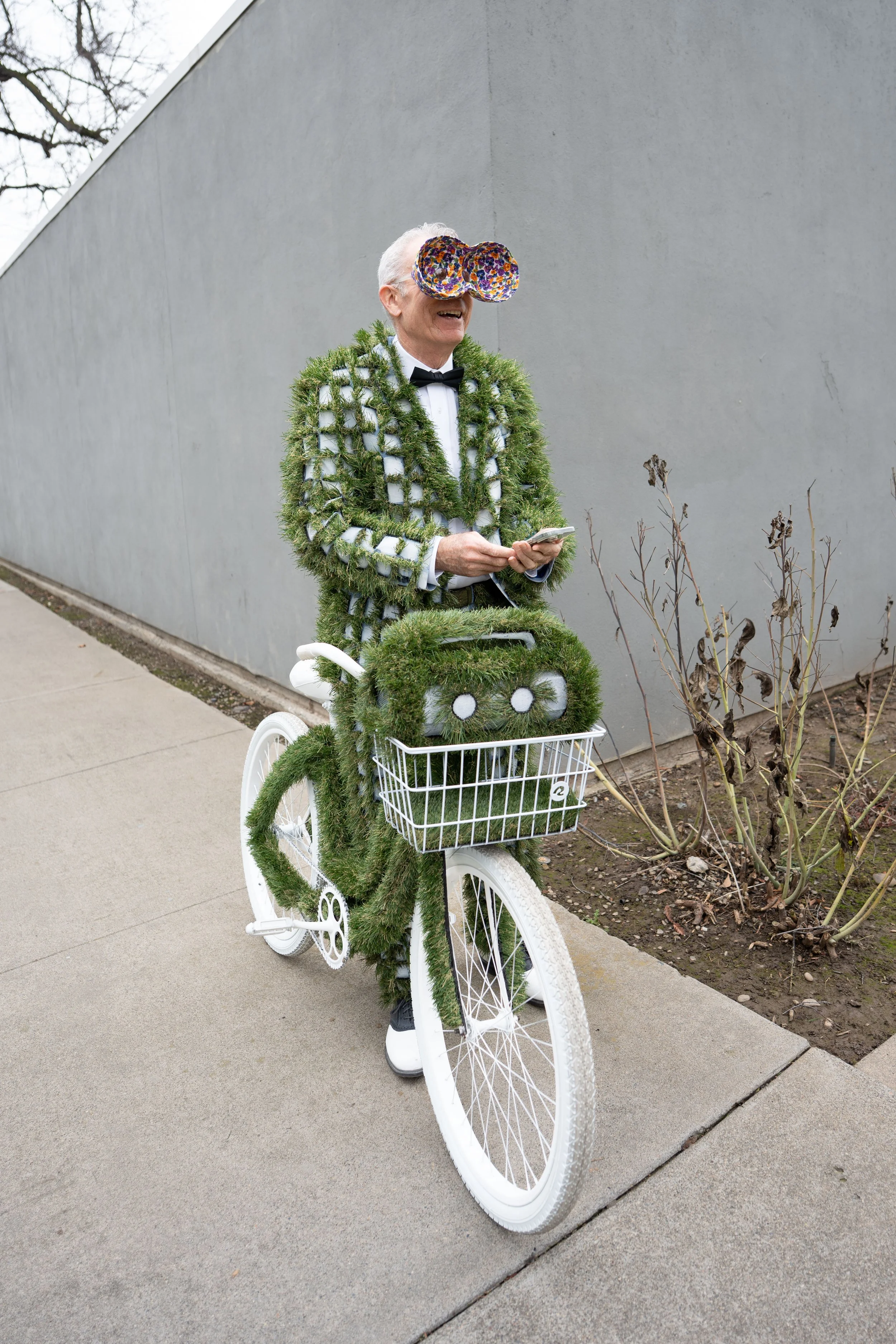
Years earlier, Ortbal had jotted a hunch into a notebook: make a suit in astroturf. Like many of his ideas, it waited patiently for its moment. Then, earlier that year, he met Bill and Nancy Roe patrons of the Pence Gallery who agreed to sponsor the exhibition. Robert connected with Bill when he showed up to their meeting clad in bike shorts, shoes and riding jersey; they are both avid cyclists. Months later, Roe was struck by a car while riding his bike and died.
The news hit Ortbal hard. The astroturf suit found its moment. Ortbal clad both the suit and an old red fat-tire cruiser left behind years earlier by a student, another idea waiting its turn. He whitewashed the bicycle to invoke the roadside memorials across our land that evoke loss and remembrance. Suited figure and bicycle: an elegy for a brief but real encounter, set in motion, a site-specific piece at Pence Gallery in Davis, California. The work is called To the Departed.
Video by Edgar Zhang
In the video accompanying the piece, the suited figure moves through Davis on the bicycle, traveling past familiar landmarks, a little strange, not quite belonging to the world it passes through. It is unmistakably a Samaritan at human scale — same hybrid logic, body of one thing and surface of another, same quiet absurdity, same suggestion of transit. The traveling case has opened, the figure inside has stepped out and taken to the road.
This is where Ortbal’s power becomes difficult to explain but easy to feel. The idea is almost embarrassingly simple: a man in a grass suit on a bicycle. And yet, encountered in person or on screen, it is completely disarming. Ortbal has the rare ability to take an idea that sounds like a punchline and make it land as something else entirely… tender, funny, and strange, all at once! His ideas are simple, he simply has the power to make them art.
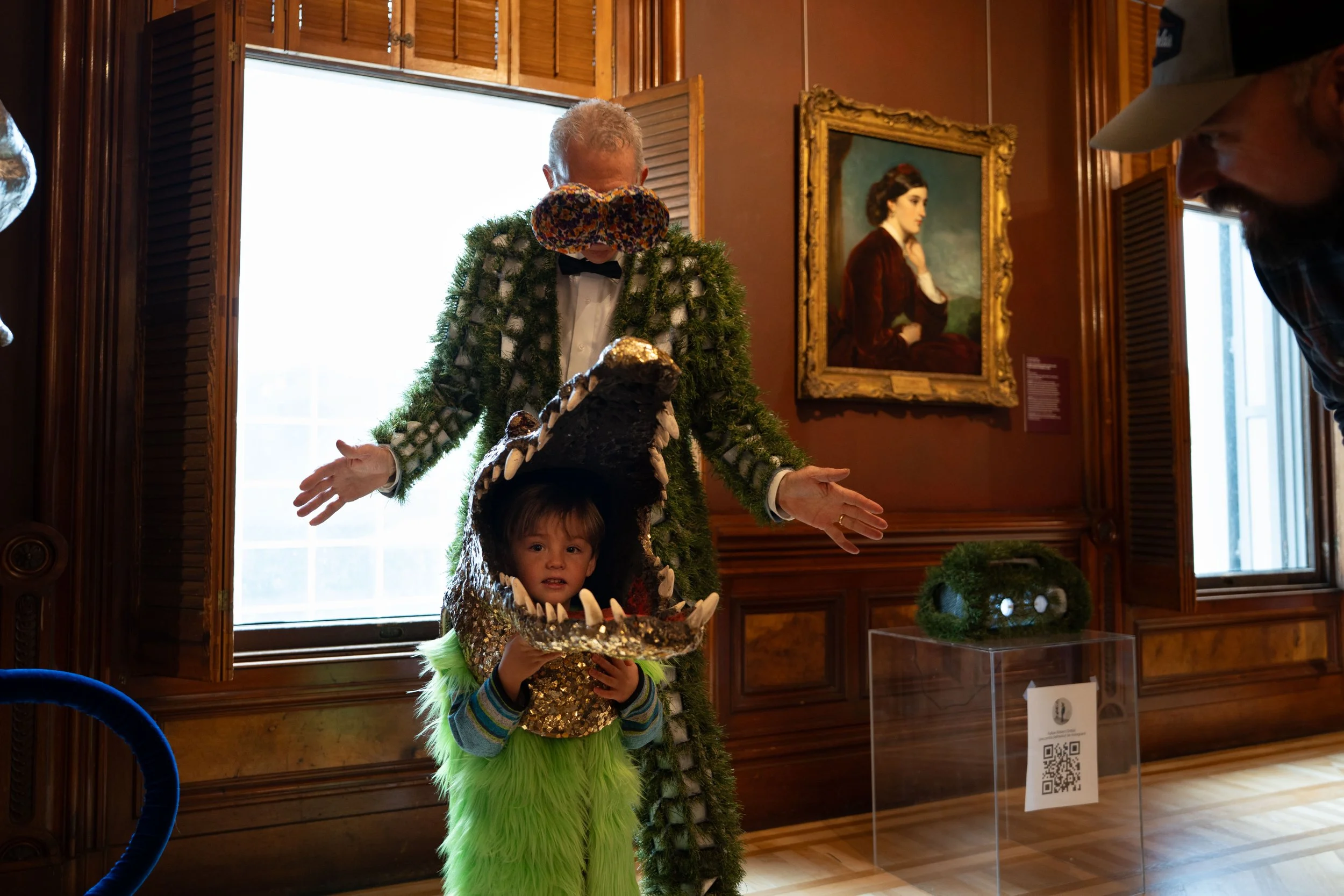
On New Year’s Eve 2025, at the Crocker Art Museum in Sacramento, something unexpected happened. Ortbal had set out a collection of wearable masks, enormous handmade heads in the shapes of dogs, rabbits, abstract geometric forms, creatures that don’t have names and invited visitors to put them on and participate not just observe.
The children loved it, of course. But it was the parents, many of them around Ortbal’s own age, who surprised everyone. Once they put the masks on, something in them released, they stopped being professionals, stopped being tired, stopped being the responsible ones. For a moment they were just bodies inside a sculpture, peering out through two small eyeholes at a world that suddenly looked different. And the children — who had expected to be the spectacle — found themselves on the other side, watching, laughing, taking over their parents’ phones to photograph their guardians.
The roles had switched. The parents were the main characters; the kids were the audience.
This is the social alchemy that Ortbal has been refining since 2018, when he first organized a group of twenty artists and colleagues to don rented papier-mâché bunny heads and enter the Crocker en masse, paying admission with carrots. The event, which he called Dumb Bunnies, was meant as a humorous response to the museum’s rigid rules about how faculty could participate in their community event. Some people were delighted, others, as Ortbal admits, were not. But the event revealed something: that the mask is not a barrier to human connection but a different kind of door.
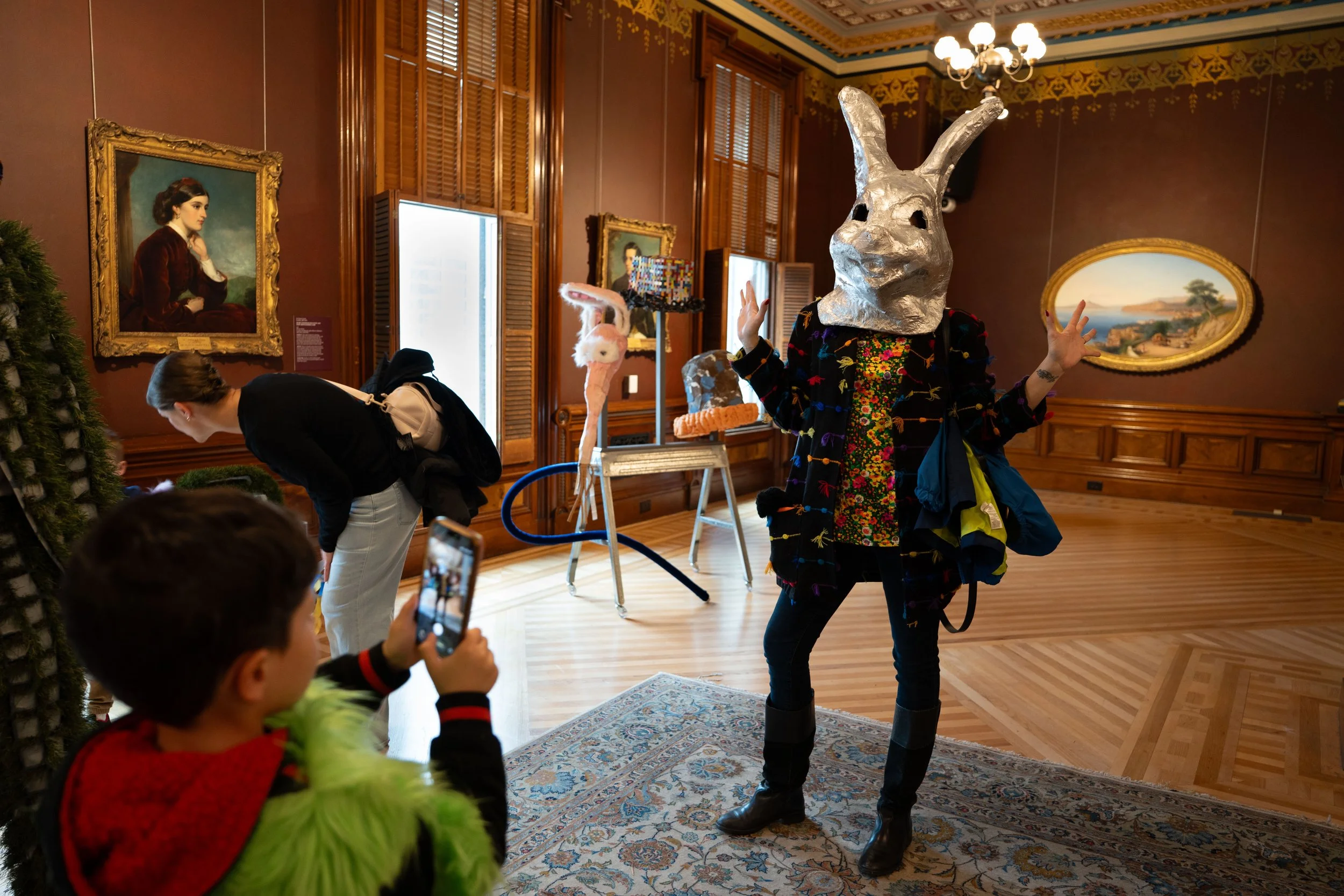
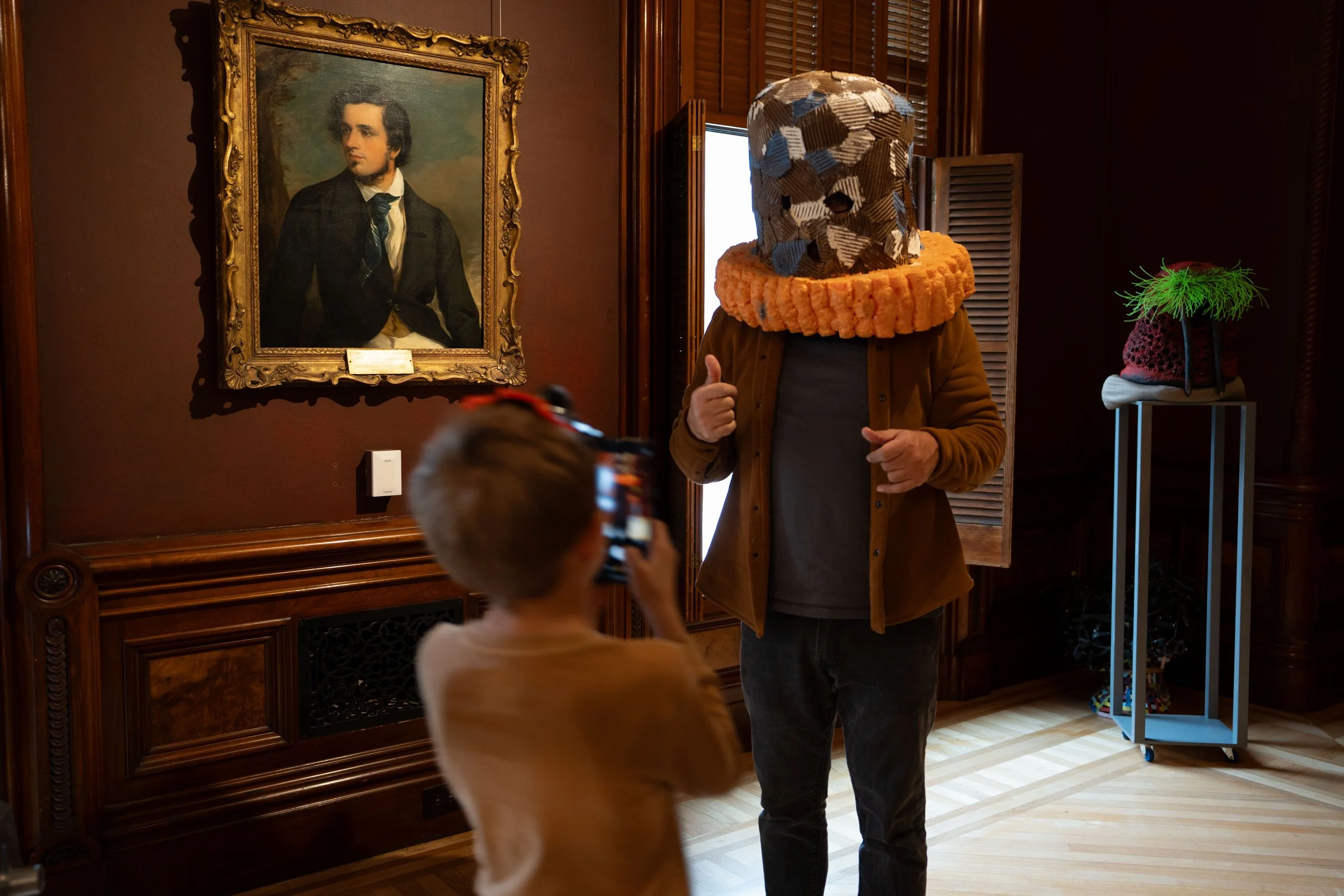
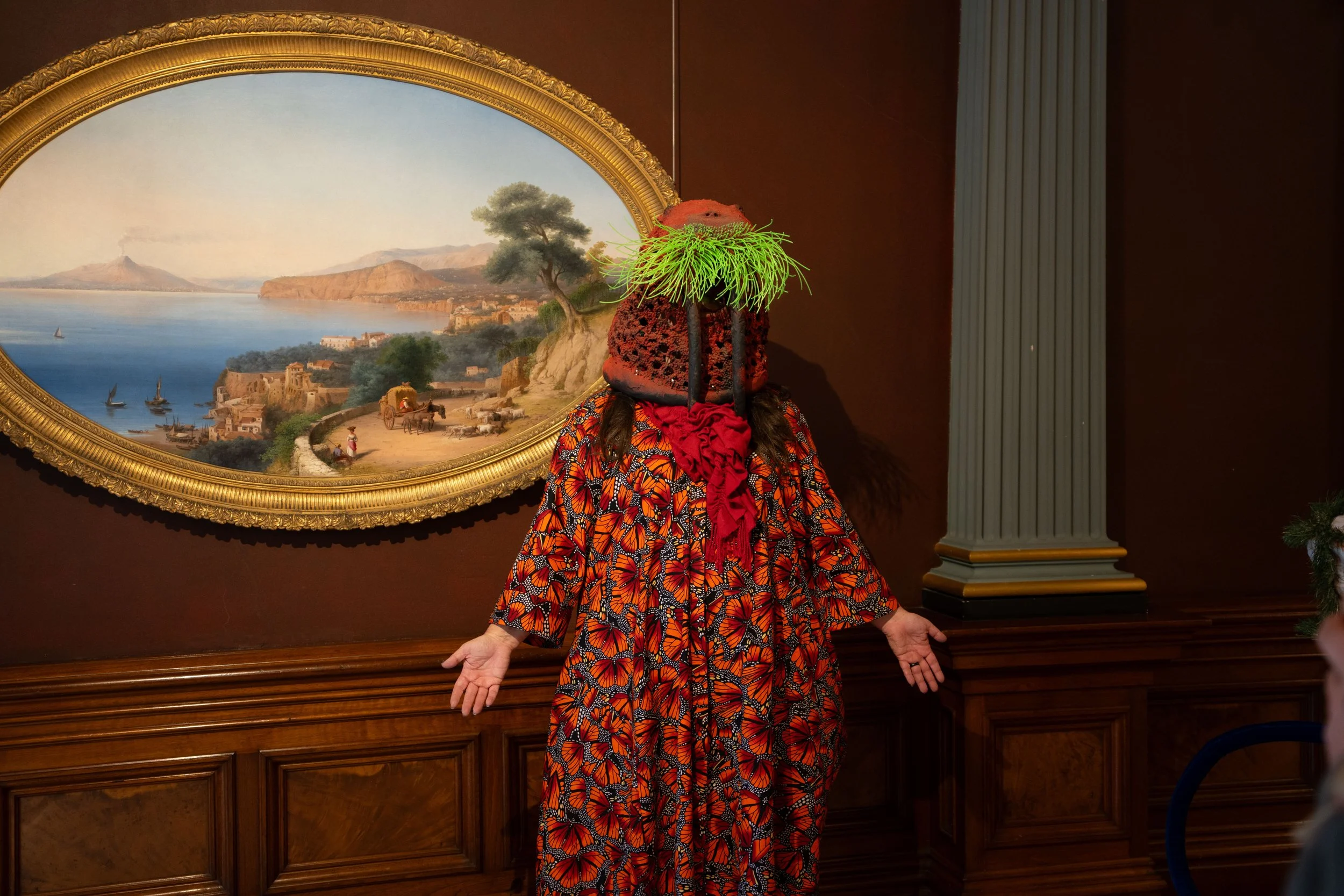
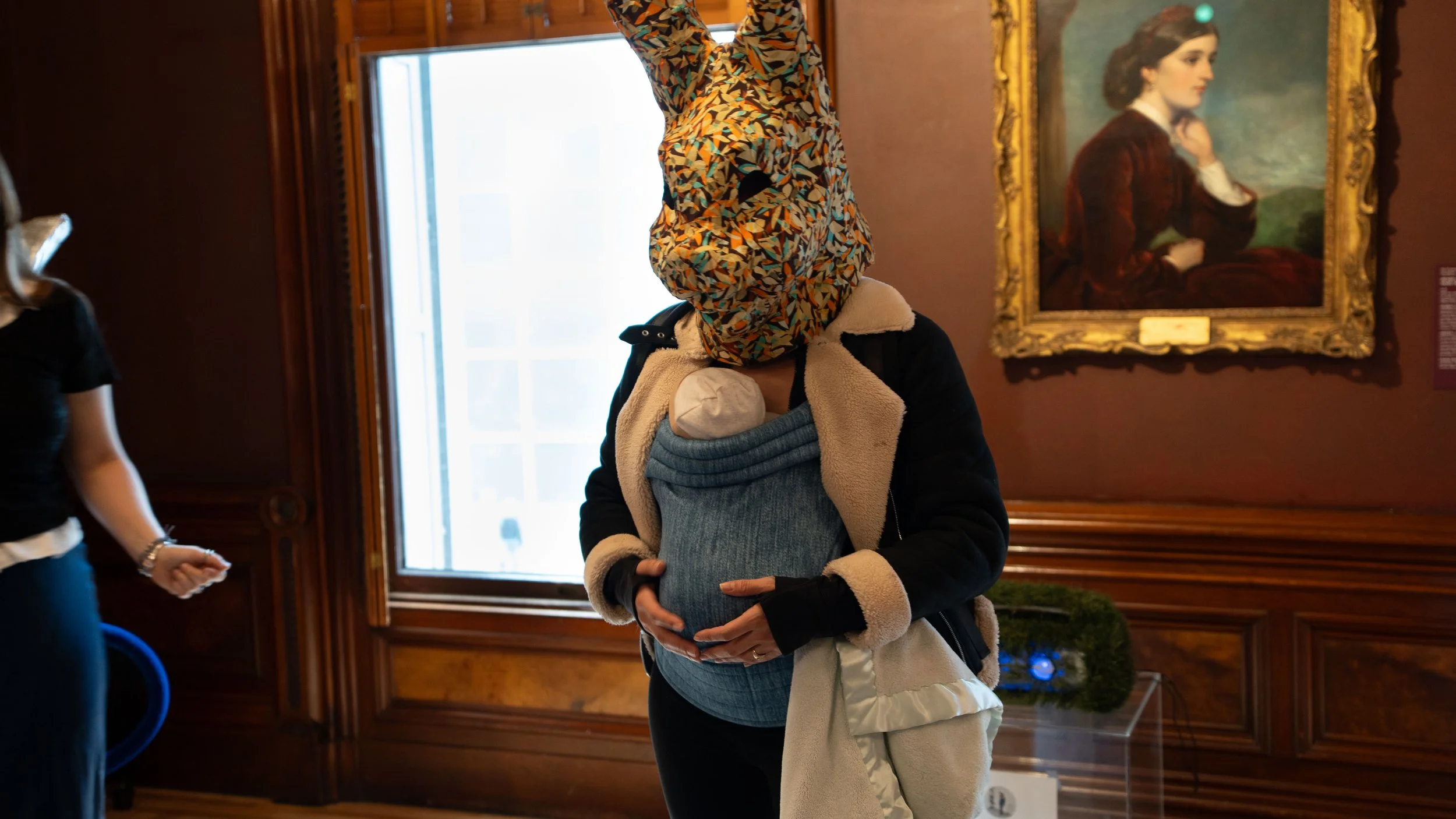
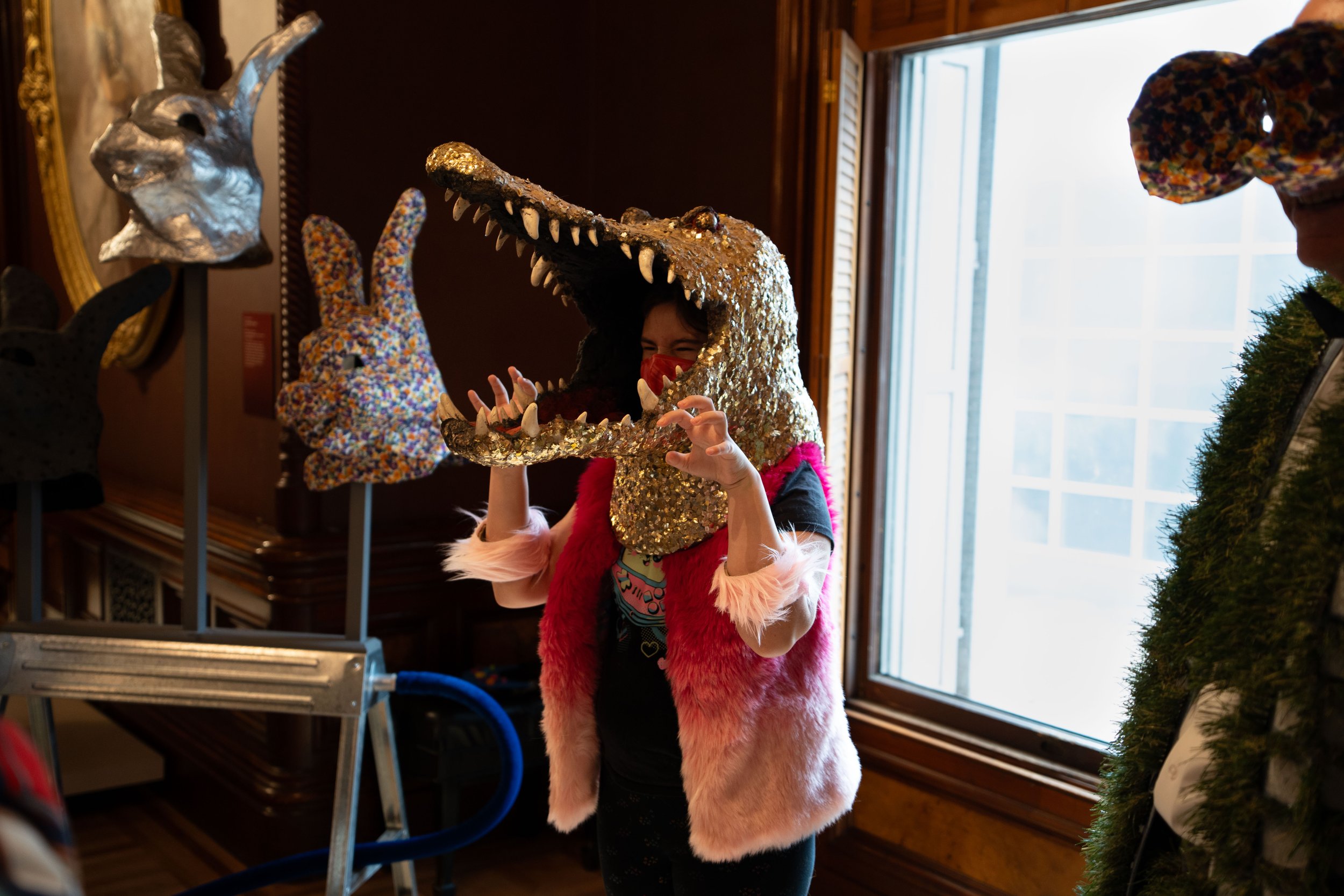
Inside the sculpted head, the world reduces to two small ovals of light, the sound becomes muffled, the edges of vision blur, your breath echoes inside the chamber.
In that narrowing, individuality slips away, or should we say another kind of individuality takes over?
Participants in Ortbal’s performances describe an unexpected sense of freedom, of community with strangers, of having stepped briefly outside their own biography. A teenage volunteer and someone in their eighties, marching together through a shopping mall to a live brass band, are briefly the same kind of creature: absurd, lighthearted, and free.
This understanding is not entirely new. In Costa Rica, the mascarada is one of the country’s oldest traditions, rooted in a mixture of colonial Spanish festivity and indigenous ritual, in which local artisans construct enormous papier-mâché heads representing folk characters: the toothy devil, the headless priest, the witch of Escazú. Worn and danced through town squares to the rhythm of cimarrona bands, these figures were never only meant to frighten. They were meant to dissolve the boundary between spectator and participant. As one Costa Rican mask maker put it, the mask standing alone is just an object — but when people put them on and begin to dance, they transform: from máscaras into mascaradas. The object becomes an event, the individual becomes the procession.
Ortbal arrived at a similar performance from a completely different direction, through a sculptor’s instinct… What the mascarada had encoded over centuries into culture and ritual, he reconstructed from scratch in Sacramento.
Ortbal describes himself as fundamentally a maker, someone who revels in the cocoon of the studio. The performative work, he has said, does not come naturally to him; It is a pushing beyond the boundaries of comfort, the kind of stretching that a curious and courageous artist must do.
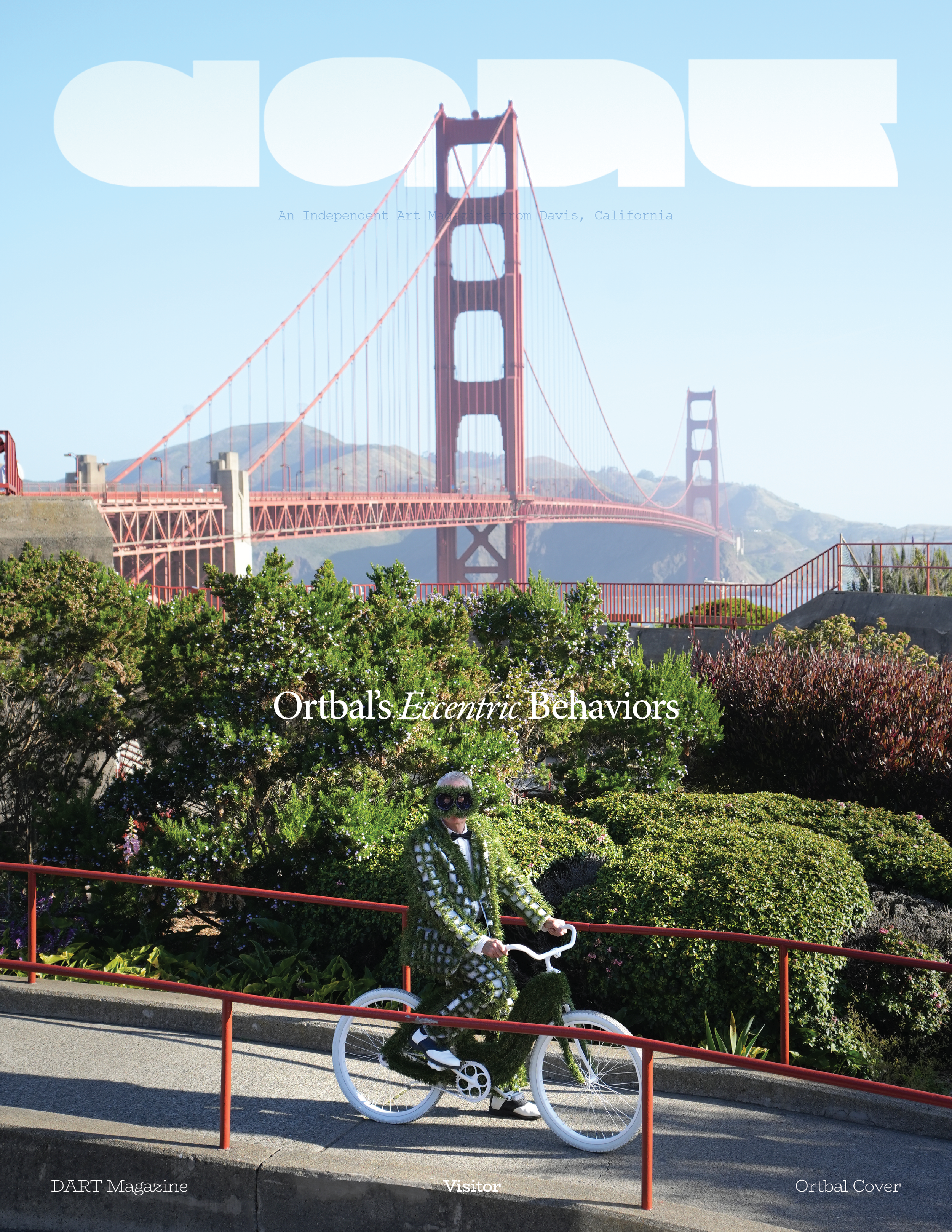
For the Visitor issue of DART Magazine, Ortbal took the astroturf suit back to the road.
This time, San Francisco: famous locations, familiar skylines, the city going about its ordinary business. The bicycle again, the same unhurried transit. But watching him work in the city makes something clear that the gallery show only implied: Ortbal’s visitor does not go somewhere new, it makes somewhere familiar suddenly, irreversibly strange.
Before any camera comes out, there is a day of scouting — walking slowly, looking for the simplest possible image. His instincts are unfussy, almost counterintuitively so. The most effective visual, he understands, is usually the most direct one. A man covered in grass on a park bench you have walked past a hundred times, a bicycle wrapped in turf leaning against a wall you have never noticed. What the figure does is not arrive from somewhere else, it lands in the middle of the known world and makes you see it as if for the first time.
This is what all of Ortbal’s visitors do. The Samaritans in their traveling cases make the ordinary objects around them, a smooth flat stone, a scrap of fabric, a tiny figure in a suit, look like artifacts from a world worth examining. The bunny heads at the Crocker did not transport the parents who wore them to somewhere else; they transformed the museum they were already standing in, made it a place where the usual rules had been suspended, where a sixty-year-old stranger could become the most interesting person in the room. The astroturf suit on a bicycle in Davis was not about departure, it was an elegy for someone who had traveled those same streets and was gone, it’s a way of returning to familiar ground and finding it charged with loss and memories.
And in each case, the visitor does something else: it makes the people watching visible to each other. The parent who puts on the mask and finds their child suddenly, unexpectedly laughing at them. The strangers who bonded years later over a shared memory of bunny heads, having never recognized one another inside them. The shopper in Emeryville who stopped mid-stride, bewildered, and reached for their phone — not to document the figure, but because something in them needed to tell someone else: you have to see this. The visitor is a mirror as much as they are a traveler. It passes through and, in passing, shows people where they are and who is next to them.
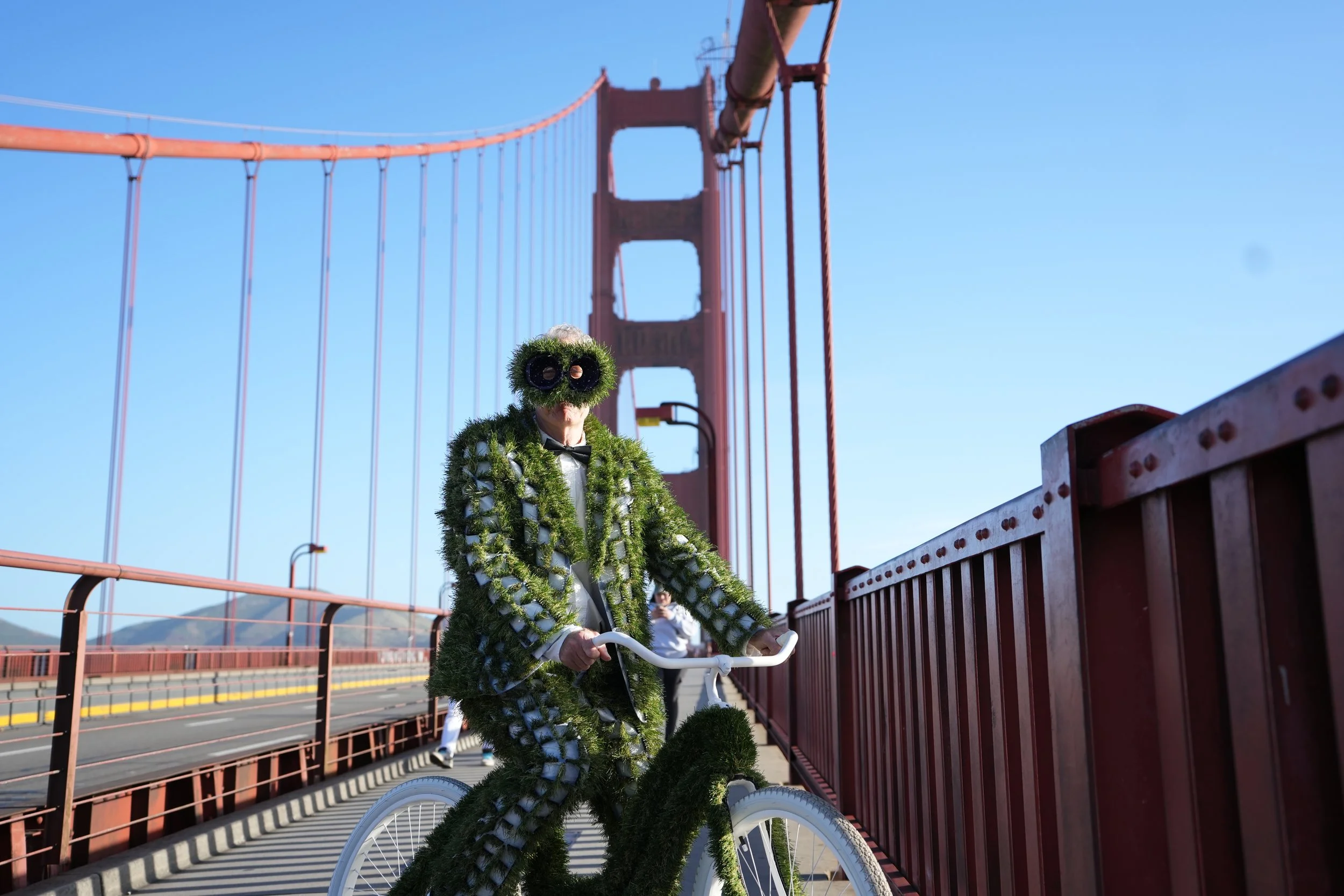
Ortbal has spent decades making objects that orbit a center he describes but never fully names. The ideas are simple. Stated plainly, they sound like punchlines. And yet, encountered in person, in a gallery in Davis, in a shopping mall in Emeryville, on a street corner in San Francisco, they land as something else entirely. The kind of strange that stays with you after the figure has rounded the corner and disappeared.
He calls it eccentric behavior, and he is not wrong. But what it produces is something harder to name, a small, involuntary shift in how you see the world when something passes through it that does not belong, and you let it. For a moment, the familiar becomes foreign, the foreign becomes beautiful. And the people standing next to you become briefly visible, Ortbal has spent a career learning how to cause that shift with the simplest possible means.
Or in my words, he had the magic to change the world around him. He is, by all appearances, just getting started.