An Abstract Dialogue of Thresholds where Paradigms Shift
An Abstract Dialogue of Thresholds where Paradigms Shift: The Meeting of Relations

Installation view of Threshold in Relations, Zihan Cui, Zhaochen Chen, Yuyu He, Xiaohan Jiang, courtesy of Christy Wang and FanFlus
A set of abstract relations arise at the threshold of visual perception at the group exhibition titled, Threshold in Relations, at Nguyen Wahed, curated by Fanfan Yuxuan Fan. In the case of Fan’s curatorial vision, “threshold” cannot be a middle compromise between the visual elements; it rather proposes a complete push to the maximum in terms of the perceptual experience and the sensory load, causing a strong shift in how the artist and the viewer continually re-conceive of the work after the initial perception and interpretation.
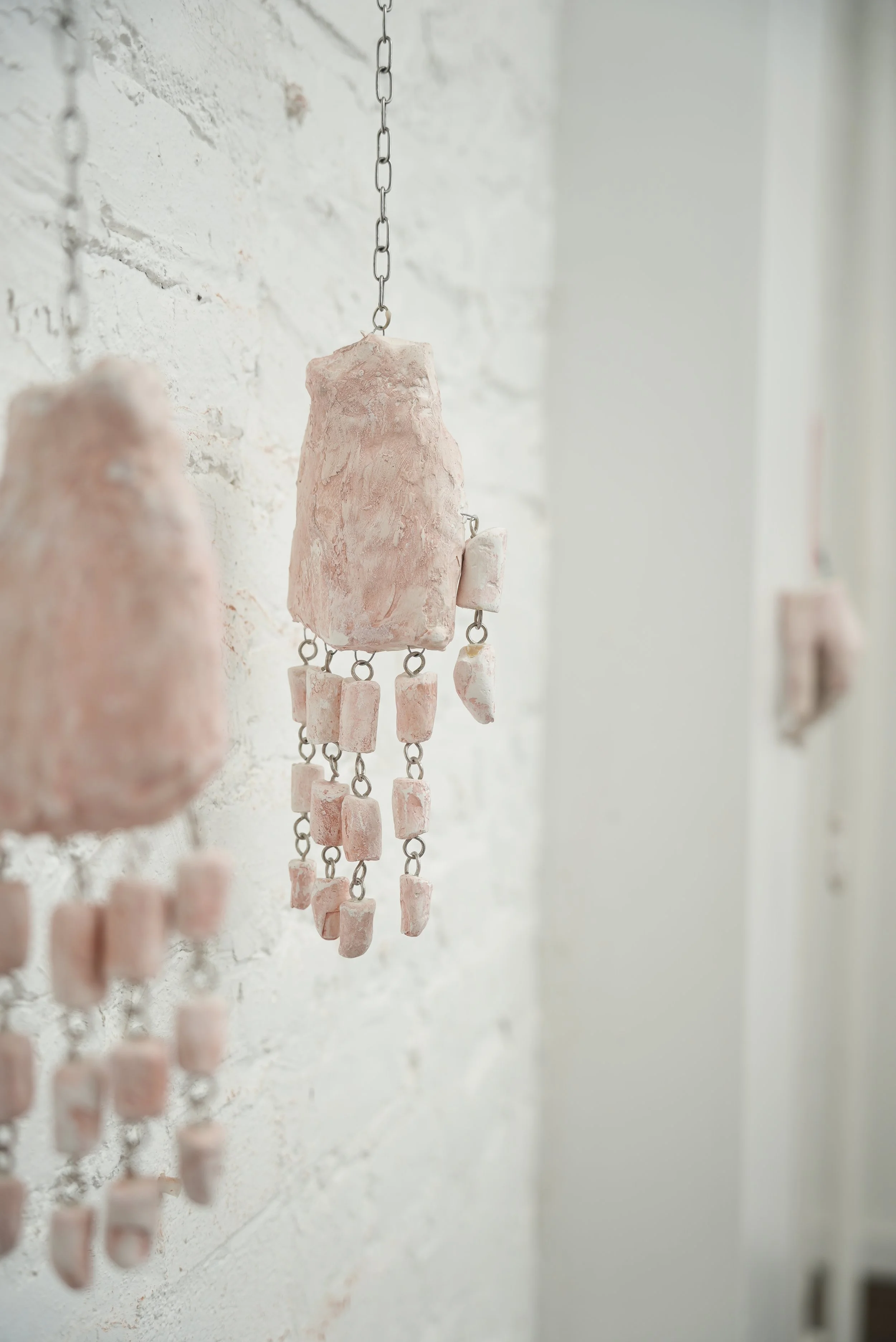
Installation view of Threshold in Relations, Zhaochen Chen, Two Hands, 2025, courtesy of Kon Zeng and FanFlus
The works of Zhaochen Chen, Zihan Cui, Yuyu He, Xiaohan Jiang, and Aubrey LaDuke engage in a highly abstract dialogue of visual and conceptual relations that traverse between the realms of the body, the environment, the subjective and the objective, system-based control and human desire, and the poetic and the grotesque. What we can gather and decipher from this exhibit of works by artists with a diverse set of interests and visions may be akin to an abstract thought or question arising from the ever-changing relations of an abstract puzzle.
Although Zhaochen Chen and Yuyu He originate from different academic backgrounds of oil painting and architecture, respectively, their works in the show converge in terms of the visual style, which appear as sculptural installations with hanging forms of biological and/or organic nature.
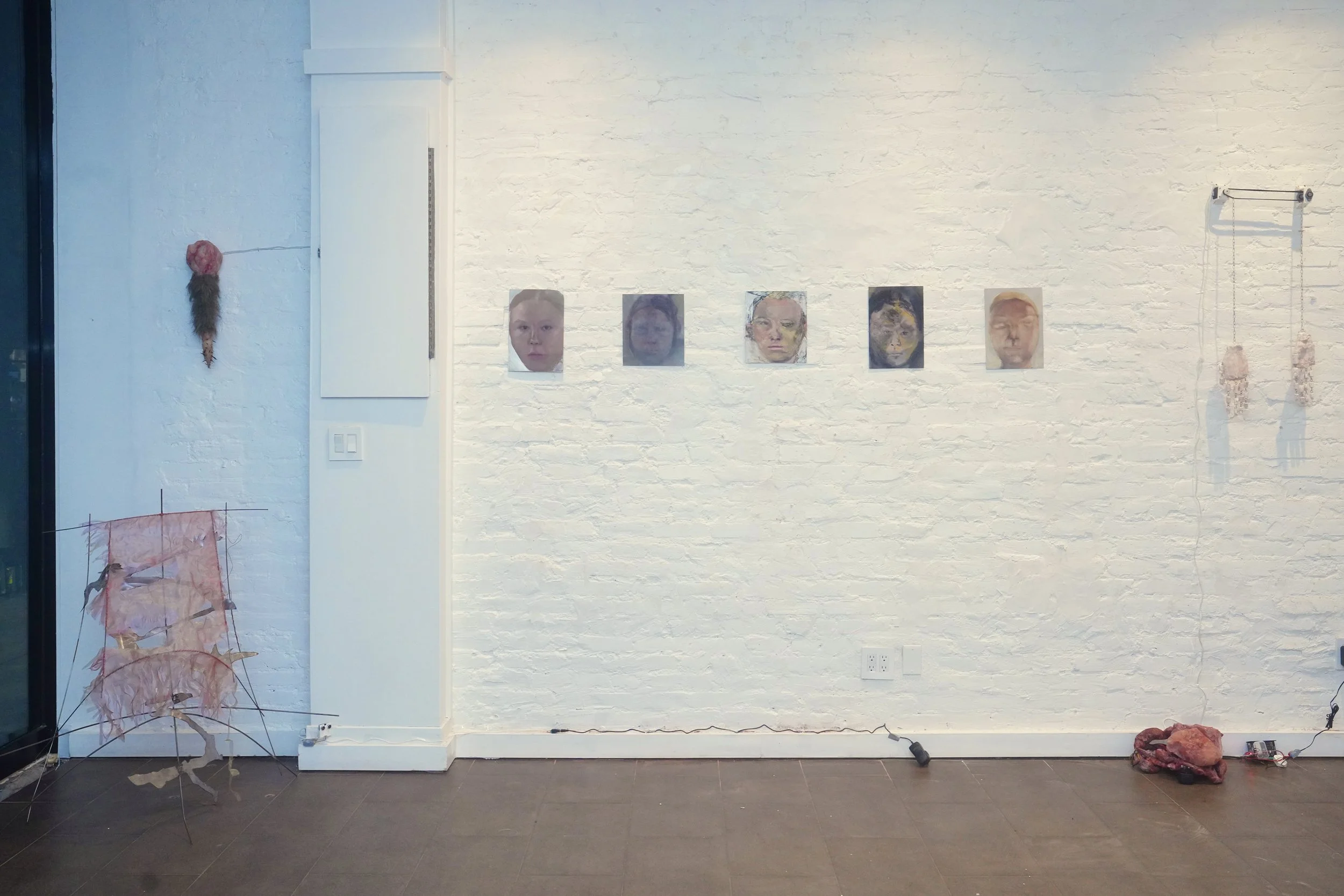
Chen’s work is the combined output of various readings on the philosophical theories on the body, such as Masahiro Mori, Kiki Smith, Gilles Deleuze, and Felix Guattari. They comprise forms of abstraction that stand on their own terms, but these also symbolically dissect and deconstruct the whole of the body into its parts (in terms of the organs, bones, hair, and jointed units, through their organic, surrealistic, and uncanny qualities. For example, Two Hands (2025) can be easily identified as a pair of hands, but it can also be interpreted as a jellyfish or a squid. Upon further examination, however, it can even be understood as an abstraction that serves as the core definition of a biological unit with arms or movable joints hanging from underneath, open to multiple subjective interpretations.
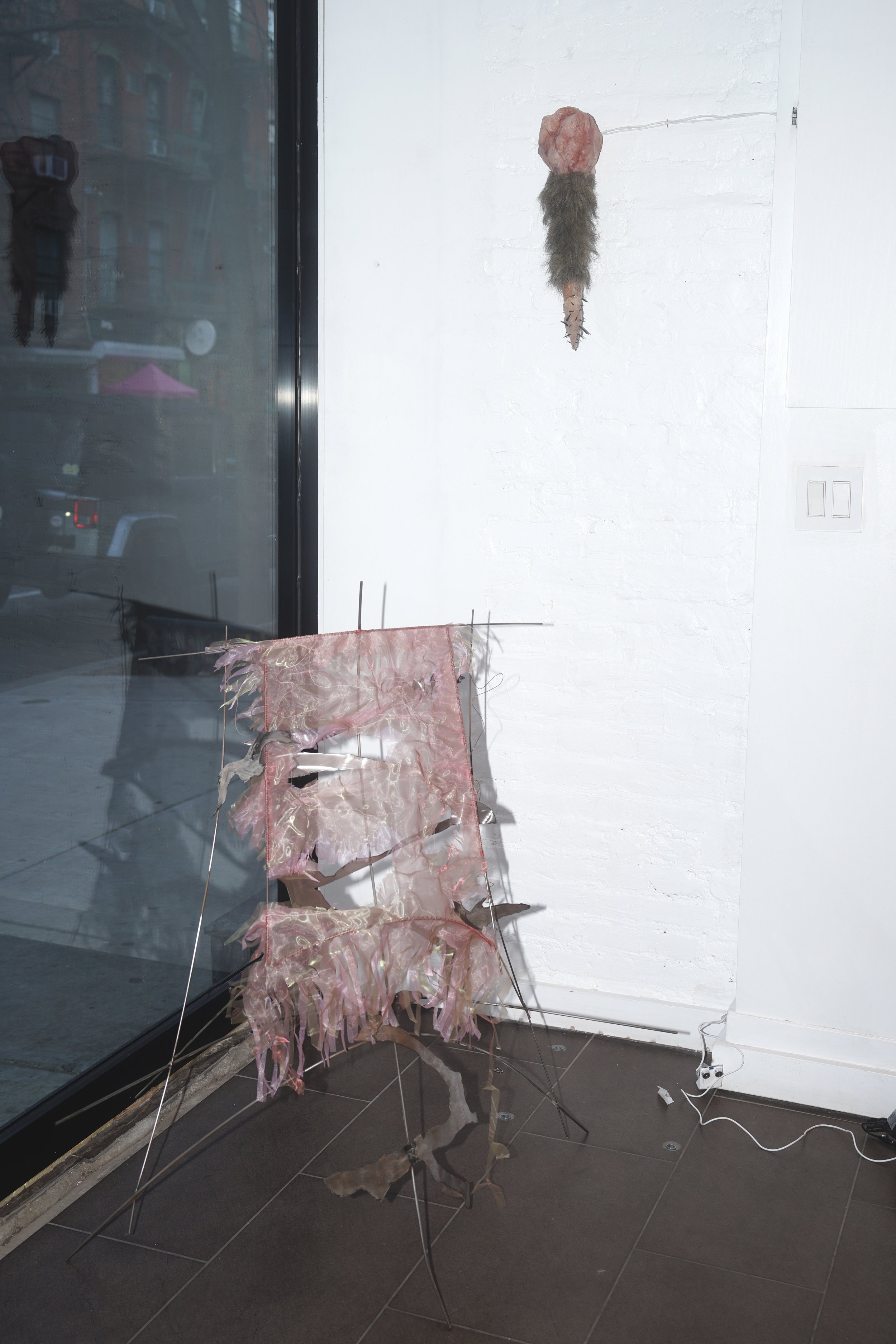
Installation view of Threshold in Relations, Yuyu He, Sha, sha, sha, 2024 (below); Zhaochen Chen, Tail, 2025 (above),courtesy of Christy Wang and FanFlus
He’s piece, Sha, sha, sha (2024), is also organically abstracted but with a slightly different nuance: the “organic” takes on a a curvilinear and aerodynamic quality like the silhouette of a waist or thighs, not the raw organs from a dissected body. In fact, the curvilinearity coexists with the rectilinear lines, forming a kind of balanced, harmonious, and stable presence or aura. He’s work also occupies a conversation between space and presence, architecture and body, and interiority and exteriority, as if the body-like forms as suggested by the pink of the flesh are converging with the space itself, in a neo-cubist style or language.
Thus, both Chen’s and He’s deal with similar questions of what is a being: in Chen’s case, the conflicting question is how the body which contains the self can also dissected and rendered as an object (which would be in opposition to the subjecthood of the self); in He’s work, the being is already a part of the space that it occupies, similar to the particle and wave duality of quantum mechanics and quantum field theory.
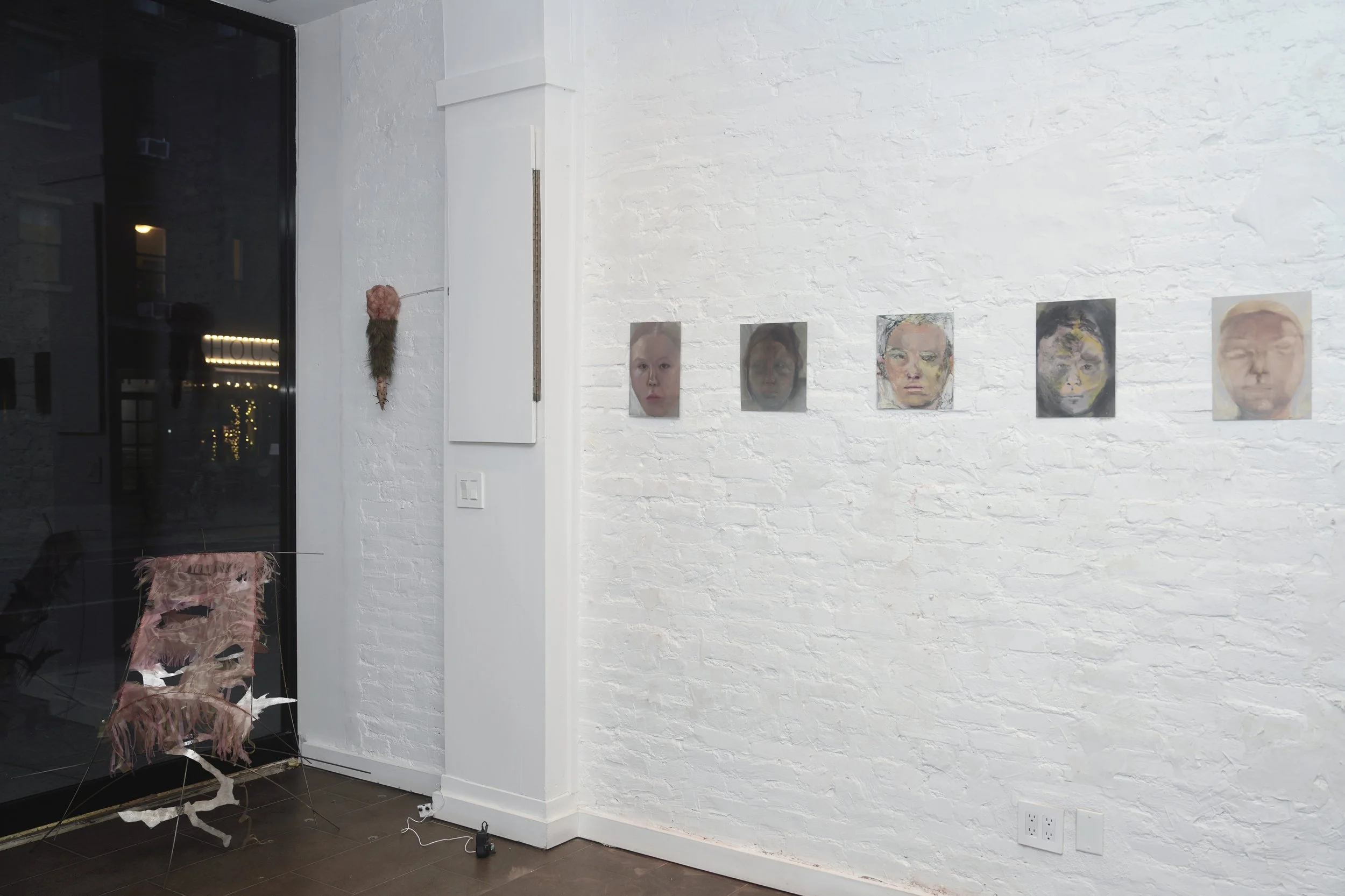
Installation view of Threshold in Relations, Yuyu He, Zhaochen Chen, Aubrey Laduke, courtesy of Christy Wang and FanFlus
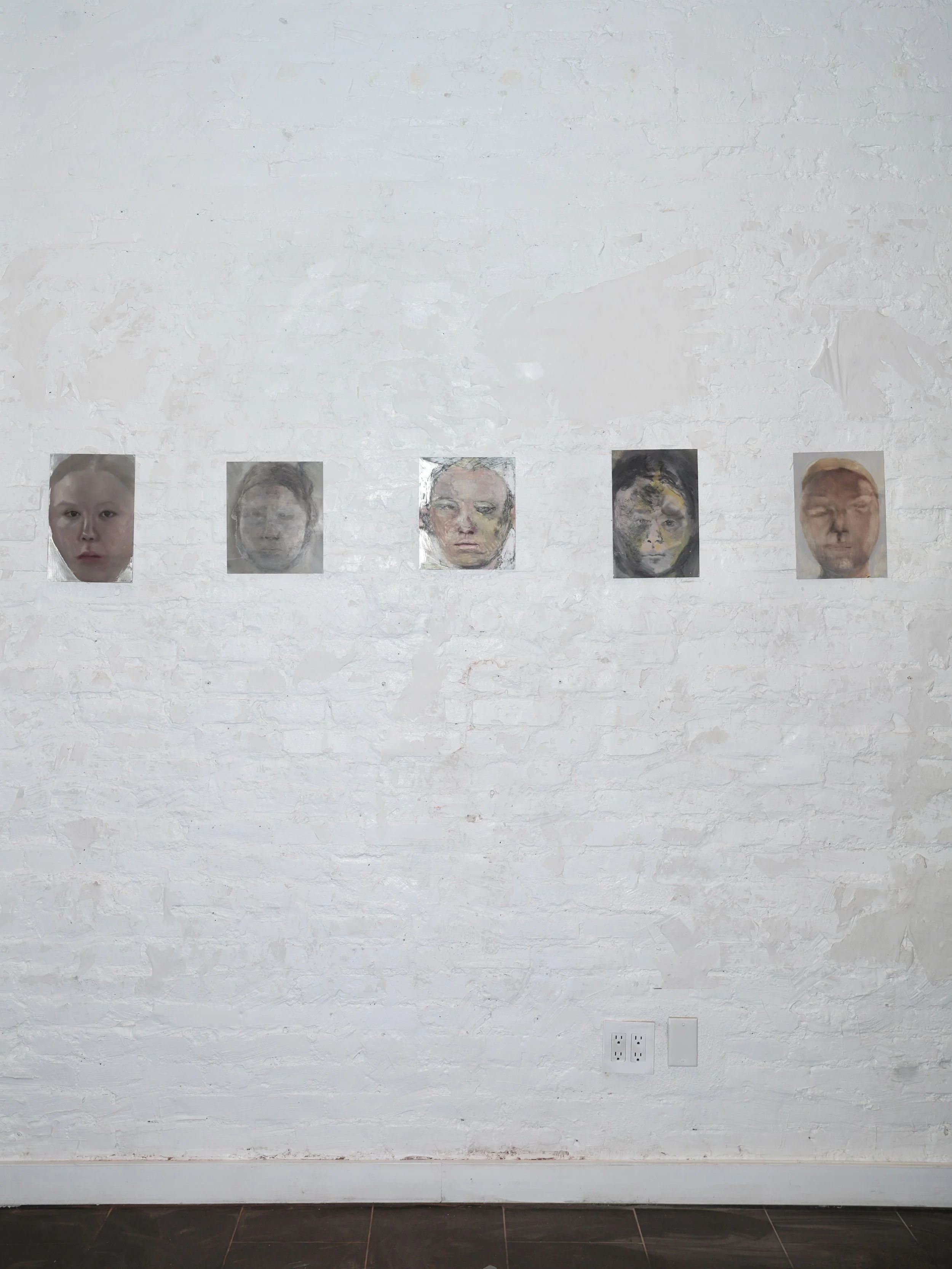
Installation view of Threshold in Relations, Aubrey LaDuke, Mirror no.6; Mirror no.4; Mirror no.8; Mirror no.5; Mirror no.7, 2025, courtesy of Christy Whang and FanFlus
The self is also represented in Audrey LaDuke’s portraits, which are painted on the reflective surface of aluminum and with the use of a mirror for the artist to observe her own face and body. The portraits are neither sweet nor pretty; rather, they are an earnest investigation of the self as a being in its original, neutral state of existence, which explains its neutral colors. Some feel moody; others, peaceful or contemplative; and the rest are disturbed psychologically. But isn’t this what the nature of the true self is, underneath the facade of an energetic personality, or a seductive or perfect image that we all present ourselves within the social landscape? LaDuke depicts the subjecthood as prone to emotional suffering, susceptible to dark states, and open to self-questioning and contemplation, even as the society and the capitalist economy demand that we always put on the masquerade of strength, invincibility, perfection, and attractiveness.
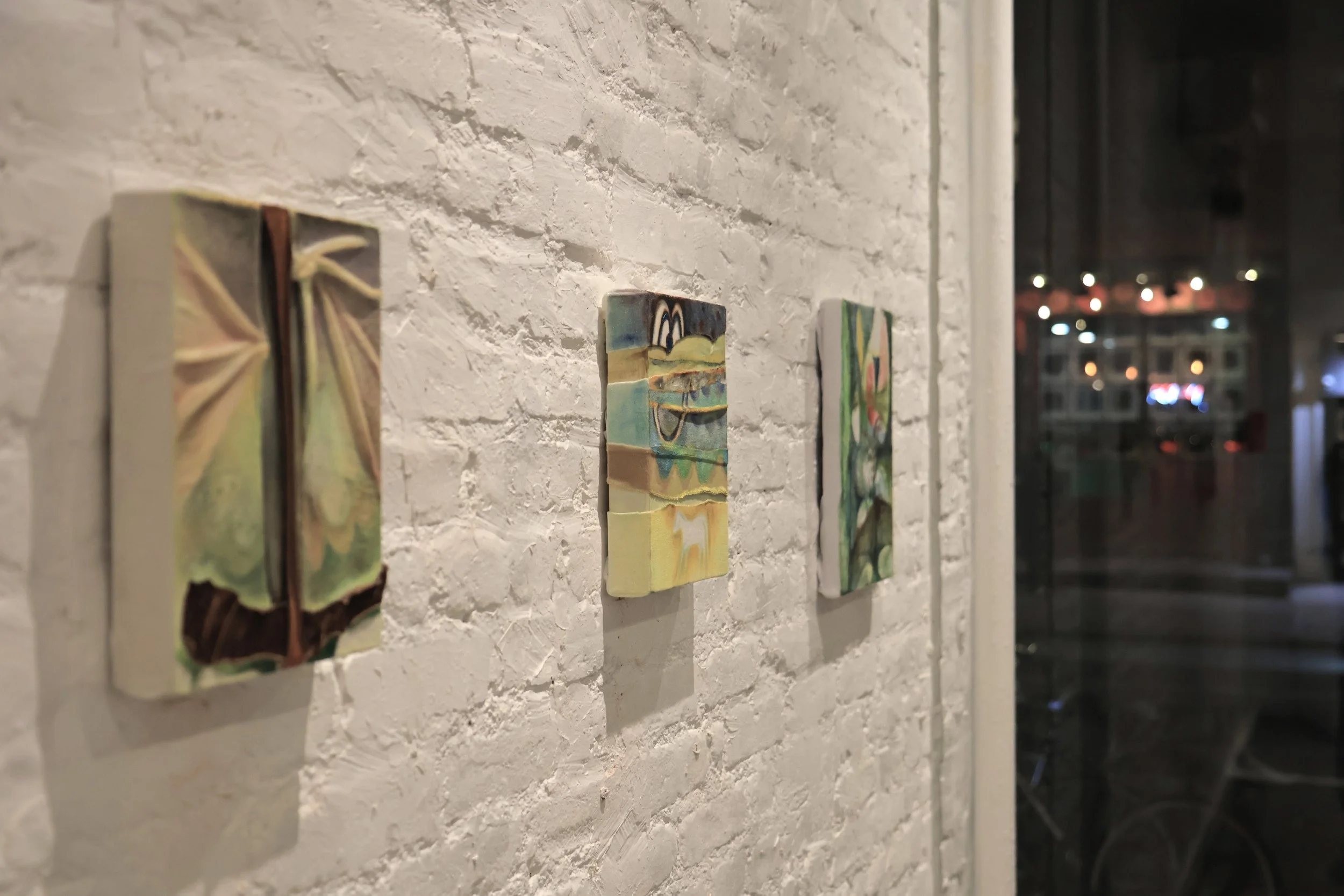
Installation view of Threshold in Relations, Xiaohan Jiang, A town called Feather Stone; Spring Echoes In The Winter Night; The Spring Breeze does not alter Moon Lake, 2025, courtesy of Zhiwei Chen and FanFlus
Xiaohan Jiang’s paintings are also a form of self-portraiture, since they depict the pastoral life of the artist’s childhood in China through an idealistic and nostalgic lens. The artist utilizes painting as a vehicle to examine her past in order to understand her present and the future. Jiang’s style merges abstraction with symbolism, with more recognizable shapes of a horse or a person and less easily comprehensible forms and colors that amount to a lyrically abstract expression. A strong feeling of utopian innocence pervades throughout Jiang’s composition as it recalls the memories of a person’s first or early contact with nature and (natural) light with great warmth and visual richness, away from the utilitarian and competitive social systems and zero-sum games of the city. Visually and sentimentally, Jiang’s paintings resist the capitalist need to put a numerical sum on every object, event, idea, and feeling that the human can ever possibly put their hands on, so that it can be bought and traded. While Jiang’s works ultimately remain as paintings and art objects that can be bought and sold in the art world, they reject this same market force by its nature put together by an authentic visual language based on the human principles of idealism, sincerity, and affection.

Installation view of Threshold in Relations, Zihan Cui, "A" Person's Life, 2025, courtesy of Zhiwei Chen and Fanflus
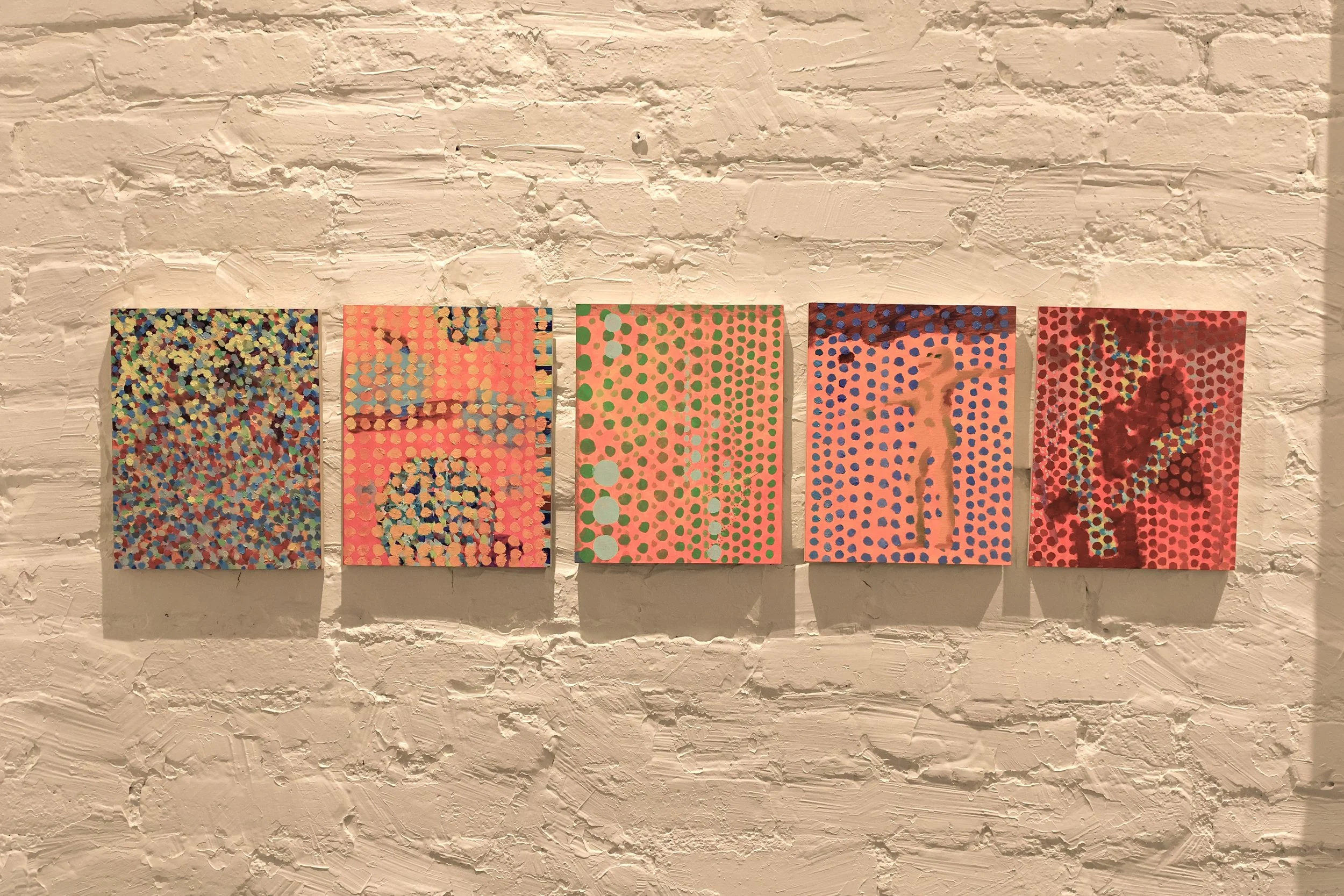
Installation view of Threshold in Relations, Zihan CUI, Untitled, 2025, courtesy of Zhiwei Chen and Fanflus

Installation view of Threshold in Relations, Zihan Cui and Zhaochen Chen, courtesy of Christy Wang and FanFlus
Lastly and on a related note to Jiang’s anti-transactional stance and style is Zihan Cui’s algorithmic abstraction that combines the calculatable with the incomputable, systems with the errors that confound the system, the predictable with the unpredictable, and the knowns with the unknowns. In Untitled (2025), which is a five-piece array of small paintings, a grid of marks change logic and form into larger areas of color as well as occasionally popping in a clay-like form with joints, which appears as a figure spreading out its arms. From observing how Cui superimposed a grid on top of a continuous image on the first panel of the artwork (when counting from the left), and how the grid of pixels form a discrete, abstract image in the second panel, it becomes evident that Cui is questioning the true nature of reality and existence as discrete or continuous, both or neither. In Cui’s work, we have what equates to a mathematical logic that alters a sequence or pattern in a logical and predictable manner coexisting with the non-calculable. Think of 1, 2, 4, 8, 16, and then an orange, followed by the hot color pink. But isn’t this what the universe really is… and, by translation, human nature? There is the potential for order within the disorder and vice versa, the yin within the yang and yang within the yin… For example, darkness absorbs the most light while lightness absorbs the least light… Can we find the direction of what counts as good and just in the midst of these flipping of values and relations?
Art is in the end a visual philosophy and a library of knowledge, experiences, and feelings that is based on what is true and real. This is why anyone who opens their mind and approaches the artwork from a place of sincerity can understand and empathize with the work, and see that the work understands and speaks to the viewer as well. This need for subtlety and nuances in human relations is an important guiding thought for curator Fan. And this may ultimately be a key idea that enables the threshold phenomena.
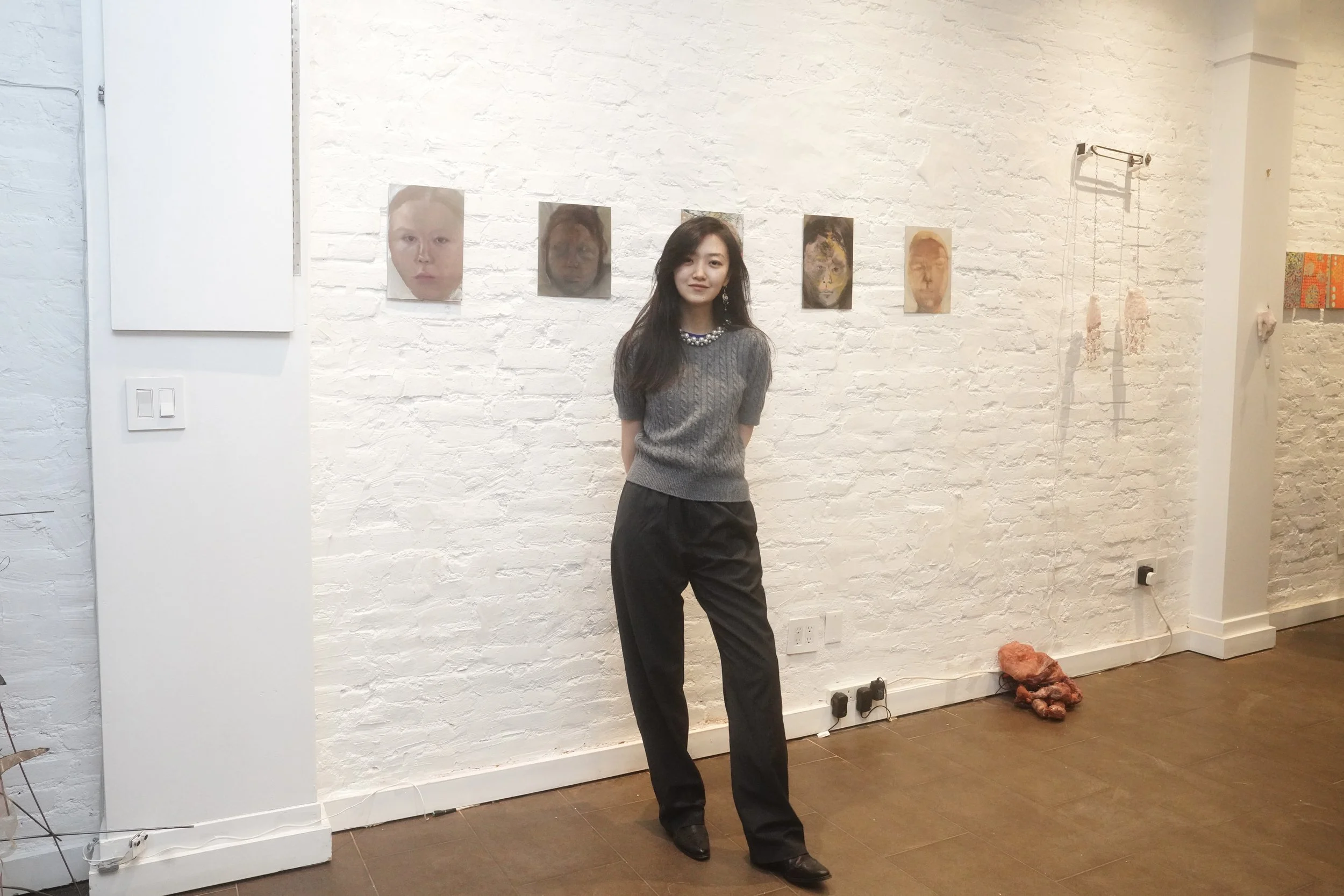
Curator Fanfan Yuxuan FAN, courtesy of Christy Wang and FanFlus
While the threshold phenomena begins as a full and saturated visual experience as defined by Fan, it catalyzes new perceptions and encounters between the viewer and the artwork, a communication in which meanings crisscross between two and form the bond of relations between people.
"Thresholds are experienced not as passive states but ascharged sites where spatial and emotional registers converge, enacting connections that are continually formed, unsettled, and renewed."
—Fanfan Yuxuan Fan
In fact, new meanings, experiences, and lessons continually emerge from the web of relations at the edges of visual perception as defined by the thresholds: between the curator and the artist, artist and the artwork, and finally the artwork and the viewer. At the center of Fan’s curation is the equation of the non-computable with the human and the system error with the new. This kind of paradigm shift coincides with the transformative nature of art that exists at the thresholds, where prior questions reconfigure as a new and evolved set of problems, and the person internally transforms with the aesthetic experience. What lessons will precipitate from this exhibition is the necessity for continual evolution and adaptation on both an individual and collective basis and the need to think outside the box, to inject the error into the system or a predefined set of problems and answers.

Installation view of Threshold in Relations, Zihan Cui, Zhaochen Chen, Yuyu He, Xiaohan Jiang, courtesy of Christy Wang and FanFlus
Installation view of Threshold in Relations, Yuyu He, Zhaochen Chen, Aubrey Laduke, courtesy of Christy Wang and FanFlus