Sheridan Greene's Grammar of Repair
How do you stay close to someone you can't fully talk to? Greene finds an answer in the fixed logic of an engine.
Guest Sheridan Greene Editor Edgar Zhang

Sheridan Greene, Assembly Interior pt. 3, 2025, oil on canvas, 24” x 48”. Image Courtesy of the Artist.
Most people probably know a version of this arrangement without naming it, a parent and a child who can't discuss politics, or grief, or who the child has become, can often still cook dinner together, watch a game, or take a drive. The unspoken thing changes from family to family, money, faith, a diagnosis, who someone loves, but the structure repeats: intimacy gets rerouted through a task with fixed rules, because the task can't turn into an argument the way a conversation can… Painter, sculptor, recent UC Davis Art Studio graduate (26’) Sheridan Greene (they/them) has found their own version of that task under the hood of a car.

Sheridan Greene, Assembly Interior pt. 4, 2025, oil on canvas, 18” x 24”.
Image Courtesy of the Artist.
Greene's work opens in a space they describe as “too complex to understand… enclosed, cramped, and radiating heat.” It is kind of a mundane place to begin a body of work about intimacy. Greene paints interiors, table settings, houseplants, a dog underfoot, but returns again and again to one unlikely subject: the engine; a maze of grey, black, and white that Greene has to physically bend into; because they spend these hours repairing their car with their dad. For them, the substance of what goes unsaid is specific: their father's refusal to accept their queer identity, an aspect of their life he treats, by their account, as something that “doesn't exist.”
A dread that shows up in two ways: One is simple: the fear that follows a crash, whether the car still runs, what the repair will cost. The other is older, the same heat rising during visits with their father, where one wrong word can turn an hour of talking into a fight. Greene has said they are mapping “the landmines in conversation” with their father and brother, and the engine is where that map gets drawn. As an Asian kid, the experience is awkwardly familiar for me.
For Greene, and their dad, an engine doesn't negotiate; every bolt has one correct torque, every hose one correct routing, everything has a right place to be, maybe just like how Greene’s father expected them to be.
The rules under the hood are strict but knowable, which makes the space they define feel safe: two people bent over a manifold don't have to agree on anything except which wrench comes next. It's closeness without the risk of getting something wrong that actually matters.
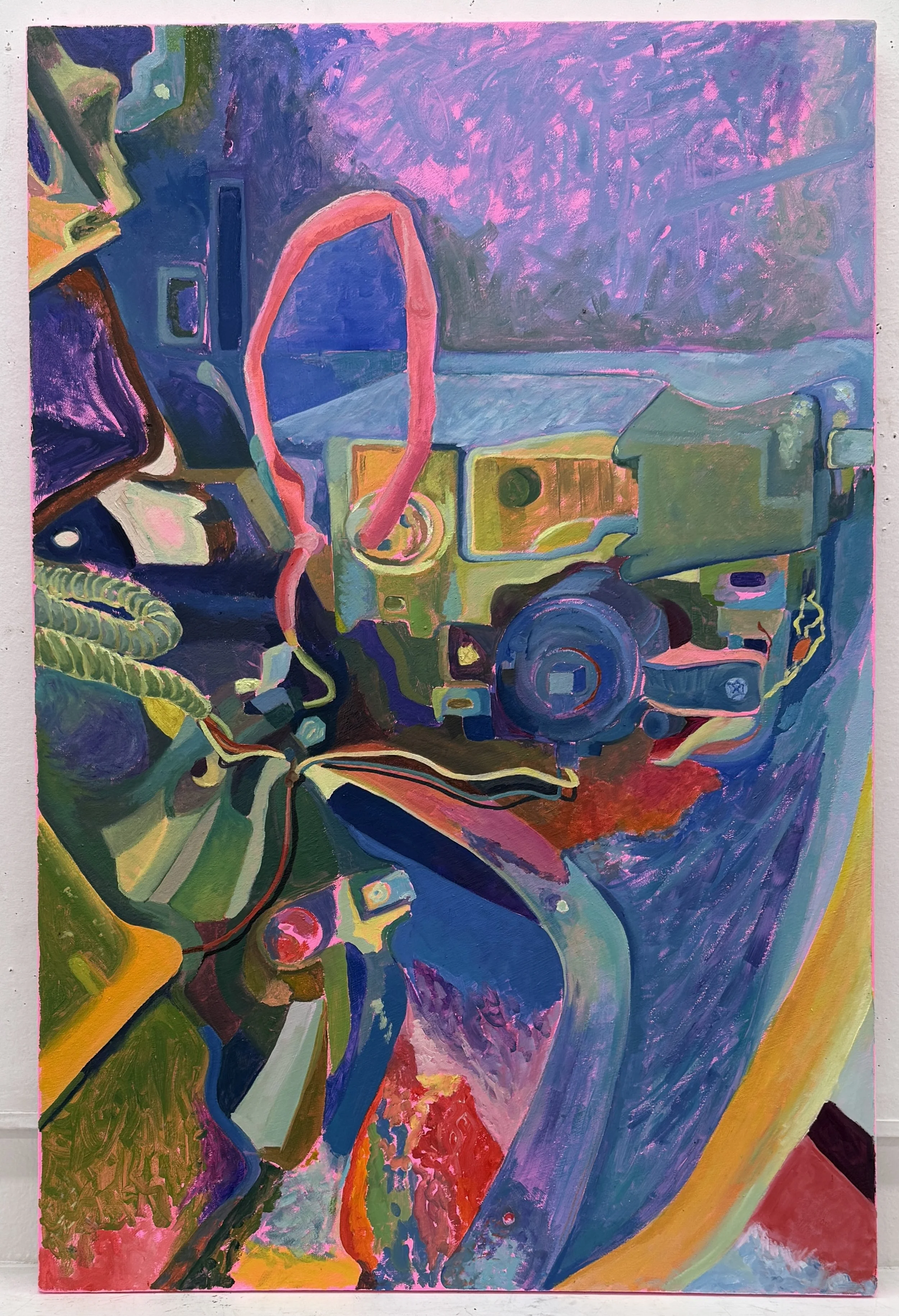
Sheridan Greene, Assembly Interior pt. 1, 2025, oil on canvas, 24” x 36”. Image Courtesy of the Artist.
Greene tracks this tension through color; they used acid yellows, reds, and oranges pushed up against cooler blues and greens. The first few times seeing them as a viewer I first thought of Salman Toor’s single non-naturalistic color, an emerald green that lights his interior scenes of queer men eating, dressing, and gathering together. But the more I look at it, Greene’s moody colors transformed into a pain from my stomach that I felt when encountering these “under the hood” moments, in my life with my parents,
I was shocked by how universal this experience could feel, and how Greene’s expressions are effective and onto the most clinging, viscous part of human interaction.
Greene had told me that people sometimes interpret their drawing as making these moments queer, that reading in my opinion is wrong and narrow. What Greene paints is something almost anyone could recognize: a relationship you keep returning to even though part of it doesn't work, and the discomfort of looking straight at that fact. Most of us turn our heads away from tangled, viscous attachments like that rather than confront them. Greene has had the courage to paint theirs anyway, for them first, and then for whoever is willing to look. For a viewer, that's its own smaller version of the same test: which relationship makes you uncomfortable to look at closely? What happens if you ask how the relationship actually works, and whether it should keep going at all? Does wanting to cut it off make you a bad person? Friend? Or for Greene, a bad child?
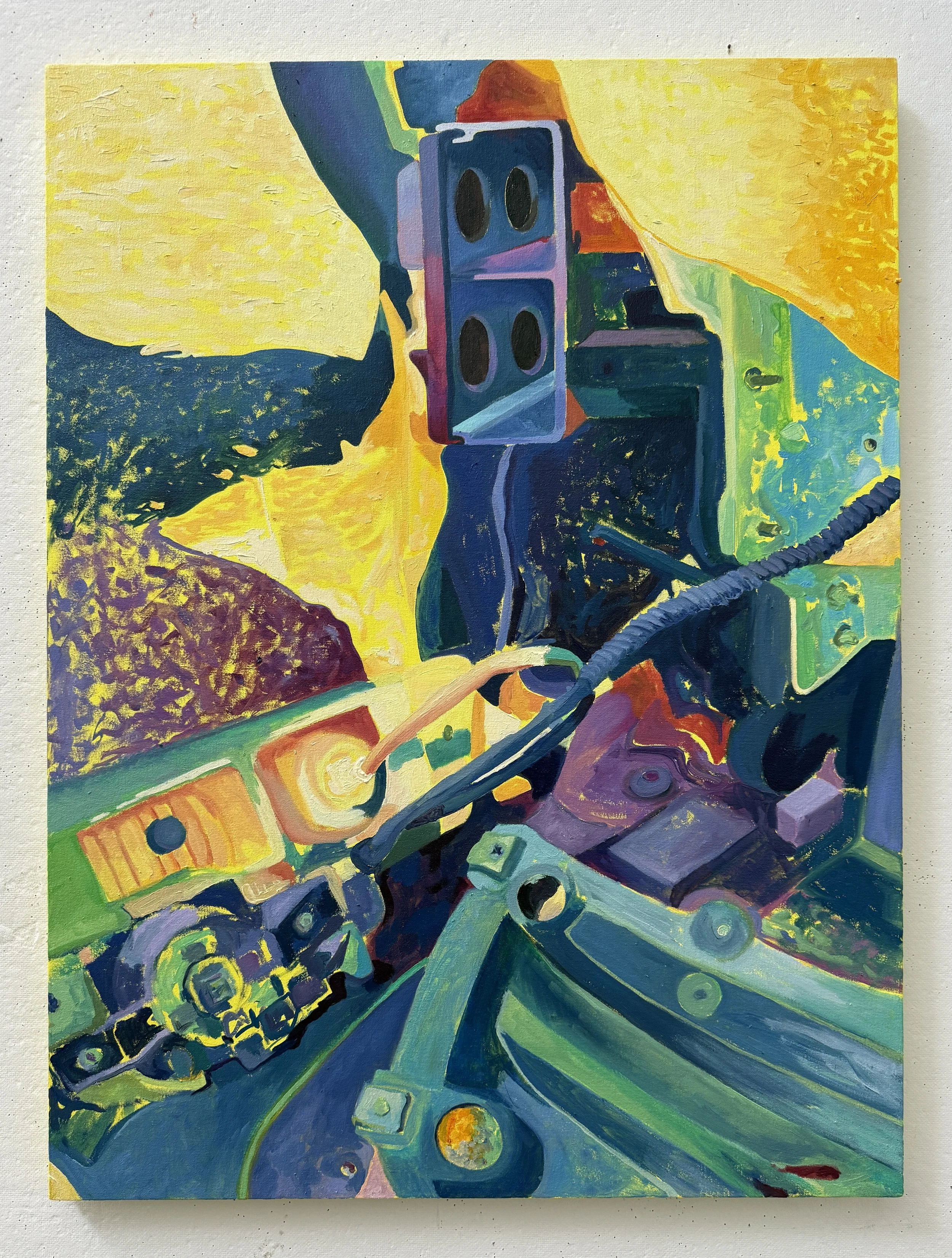
Sheridan Greene, Assembly Interior pt. 2, 2025, oil on canvas, 30” x 40”. Image Courtesy of the Artist.
The engine is the actual, physical place where the relationship still happens. “It [the hood] becomes a shell worn by a driver, hiding internal issues.” Greene said, “[It is] Stuffing myself into that heat-pressed mold, but also freely hiding this messy self under the seat or under the hood.”

Sheridan Greene, Dinner I, 2025, oil on canvas, 16’ x 20’. Image Courtesy of the Artist.
When Greene is asked about their future paintings, they shared openly: “I plan to paint moments I want to celebrate and remember. [It is] A documentary of my emotions and the people there during a dinner with friends. Quotidian meals where my identity is something that brings me closer to others, versus becoming a point to argue over. The consequences of social interactions are lessened due to the fact that the time you spend with people is short — you can go home and not have to consider how you will face someone every holiday. I hope to attend and foster more gatherings outside of restaurants but still over food, where I can continue to share both play and laughter with friends. Additionally, I plan to continue to [paint and] appreciate landscapes that make me curious, unsettled, or show evidence of an impact or break from the polished, acceptable, or model version, be that a car’s fender rusting with cracks or a garden covered in tarps, overgrown moss, and weeds.”

Sheridan Greene, Dinner for Three, 2026, oil pastel, oil, and acrylic on canvas, 16” x 20”. Image Courtesy of the Artist.