Her Hair
Identity Through Strands: Hair as Root, Legacy, and Cultural Memory
Guest Hong Chun Zhang Interviewer Pan Liu Editor Mud Pusa
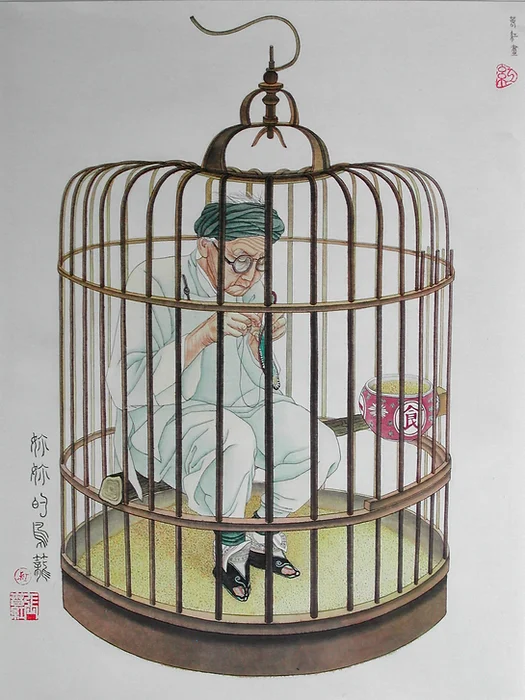
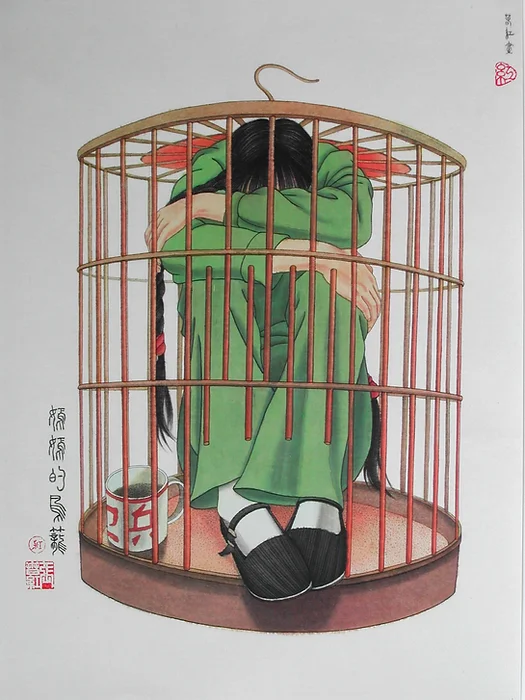
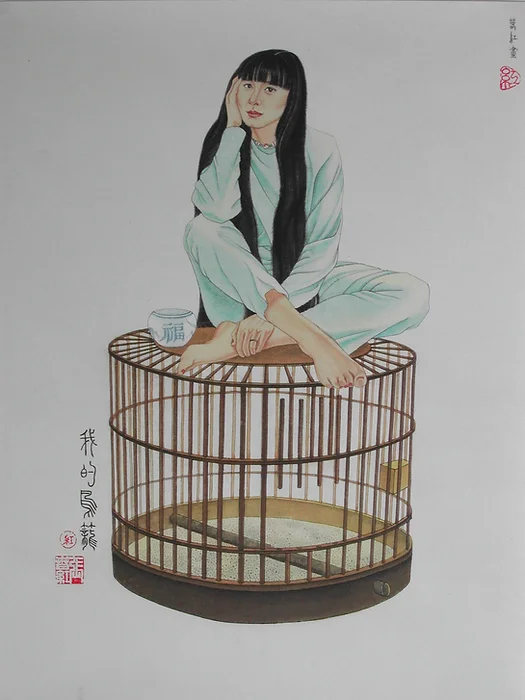
Three Generations: Grandma’s Birdcage, Mother’s Birdcage, My Birdcage
“No matter where we go, we always carry our past like a tree root and adopt something new to the unfamiliar land.” —— Hong Chun Zhang
As an immigrant to the United States, Hong Chun Zhang brings the rigorous training of one of China’s top art academies, channeling culturally specific materials and symbols into her installation and painting practices.
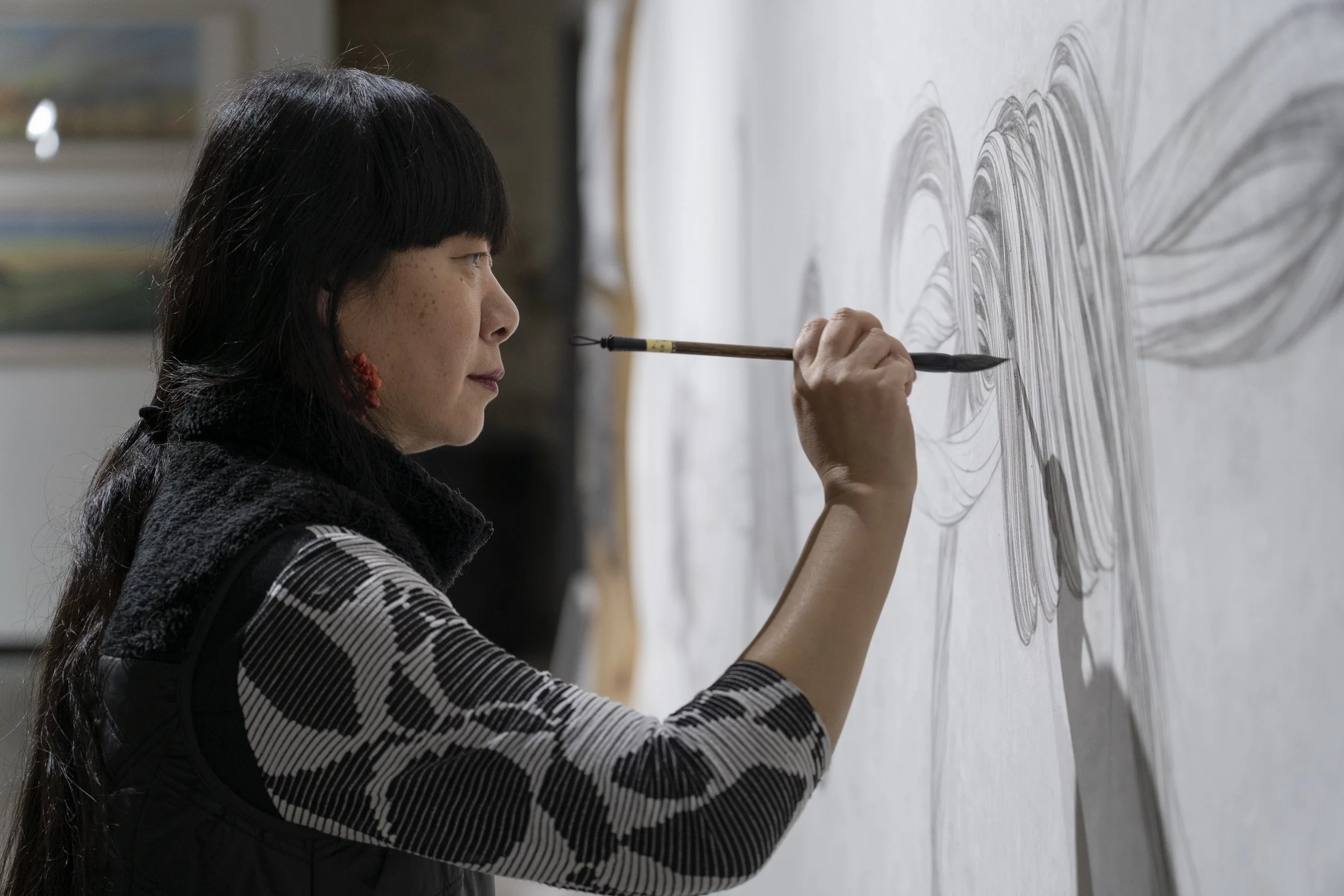
Hong at work for Bound(2025) photo by Ryan Waggoner
When Zhang first arrived in the United States, she began to reflect deeply on the living conditions and social realities of Chinese women. In her 3 Generations painting series, she employs metaphor to explore the experiences of three generations of women in her own family—herself, her mother, and her grandmother—each shaped by the distinct environments of their respective eras in China. Through the recurring image of birdcages and figures trapped within them, Zhang visualizes the various forms of confinement and oppression women have endured across time. The birdcage becomes a powerful symbol of limitation—its shape changing, but its function enduring. Yet in Zhang’s self-portrait within the series, she sits calmly and confidently outside the birdcage, suggesting a new chapter: a generation of women, like herself, who are increasingly able to break free from the restrictive enclosures of the past. Her work negotiates the duality between Chinese and American cultural frameworks while engaging with global feminist themes. It was also during this period that Zhang began to express the duality between American and Chinese culture within her work.
During her graduate studies at UC Davis, Zhang began to experiment with incorporating hair as a central element within her artistic practice. The recurring motif of human hair—profoundly personal and unmistakably intimate—serves as both medium and message, a vibrant testament to her presence as a living, breathing being.

Continuity
58" x 240", Chinese ink on Alcantara material (Italian fabric), 2020 Photo credit: The Nelson Atkins Museum of Art
This element has garnered public attention and contributed meaningfully to her artistic success. For instance, in her work Bound (2025), Zhang draws upon visual elements rooted in traditional Chinese culture to paint the motif of hair — transforming it into a symbol of entanglement and resilience. Through this imagery, she reflects on the harsh reality that countless women around the world — particularly in remote and marginalized regions — continue to live in conditions of captivity and restriction, often as a result of human trafficking and systemic violence.
Zhang, a Full-time artist, candidly speaks of the challenge of balancing a creative career with the demands of motherhood—a struggle she shares with many women in her field, some of whom have relinquished their artistic aspirations altogether.
On the other hand, while introducing her daughter to American culture as part of her early childhood education, Zhang found inspiration in the quiet and close relationship she had with her mother. In those moments, she began to see her past like the roots of a big tree—strong and steady, quietly giving her strength—while the trunk and branches stood for how she kept growing and pushing forward. This idea comes through clearly in her work Continuity, where memory and personal growth are shown together. In the calm pace of a Midwestern city—where everyday life felt less stressful—Zhang slowly developed her creative work, gaining experience and moving steadily toward greater success.
Interview
Pan: In your works, hair emerges as a recurring visual element. Could you share your thoughts on the significance of hair in your practice? Why hair, as opposed to other parts or materials of the body? And what initially drew you to this element as a central motif?
Hong: “First, hair represents my identity as an individual and as a twin. I used disembodied long hair as a motif to create self-portraits of me and my twin sisters 20 years ago at graduate school in UC Davis.
We have had long hair since high school, and long hair has become part of our identity. At that time, I was also questioning myself, “who I am and where I came from,” and searching for a motif that is personal and universal with a breakout work. I still wanted to incorporate my Chinese fine style ink painting technique (mainly building the imagery through layers and lines) with a larger-than-life-size scale and transform 2D work on paper to 3D pieces that occupied the room. The strands of long hair seemed to fit well with my form and content. That is how the hair theme started as a personal identity and resulted in a series of figurative drawings. Then, it progressed and grew as I moved to Kansas. The mid-west environment, such as the iconic tornado, has become my new interest. I continued using hair in my nature-inspired work to create work representing me as a Chinese American in Kansas.
No matter where you go or move, you always carry the past with you, another good example of the Hair and Object series. To me, hair is like my roots, DNA, and cultural heritage. ”
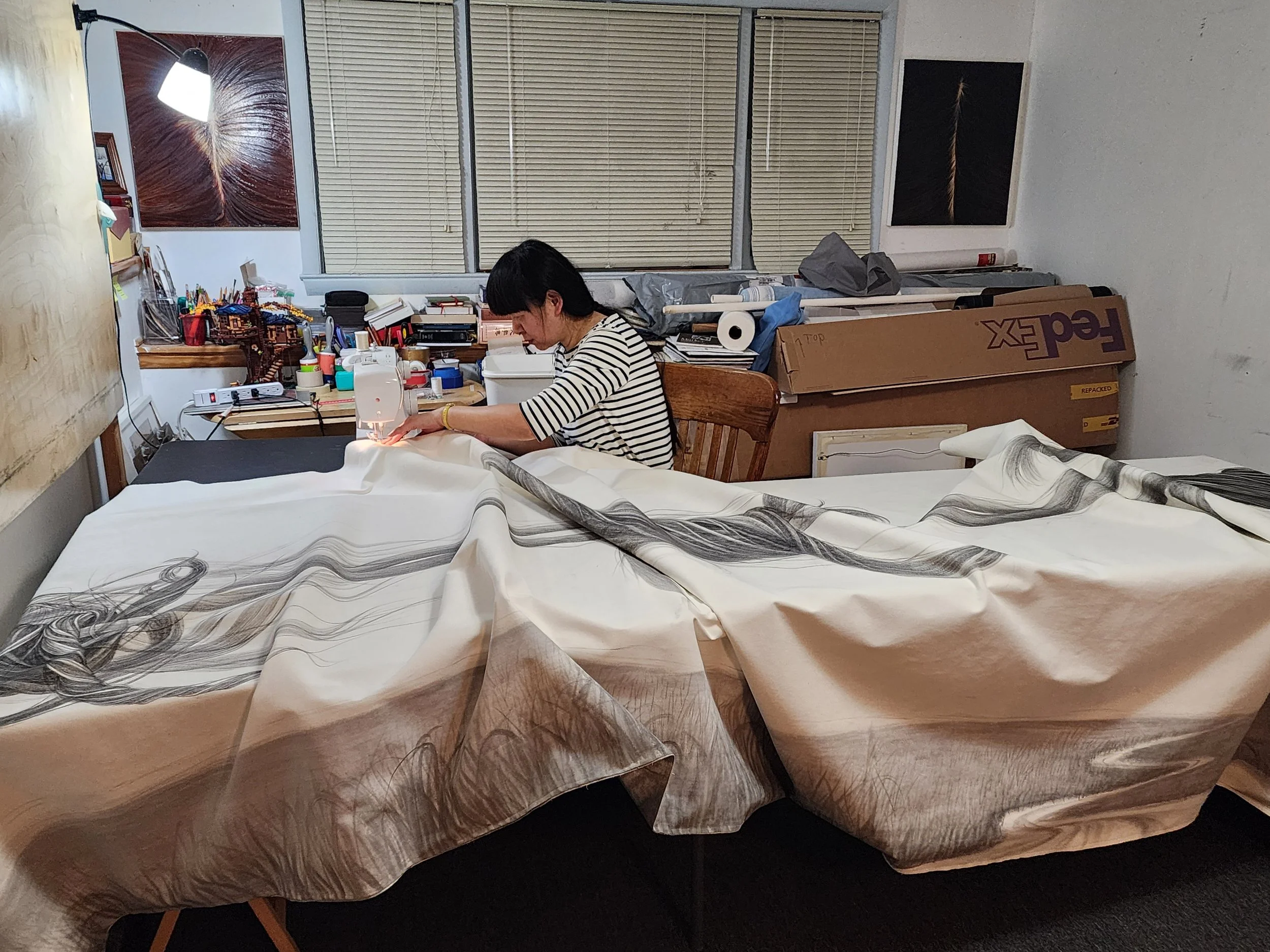
Hong at sewing
Pan: In your work Bound (2025), you discuss trafficking of women and chose to use Italian Alcantara fabric as the canvas — a suede-like material that, as I understand, is entirely vegan-friendly. Was your intention behind selecting this medium to subtly allude to the exploitation of both women and animals under patriarchal structures by employing an animal-friendly material as a form of resistance? If that’s not the case, then what does this material represent for you?
Hong: “The Italian Alcantara material does feel like a thin felt, and it is environmentally friendly. But that is not my intention behind the material selection as a form of resistance, rather a choice of collaboration for visual purposes. In 2019, I was first introduced to Alcantara, a Milan-based textile company, by an Italian curator, Dagmar Lavezzoli, who invited me to participate in her co-curated show ‘Out of the Blue: A Calligraphy Journey through Alcantara’ at Milan Royal Palace. She thought my previous large-scale charcoal drawing would translate well onto this material with the Chinese ink medium. I did some experiments, and it turned out Alcantara material not only could achieve a strong visual effect like my large charcoal drawings on paper but also would solve some problems like charcoal smudges as well as fragilities and mounting issues that Chinese ink on thin rice paper often encountered. Moreover, it can be stretched, hung, sewed, and folded like a 3D sculpture, which I have been interested in.
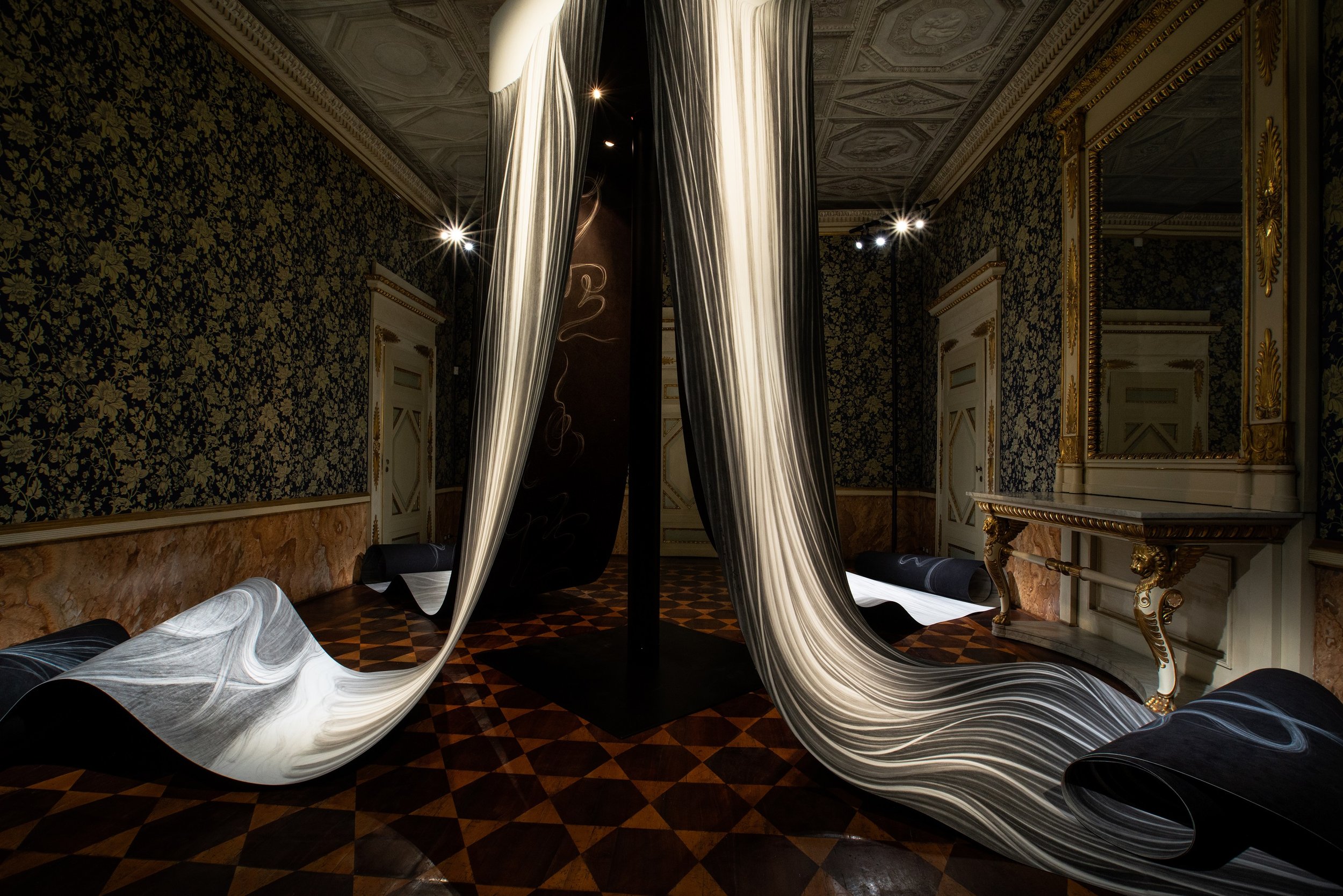
Fall (side view)
Chinese ink on Alcantara Material, a site-specific installation at Milan Royal Palace, Sept 2020
Therefore, Alcantara material seems a natural discovery. Its flexibility and sustainability open more possibilities for me to explore in large formats. Since 2020, after my first collaboration/exhibition with Alcantara, I have been using Alcantara materials, and they have served my visions above and beyond. ”
Pan: In a previous interview, you mentioned your background in receiving higher art education in China. Has that experience influenced your current artistic practice, and if so, in what ways? Beyond your academic background, have there been any significant life experiences that have shaped the way you approach your art today?
Hong: “Yes. My Chinese art education/training began at the age of 15 when I passed my first entrance exam to attend the Central Academy of Fine Arts Attached High School in 1986. I left my hometown Shenyang and moved to the capital city of Beijing and lived in the dorm for 4 years (86-90 focusing on all the foundational studies, including oil painting, drawing, printmaking, Chinese ink painting, sculpture, graphic design, and east/west art history. From 1990 to 94, I had to take the national college entrance exam again to get into the academy (CAFA) and spent another 4 years concentrating on Chinese fine style figurative ink painting. I think my 8 years of Chinese academic art training, especially the solid craftmanship and practices I learned in both east and west art mediums, helped me with an easy transition to adopt American art school.
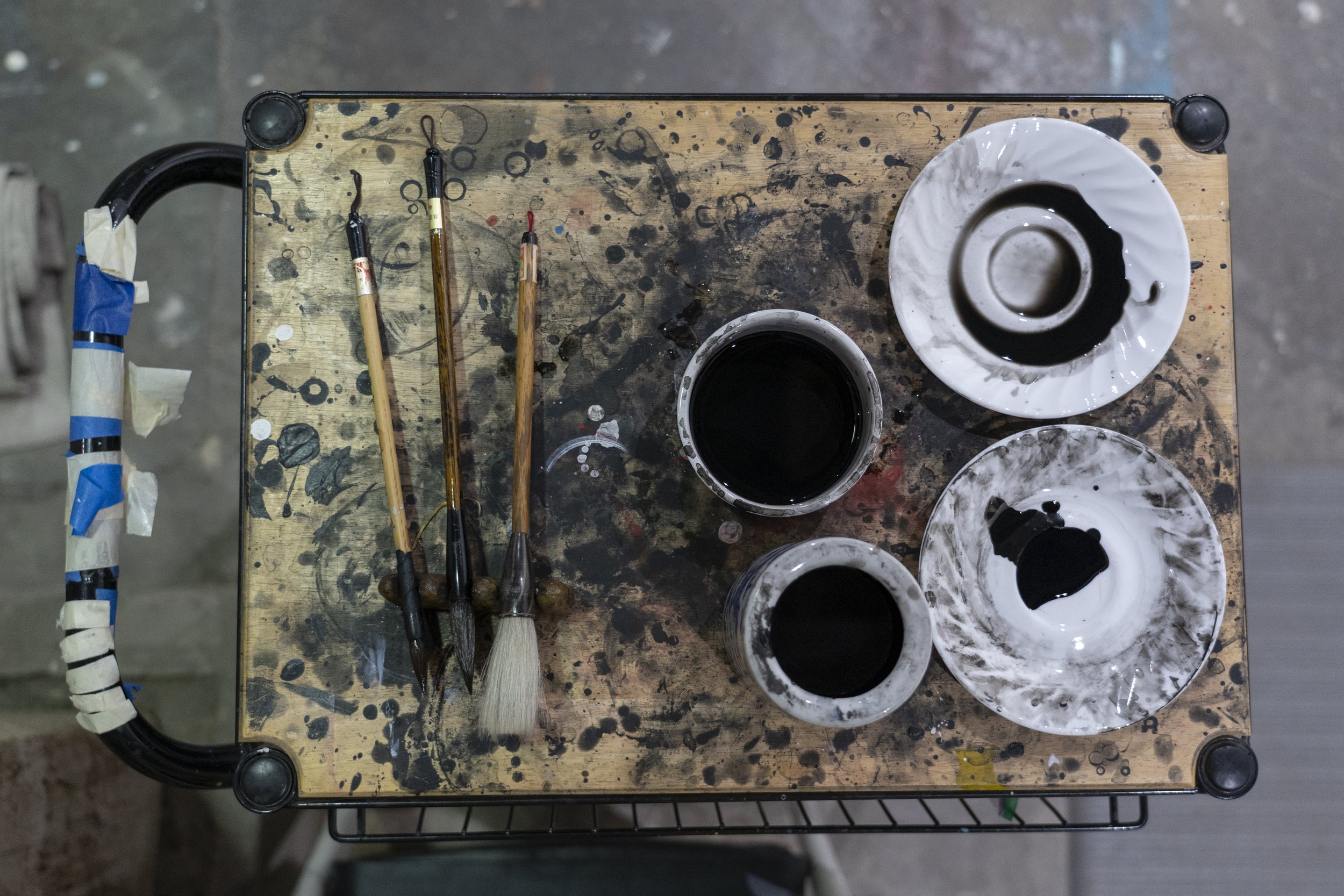
My realistic skill in fine style Chinese ink painting became my strength and later influenced the large-scale charcoal drawing and installations I developed in the US. After I moved to the US in 1996, I looked back with a full perspective and realized how much of an impact it had on me as a new immigrant and a female artist. I started to create my first new body of work in the US, “Three Generations,” which had a strong social and political overtone. I used politically incorrect subjects and images to express my feelings about being bound under the Chinese government. This type of content was not allowed in China at that time. Moreover, coming to America at the age of 25 after graduating from the top Chinese art school and restarting everything in the US was a big challenge. But my cross-cultural, educational, and life experiences all contributed to the development of my art later in America, and they became my inspiration. I am very fortunate and happy to keep making art here with full freedom and following my dream as a full-time artist.”

Bound (front side)
5ft x 17ft, Chinese ink on Italian Alcantara fabric with steel chains, 2025. It is currently on view in “ Bold Women” exhibition at Spencer Museum of Art at University of Kansas. Photo by Ryan Waggoner.
Hong Chun Zhang’s work offers a delicate yet powerful meditation on identity, memory, and womanhood—braiding together the personal and political, the cultural and universal. Through the motif of hair, she draws not just lines on canvas but lines across generations, geographies, and lived experiences.
Whether addressing the quiet strength of maternal lineage or the harsh realities of gendered oppression, Zhang’s art insists on presence, resilience, and transformation. Her journey—rooted in tradition, reaching across continents—reminds us that to create is also to remember, to question, and to grow.
And as her hair flows across pages and galleries, it speaks not only for herself but for all those learning to live freely, in continuity and in change.